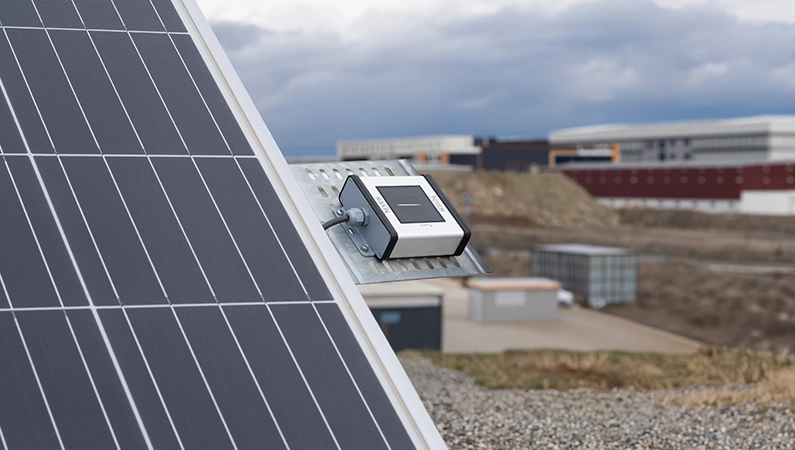
An irradiance sensor measures the solar irradiance reaching a surface and helps monitor the performance of photovoltaic systems. It is widely used in solar power plants because it provides reliable irradiance data, requires little maintenance, and offers a practical, cost-effective alternative for professional PV monitoring.
Why Is an Irradiance Sensor Important in Solar Energy Systems?
Accurate irradiance measurement is essential for designing, installing and evaluating the performance of solar energy systems. In order to assess how a photovoltaic plant is operating, it is necessary to know how much solar irradiation is reaching the panels. This is where irradiance sensors come in.
An irradiance sensor, also known as a photovoltaic pyranometer, was developed alongside photovoltaic systems as a derivative of the traditional pyranometer. They measure the irradiance coming from the sun and provide reliable data for professional PV plant monitoring and analysis. Irradiance sensors are particularly valued for their low cost and minimal maintenance requirements.
What Are the Main Parts of an Irradiance Sensor?
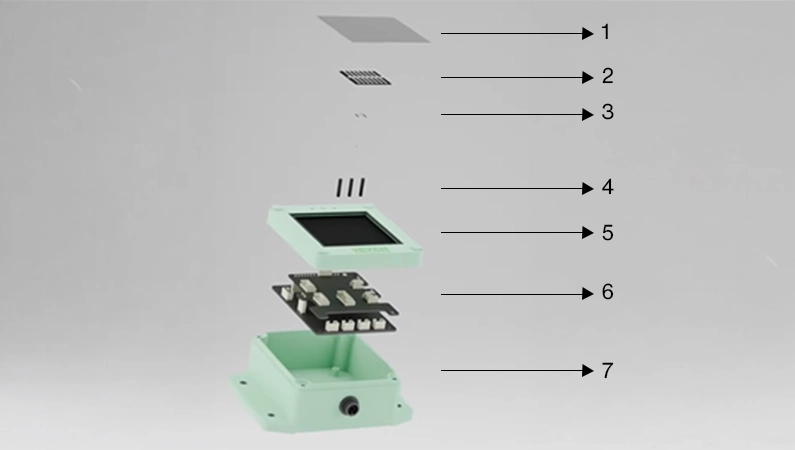
An irradiance sensor consists of seven main parts:
- PV Tempered Glass: A PV tempered glass layer which protects the sensing surface.
- PV Cell (Laminated with EVA & Tedlar): Under the glass is a gallium-doped monocrystalline silicon PV cell, laminated with EVA and Tedlar for durability.
- Internal Temperature Sensor (PT1000): On the back side of the PV cell, a Class A PT1000 temperature sensor, compliant with IEC 60751:2022, measures the cell temperature.
- Precision Shunt Resistor: Converts PV cell current to voltage
- Electronics Board (PCB): Converts voltage signal to irradiance output
- Durable ASA Housing: Fiber reinforced, UV-resistant
- Built-In Diagnostic LEDs: For quick status checks, the device also features built-in diagnostic LEDs: Power, Tx, and Tr, which are providing instant visual feedback during operation and communication.
What Does the Sensor Box Do?
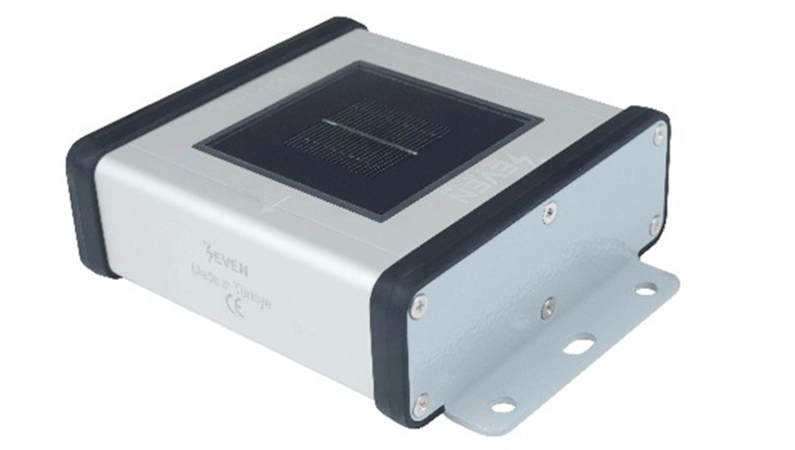
The sensor box contains both the photovoltaic cell and the electronic circuit board. It is made of UV-resistant material and is designed to withstand harsh weather conditions. It also has built-in mounting holes for easy installation in the field.
What Is the Role of the Photovoltaic Cell?
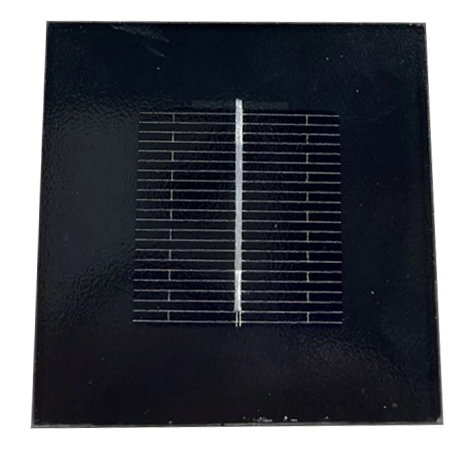
Typically made of gallium-doped monocrystalline silicon, the photovoltaic cell absorbs solar irradiance. Since it has the same characteristics as a PV module cell, it responds to light and temperature similarly to a photovoltaic panel. This makes it especially suitable for solar energy applications.
What Does the Electronic Card Do?
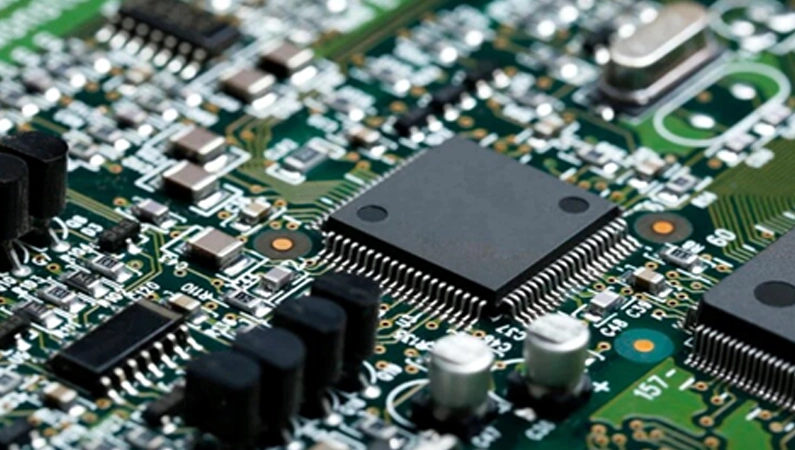
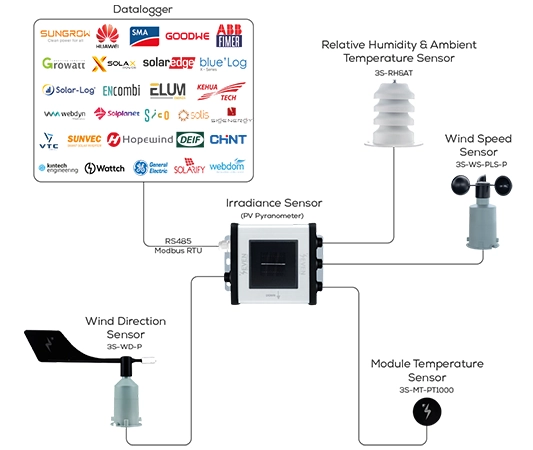
The electronic card processes the collected data with the help of a microprocessor and converts the voltage signal into an irradiance output in W/m². The SEVEN irradiance sensor can also be connected to temperature and wind sensors, allowing multiple environmental values to be collected and processed together.
How Does an Irradiance Sensor Work?
An irradiance sensor uses a monocrystalline solar cell to absorb sunlight and generate an electrical current. As the short-circuit current of a silicon solar cell is proportional to solar radiation, this current can be used to measure irradiance.
Inside the sensor, a precision shunt resistor converts this current into a measurable signal. A temperature sensor positioned behind the cell measures the cell temperature and helps correct any heat-related deviations. These signals are then processed by the electronic card, which calculates compensated irradiance values in W/m².
The measured data can be transmitted to receiver units via RS485 using Modbus RTU. Depending on the model and application requirements, analog outputs such as 4–20 mA, 0-5V, or 0–10 V are also be available.
Thanks to its flexible design, the irradiance sensor can be connected to additional environmental sensors, enabling comprehensive monitoring of photovoltaic plants.
Where Are Irradiance Sensors Commonly Used?
Irradiance sensors are mainly used in photovoltaic plants for:
- Performance monitoring
- System evaluation
- Comparing expected and actual plant output
- Supporting maintenance and troubleshooting
- Recording solar resource data at the installation site
In practice, these sensors help operators determine whether a drop in power output is due to weather conditions or a system issue within the PV plant. This makes them an important component of professional solar monitoring systems.
What Makes Irradiance Sensors a Practical Choice?
Compared with some other solar measurement devices, irradiance sensors stand out because they are:
- Cost-effective
- Easy to integrate into PV systems
- Low-maintenance
- Suitable for professional monitoring applications
Because their photovoltaic cell behaves similarly to a solar panel cell, they offer a practical way to monitor conditions that closely reflect the operating environment of the PV modules themselves.
Frequently Asked Questions (FAQ)
What does an irradiance sensor measure?
An irradiance sensor measures the solar irradiance reaching a surface. In PV systems, this data is used to monitor and evaluate performance.
Are irradiance sensors and pyranometers the same thing?
No, they are not the same device. Both measure solar irradiance, but their operating principles are different. A pyranometer works with thermopile technology and is generally used to measure the total solar irradiance received by a surface. For this reason, it is commonly preferred for Global Horizontal Irradiance (GHI) measurements. An irradiance sensor, on the other hand, is usually based on a photovoltaic reference cell. Since it behaves similarly to PV panels, it is especially preferred in photovoltaic systems. It is mostly installed at the same tilt and orientation as the panel to measure Plane of Array (POA) irradiance. In short, although a pyranometer and an irradiance sensor serve the same purpose, they do not use the same technology.
What output options are available for the SEVEN Irradiance Sensor?
Calculated temperature compensated irradiance and temperature values can be provided via RS485 using the Modbus protocol. If analogue output is required, 4–20 mA, 0–1.5 V or 0–10 V outputs can also be used.
Why is irradiance measurement important in PV plants?
It helps to determine how much sunlight is available to the solar modules. This makes it possible to compare actual plant output with expected performance and establish whether a drop in production is due to weather conditions or a system issue.
How does temperature affect irradiance measurement?
Temperature can influence the behaviour of the photovoltaic cell. For this reason, an internal temperature sensor is used to measure the cell temperature and compensate for deviations caused by heat, thereby improving measurement accuracy.
Can SEVEN irradiance sensor be integrated into a monitoring system?
Yes, SEVEN irradiance sensors are designed to be integrated into photovoltaic monitoring systems. They can send measurement to data loggers, controllers, SCADA systems or other receiving units.
Can additional sensors be connected to the SEVEN irradiance sensor?
Yes. SEVEN irradiance sensors can also be connected to additional environmental sensors, such as temperature or wind sensors, creating a more complete monitoring solution for PV plants.
How does an irradiance sensor help with plant maintenance?
By comparing irradiance data with actual power generation, operators can detect whether reduced performance is caused by low solar radiation or by a fault in the system. This supports faster troubleshooting and more effective maintenance.