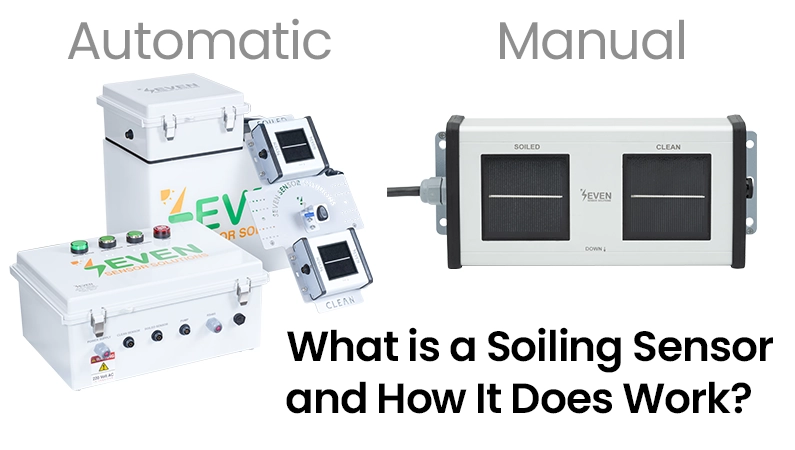
A soiling sensor measures the performance loss caused by contaminants such as dust, sand, pollen, and salt on PV panels. It provides data that helps determine cleaning frequency and quantify soiling-related power losses. The panels need to be cleaned—but which panels, and how often?
In solar power plants, not all panels soil at the same rate. Not all panels undergo the same:
- Conditions
- Topographies
- Weather patterns
That’s where soiling sensors come in.
A soiling sensor, or dust sensor, is used to help operators determine when and where panels need cleaning. It is a method of assisting PV plant operators and determining power loss.
Soiling sensors generally do not measure dust thickness; instead, they measure the performance loss due to soiling through comparative electrical measurements. It’s used as a reference point to determine what percentage of power loss is due to soiling. It gives a representative value that’s intended to define a region of soiling and give that approximation.

Where Soiling Sensors Is Used
Generally, soiling is monitored in utility-scale and commercial & industrial(C&I) solar PV plants. There are many considerations that go into monitoring soiling, such as:
- Site location
- The rate of soiling
- Local weather patterns
- Cleaning costs
Rainfall can help estimate natural cleaning cycles, but it does not quantify actual soiling losses or guarantee clean panels. Soiling sensors are therefore needed to accurately measure performance loss and optimize cleaning decisions.
Are SEVEN Soiling Sensors Designed in Accordance with IEC 61724-1?
IEC 61724-1:2021(Annex C) specifies performance monitoring classes (Class A, and B) for PV systems and defines measurement requirements for high-accuracy Class A monitoring, including soiling loss evaluation if applicable.
For PV plants that seek to comply with the IEC 61724-1 Class A performance monitoring requirements, soiling measurement is required if soiling has a strong effect on performance, and SEVEN Soiling Sensors are developed to fulfill these Class A performance monitoring requirements.
Benefits & Advantages of Soiling Sensors in Solar Plants
SEVEN has two different types of permanent soiling sensors: manual and automatic.
Manual Soiling Sensor
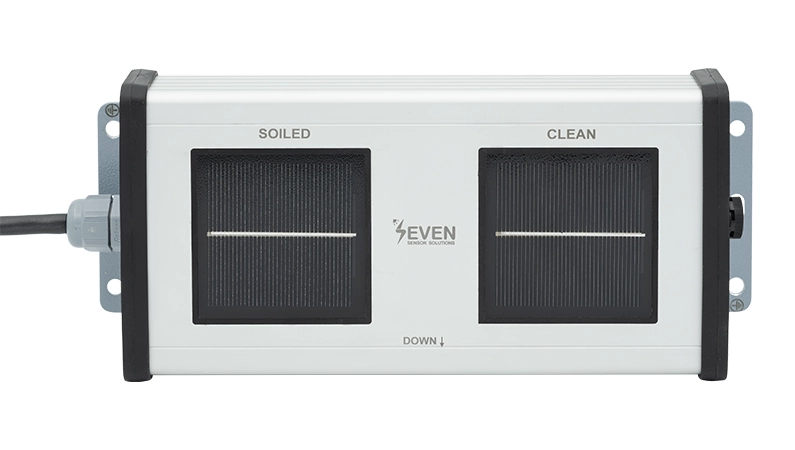
The Manual Soiling Sensor consists of two irradiance sensors placed under the same conditions as the PV system: one cleaned and one maintained under the same environmental exposure conditions as the PV modules. The system compares the measured irradiance values and calculates the soiling ratio in accordance with the IEC 61724-1 standard. The cleaned sensor needs to be manually cleaned periodically by qualified maintenance personnel to guarantee precise measurement. This system enables the determination of reliable soiling losses for performance monitoring and maintenance planning.
Automatic Soiling Sensor
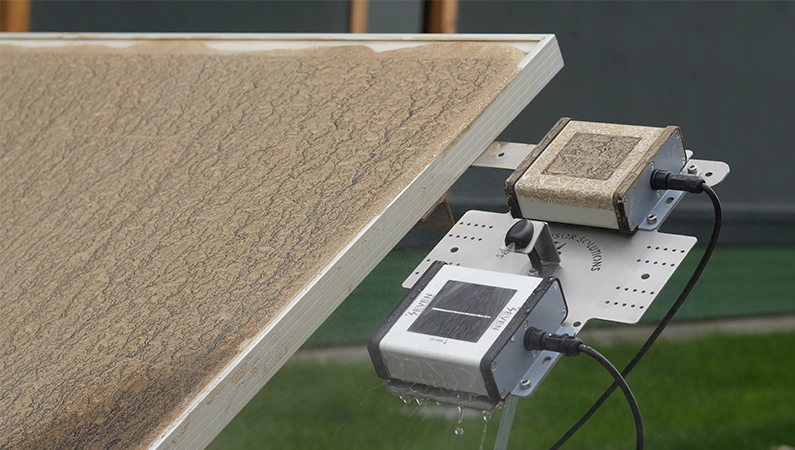
The Automatic Soiling Sensor consists of two irradiance sensors: one maintained under the same environmental exposure conditions as the PV modules and one cleaned by an automatic cleaning system. The system includes a water tank, pump, and electronic box that automatically perform scheduled cleaning. The system compares the irradiance values and calculates the daily soiling ratio in accordance with IEC 61724-1.
Since the clean sensor is automatically maintained, the system is labor-saving and provides better continuity in measurement. This is especially beneficial in rooftop and difficult-to-reach locations, where cleaning the sensor manually can be a time-consuming and potentially dangerous process.
Operational Use of Soiling Sensor Data
The data provided by soiling sensors can be used for monitoring trends over time and developing cleaning schedules based on performance losses measured, as opposed to the conventional method of cleaning the panels two or three times a year.
Weather patterns can also be taken into account during the evaluation process, such as the intensity of pollen during a particular season or the possibility of a storm that could clean the panels naturally.
The trend of soiling, together with the overall plant power loss, enables the evaluation of whether the performance loss is due to soiling or other technical problems. For instance, if the soiling sensor measures 3% soiling and the plant is experiencing a power loss of around 3.4%, it is possible to determine whether the loss is due to soiling or if further analysis is required.
Frequently Asked Questions (FAQ)
What is an acceptable soiling ratio in solar PV plants?
There is no generally accepted soiling ratio for PV plants, and the economic cleaning threshold should be determined by site-specific data on soiling and its economic impact on plant revenue, rather than a percentage value, with data-driven maintenance decisions using soiling sensors. In practice, if the loss of revenue caused by soiling exceeds the cost of cleaning the panels, the cleaning process should be carried out.
How many soiling sensors are required per PV plant according to IEC 61724-1?
IEC 61724-1 specifies the measurement of soiling for Class A monitoring if soiling has a significant impact on performance, and the number of soiling sensors is plant size and environmental dependent. Large or distributed PV plants may need multiple soiling sensors to ensure that the measured soiling is representative of the plant conditions. According to the IEC standard, if the fields <40 MW, at least 2 Soiling Sensors are required.
Where should a soiling sensor be installed for accurate measurement?
A soiling sensor should be installed at the same angle and orientation as the PV modules and in a location representative of the general plant environment, avoiding areas with shading and abnormal dust accumulation, and multiple locations may be needed for large or environmentally diverse plants to measure differences in soiling behavior.