Client: Naturel Enerji
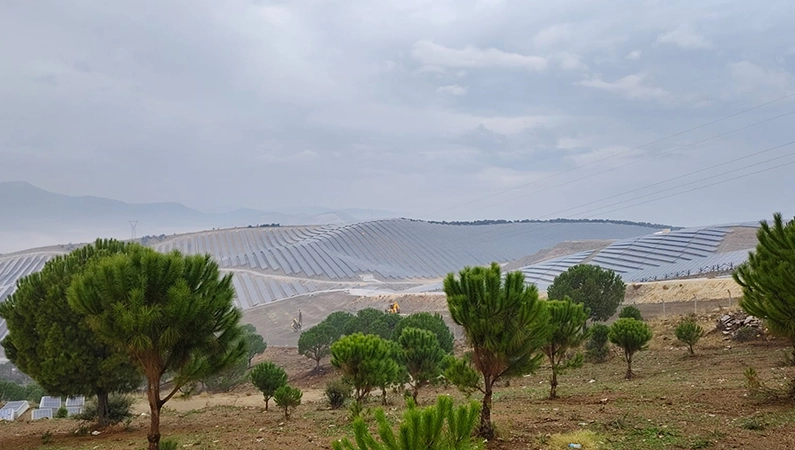
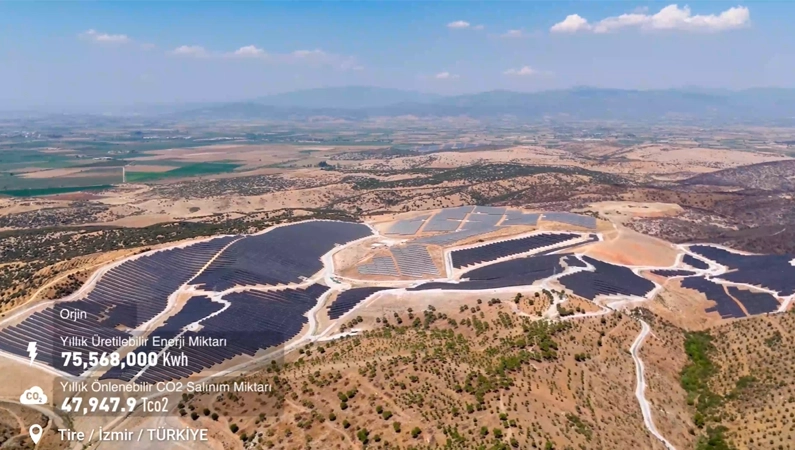
Site: Orjin Enerji GES-1 – Tire, İzmir, Türkiye
Topic: How many irradiance sensors are needed when a PV field has many different tilt/azimuth angles?
The Challenge
Naturel Enerji asked a very practical question during the project phase:
“How many sensors do we need on this site to calculate Performance Ratio (PR) correctly?”
This wasn’t a standard, flat PV layout. After reviewing the general site layout plan and field photos, our team identified two major complexity drivers:
1. Very uneven / hilly terrain
In highly undulating fields, PR calculation becomes more difficult because the site does not behave like a single uniform plane. Accurate PR requires a measurement approach tailored to the terrain.
2. Many different module orientations (azimuth & tilt)
When modules face multiple directions and sit at different tilt angles, one irradiance sensor cannot represent all arrays. If irradiance is not measured for the same plane and direction as the modules, PR can appear artificially low or high, leading to misleading conclusions.
Why Sensor Quantity Matters for PR
For PR to be meaningful, the irradiance measurement must match the PV arrays being evaluated.
Key principle:
- Each distinct azimuth/tilt group should be represented with its own plane-of-array irradiance measurement.
That means the more unique orientations the site has, the more measurement points may be required. For Orjin Enerji GES-1, based on the visuals and layout review, the required number could reach dozens of sensors depending on how many distinct azimuth/tilt combinations exist across the field.
SEVEN Sensor Support Approach
To support Naturel Enerji, SEVEN Sensor reviewed the project documentation and provided a clear method to determine the correct sensor count:
- We requested the full list of azimuth and tilt angles across all PV table groups.
- We explained that sensor quantity should be driven by the number of unique orientations, not by total plant size alone.
- We outlined what happens to PR quality when measurement coverage is reduced.
Once the client provides the orientation breakdown, SEVEN Sensor can confirm the sensor quantity precisely and propose a sensor deployment plan aligned with the plant’s real geometry.
What If the “Ideal” Sensor Coverage Isn’t Possible?
Sometimes project constraints (budget, wiring, installation complexity) require using fewer sensors than ideal. We explained the trade-off transparently:
- Minimum practical setup: 2 irradiance sensors
- These can be selected based on the weighted average azimuth/tilt, considering how many modules exist in each orientation group.
- Expected result when using fewer sensors than orientation groups:
- PR may fluctuate significantly during the day.
- PR can appear below 60% during some hours or even above 100% during others, values that are typically not physically meaningful and can trigger unnecessary troubleshooting.
Rule of thumb:
- The closer the number of sensors is to the number of azimuth/tilt groups, the more accurate and stable the PR will be.
- The further you move away from that, the more uncertainty you introduce into PR and diagnostics.
Terrain, Height Differences, and “False PR” in Morning/Evening
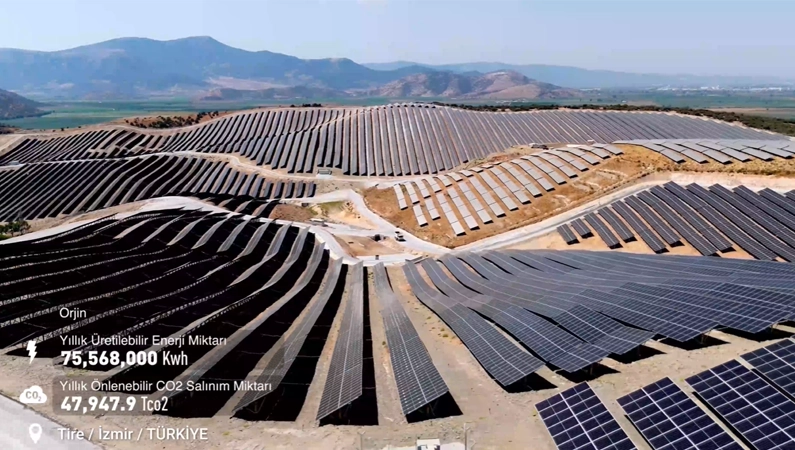
A second issue we flagged was elevation differences across the site.
In the early morning and late afternoon, parts of the plant may fall into shade due to terrain and height variation. This can create “false PR” periods that do not reflect system health, only site geometry and shading.
Our recommendation:
- Treat PR values during these hours with caution.
- For meaningful KPI reporting on this type of site, it can be reasonable to exclude certain morning/evening periods from PR evaluation.
If the project requires PR to be calculated and reported including these hours, then the solution becomes more complex and the sensor count may need to increase to better represent localized conditions.
Outcome: A Clear, Defensible Measurement Strategy
With SEVEN Sensor support, Naturel Enerji received:
- A structured, engineering-based explanation of why sensor quantity matters
- A practical method to determine the correct number of sensors based on real orientation groups
- Clear expectations of the impact of using fewer sensors
- Guidance on how terrain-driven shading affects PR interpretation
Takeaway
On complex PV sites, PR is only as reliable as the irradiance measurement behind it. When a field has many orientations and uneven terrain, the correct sensor strategy protects the owner and EPC from:
- misleading PR values,
- unnecessary fault investigations,
- and inaccurate performance reporting.
SEVEN Sensor helps teams turn complex PV geometry into a measurement plan that produces PR values you can trust.