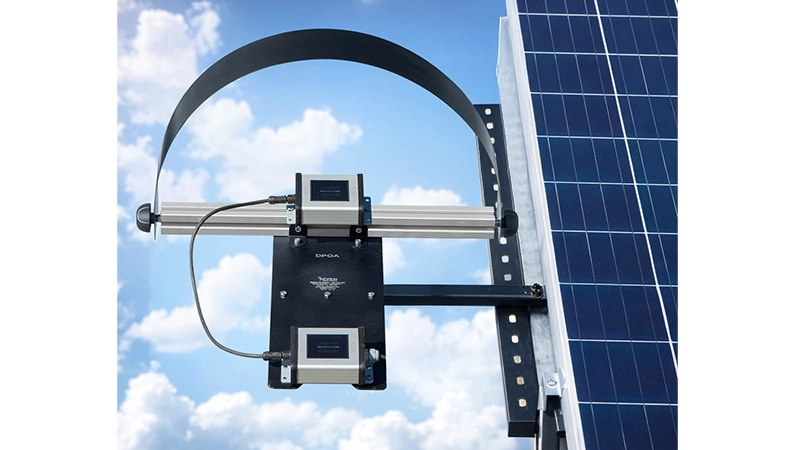
One of the primary environmental factors affecting production performance in solar power plants is cloud cover. As cloud density in the sky increases, direct radiation reaching the solar panels decreases; conversely, the proportion of diffuse radiation increases. This change can directly affect energy production efficiency, particularly in large-scale solar power plants. For this reason, cloud sensors are utilized in modern solar energy systems. These sensors are used to monitor atmospheric conditions and analyze the distribution of radiation.
This article will discuss what a cloud sensor is, how it works, and how cloud cover is calculated within a technical framework.
What Is a Cloud Sensor?
A Cloud Sensor is a meteorological device that determines cloud density in the sky. These sensors are primarily used to analyze irradiance conditions at solar power plants (SPPs).
With a cloud sensor, you can measure:
- Cloud cover
- Total irradiance at the array plane (POA – Plane of Array Irradiance)
- Diffuse irradiance at the array plane (DPOA – Diffuse Plane of Array)
- Direct irradiance in the array plane (BPOA – Beam Plane of Array)
These data are used in energy production analyses. This sensor plays a particularly important role in optimizing panel movements in tracker (solar tracking) systems.
Cloud Sensor Operating Principle
The operating principle of the cloud sensor is based on comparing irradiance data measured by two different irradiance sensors.
The sensor system typically consists of two different measurement elements:
- Open-path irradiance sensor (POA measurement)
- Sensor shaded by a shading band (DPOA measurement)
The open-path radiation sensor measures the total solar radiation incident on the panel plane. This measurement includes both direct and diffuse solar radiation components.
The sensor shaded by a shading band, however, is kept in constant shade by a special shading band. Therefore, direct sunlight does not reach the sensor; the measurement taken primarily represents diffuse and reflected radiation.
Calculations are performed using data from these two sensors to determine cloud cover in the sky.
That is, when the sky is clear:
- Direct radiation is high
- The diffuse radiation measured by the shaded sensor remains low
- The difference between the two sensors is large
When cloud cover increases:
- Direct radiation decreases
- The proportion of diffuse radiation increases
- The difference between the sensors decreases
These changes are detected by the system
How Is the Cloud Cover Percentage Calculated?
In cloud sensors, the cloud cover percentage is calculated using the ratio of diffuse radiation to total radiation.
The calculation principle is as follows:

As cloud density increases, the proportion of diffuse irradiance in the total irradiance rises, and the calculated cloud cover percentage also increases.
The Role of the Shading Strip in Sensor Performance
The shading strip used to ensure the cloud sensor operates correctly is a critical component. The shading strip meets the criteria specified in TS ISO 9846:2025.
This strip:
- Keeps the DPOA sensor cell constantly shaded
- Always blocks direct sunlight
- Enables the measurement of diffuse radiation
As a result, the system can calculate the cloud cover percentage by analyzing the difference between direct and diffuse radiation.
Measurement errors may occur if the shading band is not properly positioned. Therefore, the sensor orientation and shading angle must be carefully adjusted during installation.
Cloud Sensor Installation
Cloud sensors can be installed using different methods depending on the system configuration.
-
Installation in Tracking Systems
In solar tracking systems, sensors are typically mounted so that they move
in tandem with the panels. The installation process must be performed in
accordance with “local solar noon,” as described in detail below.During installation:
- The sensor must have the same tilt angle as the panels.
- The sensor’s orientation must match the panel’s orientation.
- The shading adjustment for the DPOA must be made according to the specified time.
- The shading strip must cast a shadow over the sensor throughout the day.
-
Installation in Fixed Systems
The Cloud Sensor must be mounted at the same tilt angle and azimuth as the
PV panels on-site. Once installation is complete, the POA and DPOA radiation
sensors on the Cloud Sensor must be positioned so that they face the same
plane as the panels.Shading Band Adjustment
- The initial adjustment of the shading band and periodic calibration should be performed, if possible, at local solar noon.
- Solar noon is the time when the sun is at its highest point in the sky and the zenith angle is at its smallest.
- The most important point when adjusting the shading band is that 12:00 PM should not be used as a fixed reference. The solar noon time is the “Culmination” time listed on the Sun Calculator website.
Periodic Inspection and Adjustment
- The position of the shading band must be checked at least once every two days, as the angle of the sun’s approach changes throughout the year.
- During the inspection, the continuity of the shadow on the DPOA sensor throughout the day must be observed.
- If it is determined that the shadow has shifted across the DPOA sensor during the day, the shifts in the sensor’s azimuth and tilt angles should be examined, and the shading band should be readjusted at solar noon.
- After adjustment, a brief visual check should be performed not only at solar noon but also, if possible, in the morning and afternoon hours to confirm that the shadow remains on the sensor.
These maintenance procedures are important for maintaining the accuracy of measurements. The approximate change in the sun’s angle of incidence throughout the year, based on the latitude of the location where the Cloud Sensor will be used, can be checked using the table provided in the user manual as a reference. You can find the necessary information in the user manual. regarding when and by what angle adjustments should be made.
Cloud sensors are essential measurement devices used to analyze atmospheric conditions at solar power plants. By comparing measurements of total irradiance and diffuse irradiance, the sensors determine the cloud density in the sky. The data obtained helps optimize panel positioning, particularly in solar tracking systems, and can increase energy production efficiency. Especially on heavily cloudy days, positioning the panels horizontally can allow for more efficient use of diffuse radiation. For more information, please contact SEVEN Sensor Solution.
Frequently Asked Questions (FAQ)
What does a cloud sensor do?
A cloud sensor enables solar energy systems to more accurately assess atmospheric conditions by monitoring cloud density in the sky.
What values does a cloud sensor measure?
Cloud sensors typically measure the following values:
- Total irradiance at the panel plane (POA)
- Diffuse and reflected irradiance (DPOA)
- Direct irradiance in the array plane (BPOA)
- Cloud cover percentage
How is the cloud cover percentage calculated?
The cloud cover percentage is calculated by dividing the diffuse irradiance by the total irradiance.
Should cloud sensors be used in solar power plants?
Cloud sensors monitor irradiance changes in solar power plants. Accordingly, they assist in analyzing system performance. They particularly contribute to optimizing panel movements more efficiently in tracker systems. For this reason, cloud sensors should be considered an important measurement and monitoring solution in solar power plants.