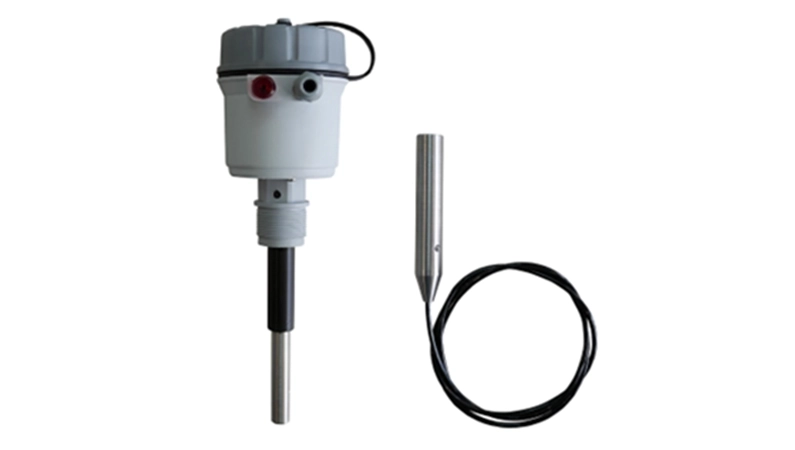
Do you manage a storage facility? No matter what you store; grains, powders, granules, or liquids—knowing the exact level is key for efficiency, safety, and saving costs. If you’re still checking levels the old-fashioned way, you know how frustrating it can be. Climbing up to peek inside a silo or tank, only to find it already full or almost empty, is not only time-consuming, it’s risky too. And frustrating.
These traditional approaches are not only labor-consuming but also error-prone methods. In the era of speed and technology, industries demand precise, reliable, and continuous monitoring solutions.
That’s why SEVEN created the Capacitive Silo Level Sensor: a smart and reliable way to know exactly how much material you have, without the guesswork, time and effort loss.
The Smart Solution: SEVEN Capacitive Silo Level Sensors.
Seven Capacitive Silo Level Sensors is one of the advanced instruments engineered and developed by Seven Sensor solutions to measure storage levels in silos, tanks, hoppers, or bins. working effectively with both liquids and solids. By providing accurate, real-time data- to optimize inventory management and take action in the suitable time.
Known for their reliability, durability, and cost-effectiveness, this sensor is designed for harsh industrial conditions, including environments with temperatures, or pressure variations.
How Do Capacitive Silo Level Sensors Work? The working principle
The core of this sensor is capacitance—the ability to store an electrical charge. The below points explain the work principle in detail:
- the system has two conductive points—one is usually the silo wall (or another reference point), and the other is a probe placed inside the silo.
- The material stored inside the silo acts as the dielectric medium between the electrodes. Air or an empty vessel has a certain dielectric constant, but when a material like grain, water, or cement fills the space between the electrodes, its presence changes the overall dielectric constant of the system. This alteration in the dielectric directly leads to a change in the measurable capacitance between the electrodes.
- The sensor detects this shift and instantly converts it into an accurate reading of your silo’s fill level.
In simple terms: when the level goes up or down, the capacitance changes—and the sensor tells you exactly what’s happening.
Capacitance Equation
The basic capacitance of a capacitor is:
C = (ε * A) / d
Where:
- C = Capacitance in farads (F)
- ε = Permittivity of the material between the electrodes (ε = ε0 * εr)
- ε0 = Permittivity of free space ≈ 8.854 × 10^-12 F/m
- εr = Relative permittivity of the material (air ≈ 1, water ≈ 80, grains ≈ 2–4)
- A = Area of the electrode facing the material (m²)
- d = Distance between the two electrodes (m)
Where Can the Capacitance Level Sensor Be Used?
SEVEN Capacitive Silo Level Sensor is versatile and can be used across many industries as we mentioned below the main ones:
- In agriculture, it helps farmers and feed producers easily keep track of grain and animal feed levels.
- In the food and beverage sector, they monitor ingredients like flour, sugar, and liquids, ensuring production runs smoothly without interruptions.
- In Chemical processing facilities rely on them for safe and precise measurement of powders, liquids, and bulk chemicals.
- In pharmaceutical companies trust them for handling sensitive raw materials with accuracy.
- In construction, it used to monitor cement, sand, and aggregates.
No matter the type of storage vessel—silo, tank, hopper, or bin. these sensors provide reliable and consistent results, helping businesses save time, reduce risk, and manage inventory more efficiently.
Why to Choose SEVEN Capacitive Level Sensors?
- Customized Solutions: Tailored lengths and designs of probes based on material type, vessel geometry, and operating environment.
- Low Maintenance: No moving parts means minimal maintenance level.
- Durability: Built to withstand d conditions.
- Cost-Effective: A long-term investment that saves time, reduces errors, and improves efficiency.
FAQ
Where can SEVEN capacitive silo level sensors be used?
In agriculture, food & beverage, chemical processing, pharmaceuticals, and construction.
Do they work with both solids and liquids?
Yes, they are suitable for both applications.
Which countries does SEVEN exports to?
More than 20 countries, including Iran, UAE, Qatar, and the UK.
Contact Seven Sensor Solutions.
📧 Email: sales@sevensensor.com
📱 WhatsApp: +90 530 889 80 19