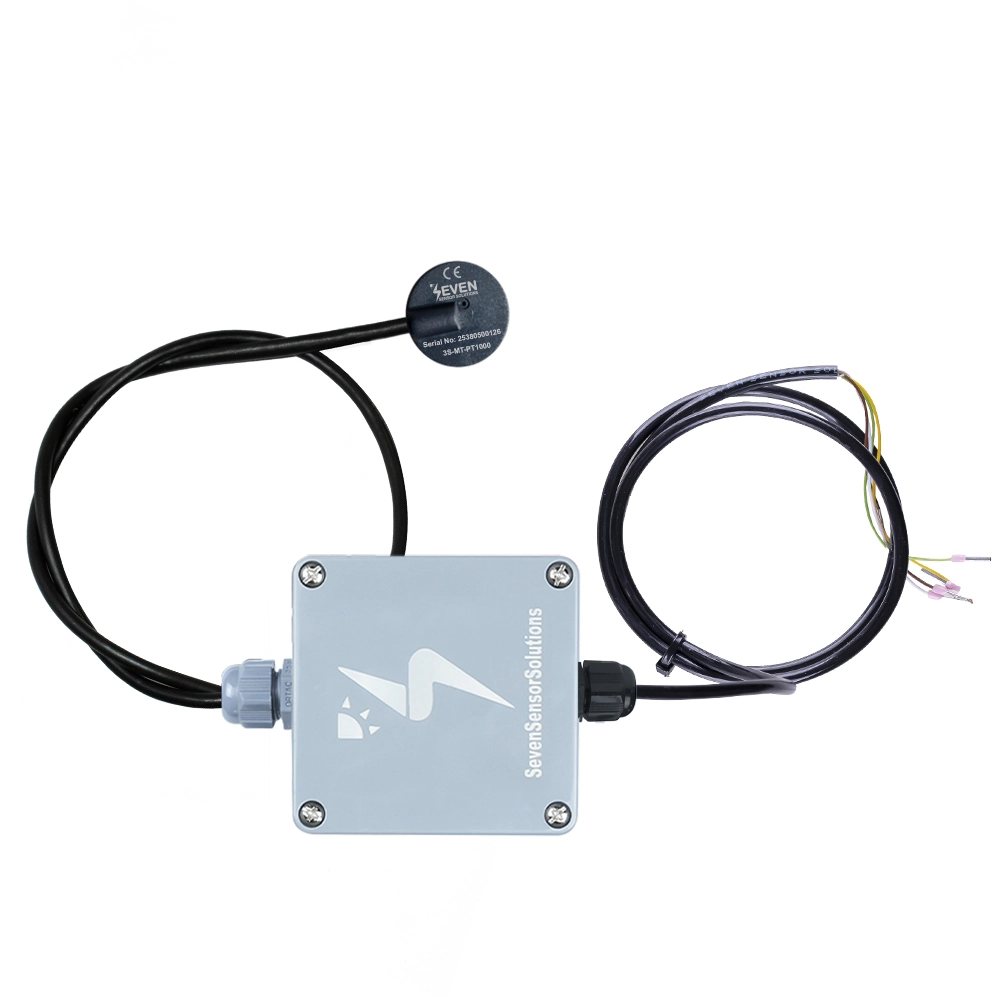
Module Temperature Sensor-PT1000 with 4-20 mA Output – 3S-MT-PT1000-I
Module temperature sensor measures the back of the solar panels temperature in degrees Celsius (°C) by using a PT1000 probe. The probe, used to measure the Back of Module Temperature, is placed between two Backsheet with EVA sheet. In order to communicate via 4-20mA, a transducer is used to convert PT000 to the required Output signal. This Module Temperature Sensor Model is compatible with all Dataloggers, Gateways, and PLCs with 4-20 mA input port.
What is Module Temperature Sensor?
Module temperature significantly affects total field performance in solar power facilities. A PT1000 probe is used to test the backside temperature of solar panels in degrees Celsius (°C).
This measurement is important because when photovoltaic panels are exposed to sunlight, they generate heat in addition to energy. This means that some of the radiation is converted to electrical energy, while the rest is released as heat, which raises the temperature of the PV cells. As cell temperature increases, the short-circuit current increases while the open-circuit voltage decreases, lowering the module’s electrical efficiency. As a result, keeping an eye on panel temperature is essential for tracking and controlling these efficiency losses.
What is the working principle of Module Temperature?
Module temperature sensors are professional, intelligent measurement sensors with a digital interface for environmental and industrial applications such as PV power plants. The unit is a temperature transmitter with an analog 4-20 mA output, specifically designed to monitor the back surface temperature of PV modules. The PV module temperature is detected by a high precision PT1000 sensor and converted to analog 4-20 mA output with an electronic card placed in UV resistant and high protection box. This Module Temperature Sensor Model is compatible with all Dataloggers, Gateways, and PLCs with 4-20 mA input port.
Technical Specifications of Module Temperature
| Item Code | 3S-MT-PT1000-I |
| Sensor Type | PT1000 |
| Measuring Range | -40°C to +85°C |
| Accuracy | ±0.1°C |
| Resolution | 0.1°C |
| Data Output | Analog 4-20 mA |
| Power Supply | 12 to 30 V DC |
| Power Consumption | 30 mA @ 24 V DC |
| Electrical Connection | 1.2 m 2x2x0.22 mm², 24 AWG, LI2YC11Y-TP PUR Cabel and 2 m 2x2x0.22 mm², 24 AWG, LI2YC11Y-TP PUR Cable, UV and Weather Resistant |
| Operating Temperature Range | -40°C to +85°C |
| Box Dimensions | 64 mm x 68 mm x 35 mm (W x L x H) |
| Sensor Cover Dimensions | Ø 33 mm x 3,5 mm Plastic model Ø 35 mm x 2 mm EVA model |
| Weight | 257 gr |
| IP Rating | IP67 |
| Box Material | ABS |
| Sensor Cover | Laminated Backsheet (EVA – Tedlar) / ABS Plastic Injection |
| Mounting Method | 3MR Tape to Back of Module |
| Standard | Class A according to IEC 60751:2022 and IEC 61724-1:2021 |
How should Module Temperature be installed?
IEC 61724-1:2021 stated that “the module temperature sensor shall be placed at the center of a cell near the midpoint of the module, avoiding cell boundaries.”
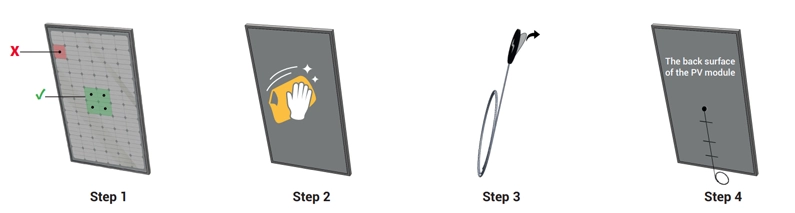
This suggests that the Module Temperature Sensor must be positioned exactly in the center of the rear of the PV module. The sensor should be positioned closest to the middle of the cell to prevent it from crossing cell boundaries. The installation area must also be completely dry and impurity-free to provide accurate measurement and a secure connection. It should be noted that the Module Temperature Sensor may have trouble attaching to the PV modules in the winter due to dew residues on them.
What are the advantages of Module Temperature?
Module temperature sensors are crucial to photovoltaic (PV) systems because they provide maximum performance, prevent overheating, and enable weather adaptation. This is an explanation of their importance:
PR Estimation: It is necessary to measure the module temperature in order to accurately calculate the Performance Ratio (PR). A module temperature sensor is necessary because temperature has a direct impact on electrical output and accurate temperature data is necessary for accurate PR calculations.
Protection Against Overheating: Excessive heat can cause long-term damage to PV panels and reduce their performance. Control systems can adjust panel tilt or start cooling strategies to avoid overheating thanks to sensors that provide real-time temperature data. This not only safeguards the system but also reduces maintenance costs, improves sustainability, and extends service life.
Weather Adaptability: Variability in the climate has an additional impact on the ever-changing weather conditions that PV modules operate in. Temperature sensors enable the system to respond dynamically, optimizing energy yield by optimizing performance across a range of environmental conditions and seasons.
Why Seven Sensor Solutions?
SEVEN products are built with reliable, high-quality components to deliver precise meteorological data for both environmental and industrial applications. A key advantage of the module temperature sensor lies in its design, which closely replicates the structure of a PV module’s backside. This ensures that the sensor and the PV module exhibit similar heat transfer behavior—an essential requirement for accurate measurement.
The sensor is specifically engineered to meet the requirements of photovoltaic plant monitoring systems, in compliance with IEC 60751:2022 and IEC 61724-1:2021 Annex B. For example, IEC 61724-1:2021, Section 9.1 specifies that for bifacial modules, rear-side temperature sensors and wiring must not obscure more than 10% of any cell area, and cabling should be routed between cells whenever possible. In addition, temperature sensors must provide a measurement resolution of ≤ 0.1 °C and an uncertainty of ±1 °C or better.
The SEVEN 3S-MT module temperature sensor fully satisfies these requirements. Our module temperature sensor delivers a resolution of ≤ 0.1 °C with an uncertainty of ±1 °C, fully aligning with the IEC standards.
Frequently Asked Questions (FAQ)
What is the Class?
All 3S-MT-PT1000-I sensors are Class A according to IEC 60751:2022 and IEC 61724-1:2021.
What is the warranty?
All 3S-MT-PT1000-I sensors come with a 2-year warranty.
What is the price of module temperature sensor?
Between 95 and 170 EUR.
What are the delivery times?
Small Orders: approx. 2-3 weeks
Bulk orders: approx. 7-8 weeks
Does the sensor include a cable?
Each unit comes with a 1.2 m 2x2x0.22 mm², 24 AWG, LI2YC11Y-TP PUR Cable and 2 m 2x2x0.22 mm², 24 AWG, LI2YC11Y-TP PUR cable (UV and Weather Resistant). Other lengths are available on request.
How do I set up the sensor?
Follow our user manual which include step-by-step instructions. The user manual link is https://www.sevensensor.com/files/d/en/Module_Temperature_Sensor_User_Manual.pdf