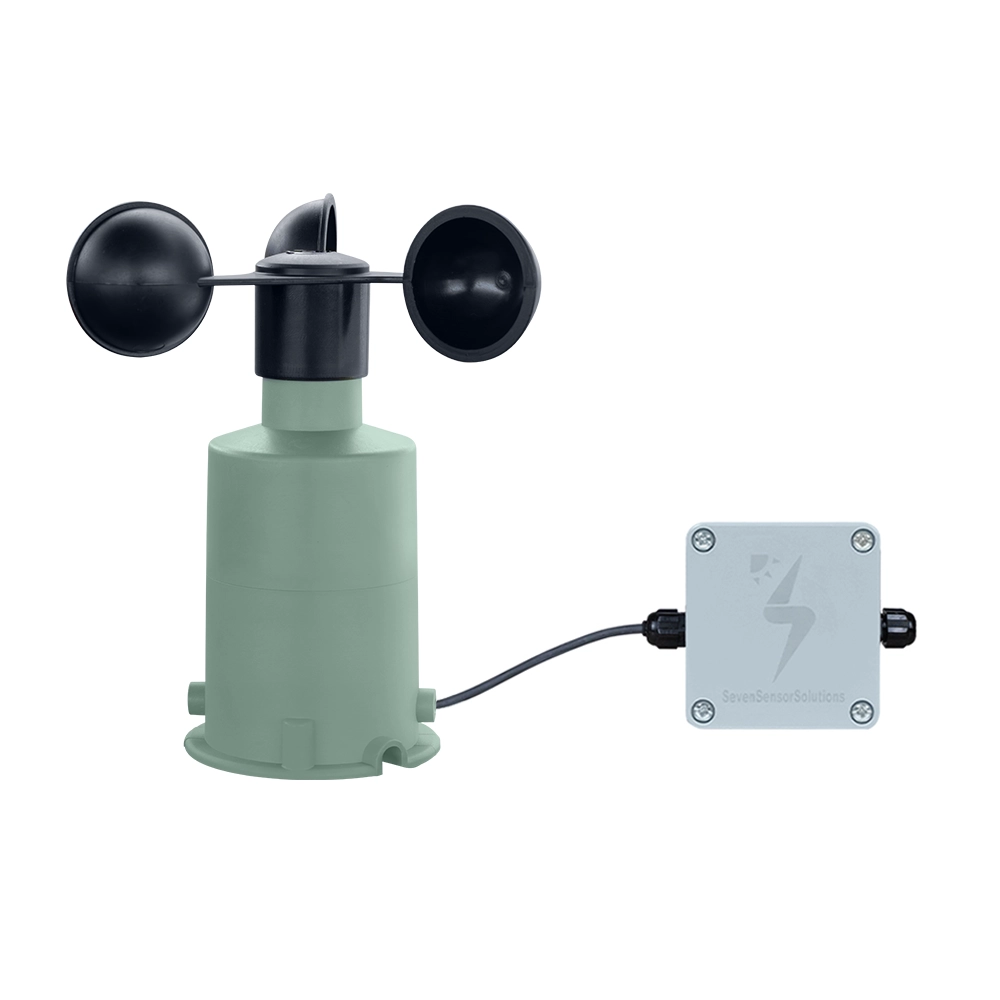

Plastic Wind Speed Sensor with Analog Output – 3S-WS-I-P
The Plastic Wind Speed Sensor with Analog Output is a compact cup anemometer made for PV plants and other outdoor monitoring applications where you want reliable wind speed data without a heavy industrial unit. It measures horizontal wind speed and sends a 4–20 mA analog signal, so it works with almost any datalogger, gateway, PLC, or SCADA that has analog inputs.
This sensor is designed to measure horizontal wind speed independently of its direction. Its measurement system is based on a reed switch, activated by a rotating magnet connected to the anemometer cups.
TECHNICAL SPECIFICATIONS OF PLASTIC WIND SPEED SENSOR WITH ANALOG OUPUT
| Item Code | 3S-WS-I-P |
| Sensor Type | Cup Star Anemometer (Reed Switch) |
| Measuring Range | 0,9 to 60 m/s |
| Accuracy | Below 5m/s 0.5 m/s and 10% of reading above 5m/s |
| Resolution | 0,1 m/s |
| Threshold | 0,9 m/s |
| Survival Speed | 60 m/s |
| Data Output | Analog (4-20 mA) |
| Power Supply | 12 to 30 V DC |
| Cable’s Length & Features | 1 m LIYYC11Y PUR Cable, UV and Weather Resistant |
| Operating Temperature Range | -40°C to +85°C (Ice Free) |
| Dimensions | Ø 136 x 151 mm |
| Weight | 0,2 kg |
| Housing Material | ASA |
| Cup Material | ASA |
| Mounting Method | Pipe or Ground Mounting |
| Standard | Compliant to IEC 61724-1:2021 |
What Does the Plastic Wind Speed Sensor with Analog Output Measure and Why is it Useful in PV Plants?
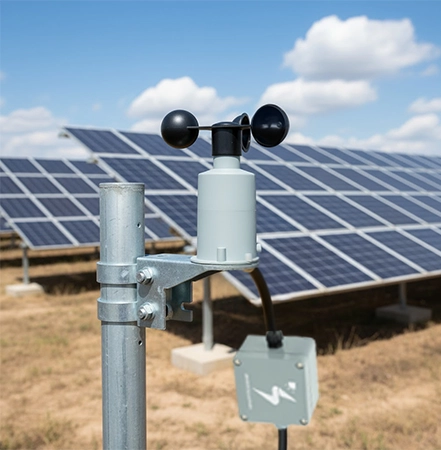
3S-WS-I-P model measures horizontal wind speed (m/s). In solar PV monitoring, wind speed is mainly used to:
- understand module cooling effects on temperature and yield,
- support event reporting during high-wind or gust periods,
- strengthen performance analysis together with POA irradiance and module temperature.
Even a simple wind input can noticeably improve site diagnostics, especially in hot climates or sites with fast temperature swings.
Why Choose the Plastic Analog Wind Speed sensor?
Many PV sites need wind speed for IEC-aligned monitoring, but don’t need a high-cost metal anemometer. This plastic analog model is a good fit when you want:
- analog 4–20 mA output for universal compatibility,
- a lightweight, economical sensor for standard PV met stations,
- easy replacement across multi-site fleets.
If your project needs aluminum housing for coastal or extreme environments, SEVEN also provides metal-body wind speed models.
How Does the 3S-WS-I-P Plastic Wind Speed Sensor Work?
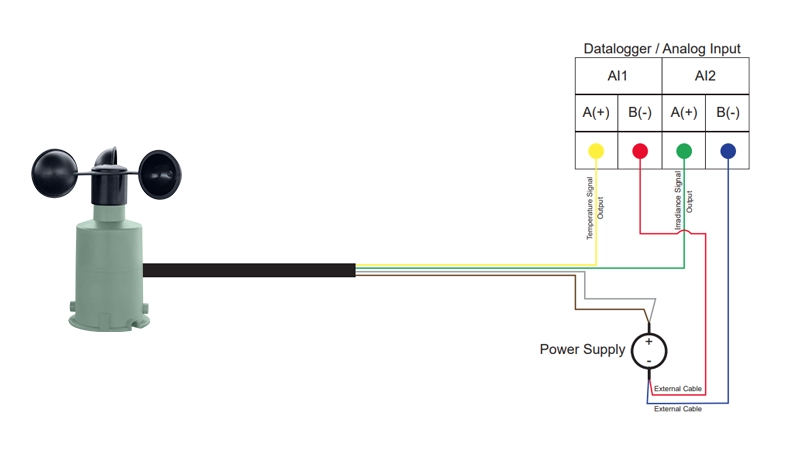
The 3S-WS-I-P is a classic cup anemometer. When wind blows, it turns the three cups on top of the sensor. Inside the sensor, a reed-switch detects how fast the cups are rotating. That rotation speed is proportional to the actual wind speed.
The signal is then sent to the transducer box, which converts the raw rotation data into a standard 4–20 mA analog output. Your datalogger or PLC reads this current signal and translates it directly into wind speed. In practice, higher wind makes the cups spin faster, the transducer increases the output current, and your monitoring system records a higher wind speed value.
Where is the Plastic Wind Speed Sensor with Analog Output Commonly Used?
You’ll typically see this model in:
- utility, C&I, and rooftop PV plants as part of IEC 61724-1 weather monitoring,
- compact weather stations and environmental networks,
- industrial or agricultural sites that need basic wind speed measurement with analog output.
Frequently Asked Questions (FAQ)
Is the plastic wind speed sensor with analog output compliant with IEC 61724-1 for PV monitoring?
Yes. The plastic wind speed sensor family is designed to meet IEC 61724-1:2021 requirements for PV met stations.
How are the analog wind speed sensors tested and calibrated?
Each plastic wind speed sensor is tested and calibrated using a high precision wind tunnel in our factory.
What is the accuracy of the plastic wind speed sensor with analog output?
Accuracy depends on the wind speed range:
For low winds (below 5 m/s): the measurement is accurate within ±0.5 m/s.
Example: if the real wind is 3.0 m/s, the sensor will read roughly between 2.5 and 3.5 m/s.
For higher winds (above 5 m/s): the accuracy is ±10% of the reading.
Example: if the sensor reads 10 m/s, the real wind could be about 9–11 m/s. If it reads 20 m/s, the real wind could be about 18–22 m/s.
Will the 3S-WS-I-P work with my datalogger or PLC?
Simply connect the 4–20 mA analog output (an industry-standard current loop where 4 mA represents the minimum measured value and 20 mA represents the maximum) to the analog input on your SCADA, PLC, or datalogger.
What wind speed range can the 3S-WS-I-P measure?
3S-WS-I-P measures between 0.9–60 m/s.
Does the plastic wind speed sensor with analog output come with a cable?
Yes. The plastic wind speed sensors with analog outputs are supplied with a UV- and weather-resistant cable for outdoor installation. Standard supply is 1 m LIYYC11Y PUR cable, and other lengths can be provided on request.
What is the warranty period?
SEVEN wind speed sensors are supplied with a standard warrantyof 2 years against manufacturer defects, extendable upon request.
Can I log gusts and high-wind events with this model?
Yes. Your logger can sample the 4–20 mA signal at your chosen rate to capture gust behavior for reporting.
What is the price of the 3S-WS-I-P?
The price ranges between 110 EUR - 200 EUR.
What are the delivery times for the plastic wind speed sensor with analog output?
The lead times vary depending on the order volume.
Small orders: approx. 5-7 days
Bulk orders (100 pcs) : approx. 6-7 weeks
How do I set up the 3S-WS-I-P sensor?
Follow our user manual which include step-by-step instructions for configuring the sensors. SEVEN also provide remote setup support when needed.