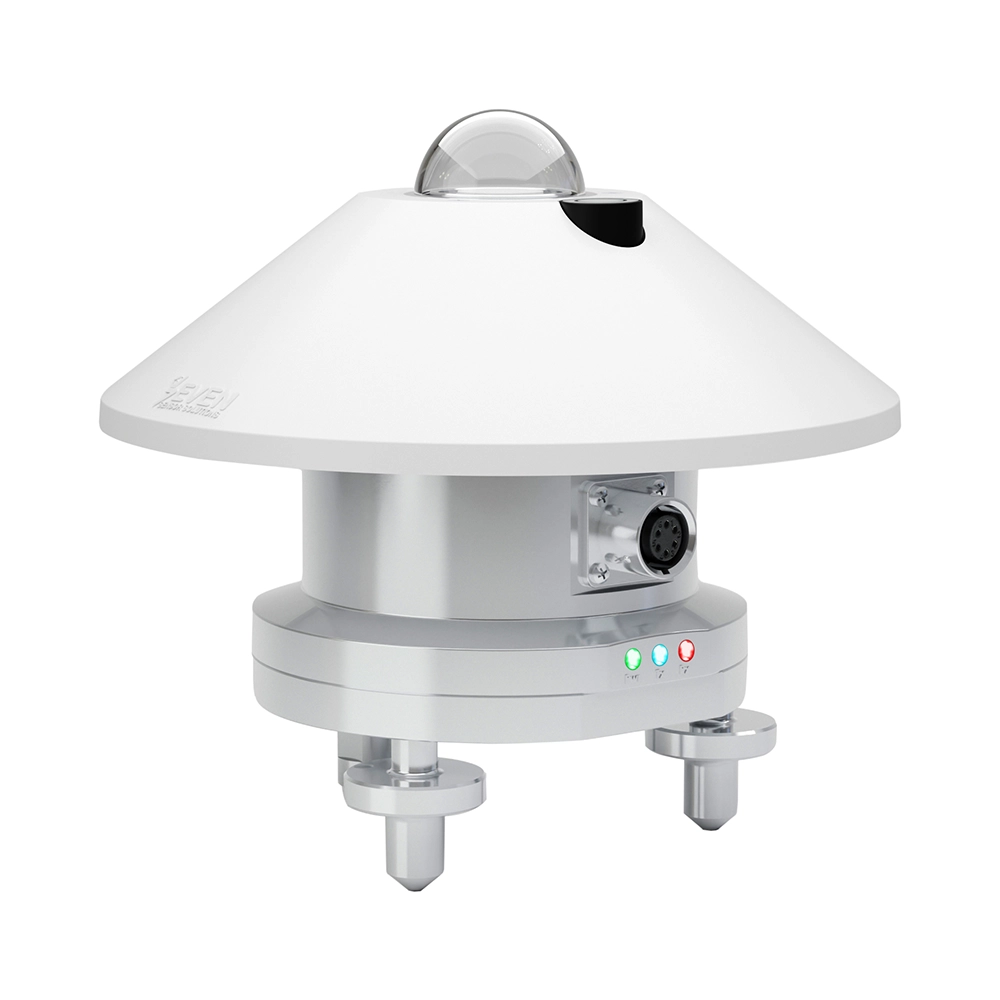
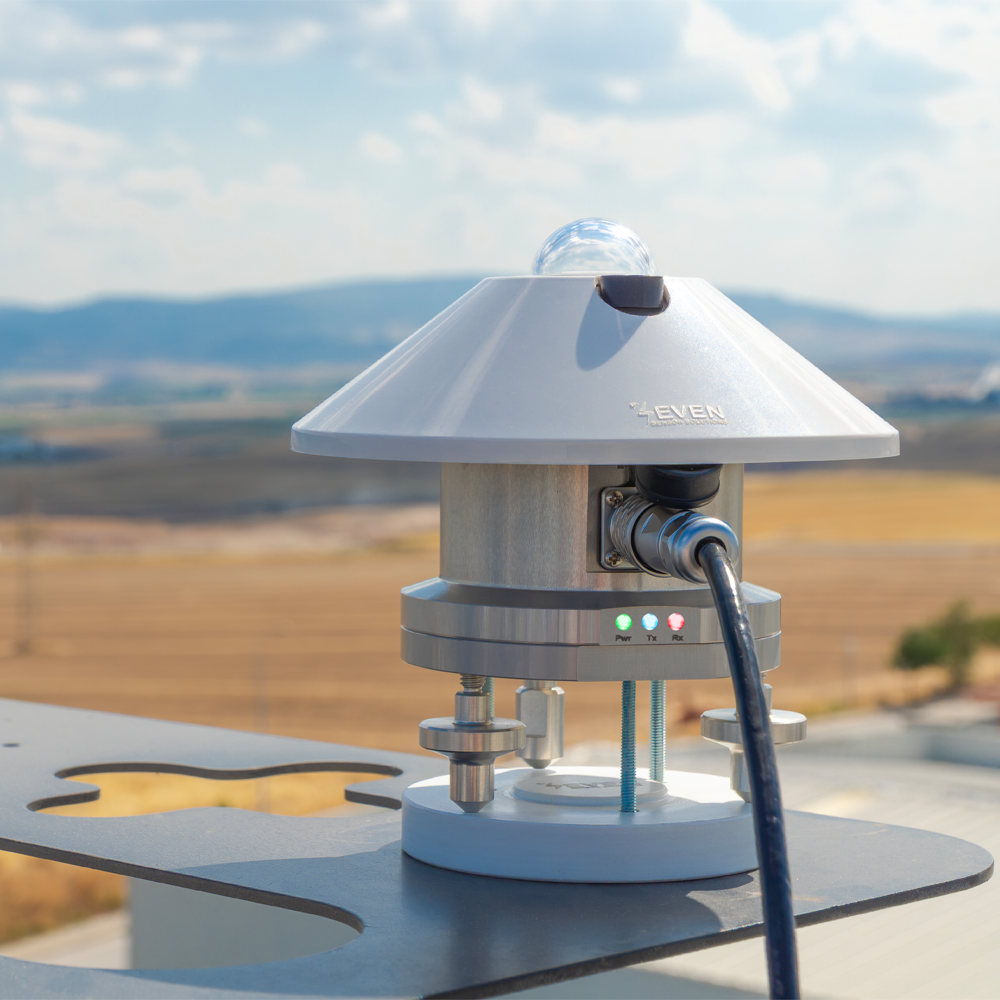
Class A Thermopile Pyranometer – 3S-TP-MB-A
The 3S-TP-MB-A Thermopile Pyranometer is a sensor used to measure solar radiation in units of W/m². It is designed for high-precision solar energy monitoring and meets the ISO 9060:2018 Class A and IEC 61724-1:2021 Class A standards. With advanced thermopile detector and diffuser technology, this pyranometer provides stable and accurate irradiance measurements, making it perfect for solar, meteorological, and agricultural applications. It offers low zero-offset behavior and exceptional stability, ensuring accurate solar irradiance measurements.
TECHNICAL SPECIFICATIONS OF THERMOPILE PYRANOMETER
| Item code | 3S-TP-MB-A |
| Measured Data | Global Horizontal (GHI) or POA Irradiance, Internal and Housing Temperature, Internal Humidity and Pressure, Sensor Tilt Angle |
| Sensor Type | Thermopile |
| Spectral range (50% points) | 280…3000 nm |
| Irradiance Range | -20…+4000 W/m² |
| Nominal Sensitivity | 8…14 µV/(W/m²) |
| Response Time (95%) | <0,5 s (less than 10 s; Class A as per ISO 9060:2018 standard) |
| Zero Offset A – Thermal Radiation (200W/m²) | ± 1 W/m² (± 7 W/m²; Class A as per ISO 9060:2018 standard) |
| Zero Offset B – Temperature Change (5K/h) | ± 1,5 W/m² (± 2 W/m²; Class A as per ISO 9060:2018 standard) |
| Total Zero Offset C | ± 3 W/m² (± 10 W/m²; Class A as per ISO 9060:2018 standard) |
| Non-stability (change/year) | < 0,5% (± 0,8%; Class A as per ISO 9060:2018 standard) |
| Non-linearity (100 to 1000 W/m²) | ± 0,2% (± 0,5%; Class A as per ISO 9060:2018 standard) |
| Directional Response (at 1000 W/m², 0 to 80°) | ± 10 W/m² (± 10 W/m²; Class A as per ISO 9060:2018 standard) |
| Spectral Error | ± 0,2% (± 0,5%; Class A as per ISO 9060:2018 standard) |
| Temperature Response (-20°C to 50°C) | ± 0,4% (± 1%; Class A as per ISO 9060:2018 standard) |
| Irradiance Resolution | 0,1 W/m² |
| Internal Humidity | Range: 0%…100% Accuracy: ± 1% RH (20…70%) @ 25°C Resolution: 0,1% |
| Internal Temperature | Range: -40°C…+85°C Accuracy: ± 0,1°C (5…60°C) @ 20…80% RH Resolution: 0,1°C |
| Housing Temperature | Range: -40°C…+85°C Accuracy: ± 0,2°C Resolution: 0,1°C |
| Sensor Tilt Angle | Range: 0°…180° Accuracy: ± 0,5° Resolution: 0,1° |
| Internal Pressure | Range: 260…1260 hPa Accuracy: 0,5 hPa Resolution: 0,1 hPa |
| Spirit Level Accuracy | <0,1° |
| Viewing Angle | 2π sr |
| Data Output | RS485 up to 38400 Baud |
| Communication Protocol | Modbus RTU (Optional Modbus TCP/IP) |
| Output Rate | 1/s |
| Operating Temperature Range | -40…+85°C |
| Power Supply | 12…30 V DC |
| Power Consumption | 45 mA @ 24 V DC |
| Cable Features | 3x2x0,14 mm², 26 AWG LI2Y(st)CTP PUR Cable, UV and weather resistant |
| Cable Length | 3 meter standard length (Custom lengths available) |
| Galvanic Isolation | 1000 V between power supply and RS485 Bus |
| IP Rating | IP 68 |
| Dimensions | Ø140 × 120 mm |
| Sensor Housing Material | Anodized Aluminum |
| Shade Disk Material | ASA |
| Weight | 0,68 kg |
| Standards | ISO 9060:2018, Fast Response Spectrally Flat Class A (Secondary Standard), IEC 61724-1:2021 Class A, ISO/TR 9901:1990, ISO 9847 |
| Origin | TÜRKİYE |
How Does the 3S-TP-MB-A Thermopile Pyranometer Work?
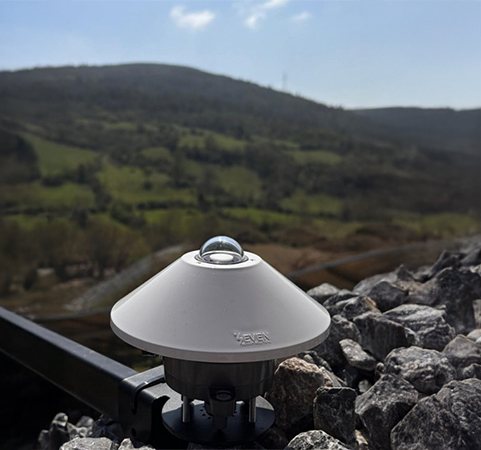
The 3S-TP-MB-A Thermopile Pyranometer measures solar irradiance by detecting the temperature difference between its thermopile sensor and the surrounding environment. When sunlight strikes the sensor, it heats the absorbing surface of the thermopile, creating a temperature differential between the hot and cold junctions. This temperature difference generates a measurable voltage that is directly proportional to the intensity of the solar radiation. The pyranometer is designed with a glass dome that allows sunlight to enter from all directions, ensuring it captures both direct and diffuse radiation. With a spectral range of 280 nm to 3000 nm, the pyranometer provides accurate readings of global solar radiation, delivering precise irradiance measurements in watts per square meter (W/m²). The device’s design ensures a rapid response time, making it ideal for dynamic solar applications.
Why Choose the 3S-TP-MB-A Thermopile Pyranometer?
- High Precision: Meets stringent Class A standards for accurate solar irradiance measurements.
- Comprehensive Monitoring: Monitors irradiance, temperature, and humidity for a complete environmental profile.
- Fast Response: Ideal for applications requiring rapid detection of solar radiation changes.
- Robust Construction: Designed to withstand harsh environmental conditions with an IP68 rating.
- Easy Integration: Supports Modbus RTU communication for seamless data integration into existing systems.
How Should I Install and Maintain the 3S-TP-MB-A Thermopile Pyranometer?
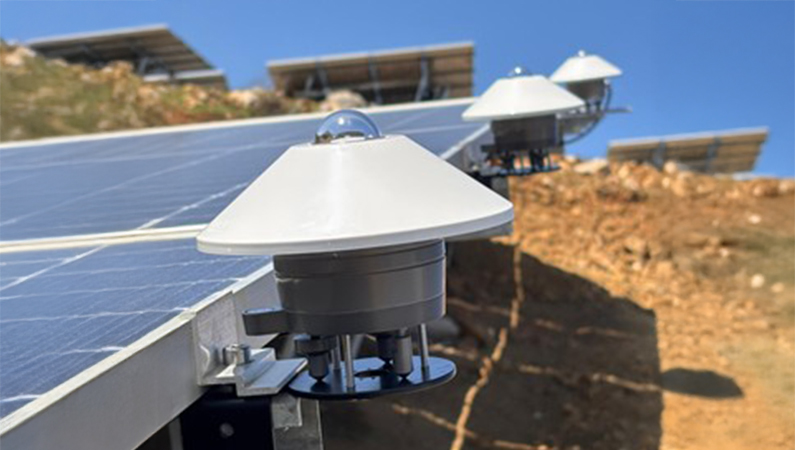
Detailed instructions are provided in the user manual, including mounting and wiring diagrams.
Installation:
- Unpacking and Inspection: Ensure all components are present and undamaged.
- Site Selection: Choose a location with an unobstructed 180° view of the sky, free from shading.
- Mounting: Install the pyranometer securely, ensuring it is level and stable.
- Electrical Connection: Connect the sensor to the power supply and data logger as per the wiring diagram.
- Configuration: Use the 3S-TP-MB Configuration Tool to set communication parameters.
Maintenance:
- Daily: Check for any visible damage or obstructions.
- Weekly: Clean the sensor dome to remove dust or debris.
- Monthly: Verify data output and system integration.
- Annually: Perform a full system check and calibration.
- Every Few Years: According to IEC 91724-1:2021, once deployed in the field, a SEVEN pyranometer requires recalibration every two years to verify solar radiation data. However, thanks to its high-precision diffusers, our recommendation is to recalibrate every five years.
Frequently Asked Questions (FAQ)
Is the pyranometer Class A?
Yes. 3S-TP-MB-A SEVEN Pyranometer is Class A as per IEC 61724-1:2021 and ISO 9060:2018.
How’s the pyranometer calibrated?
SEVEN Thermopile Pyranometers are calibrated under a 1000 W/m² Class AAA sun simulator in a dedicated facility that complies with the ISO 9847 standard.
How often should the SEVEN pyranometer be calibrated?
The pyranometer should be recalibrated every two years according to the IEC 61724-1:2021 standard. However, due to its high-precision diffusers, recalibration every five years is recommended.
Where can I recalibrate the pyranometer?
SEVEN Sensor provides calibration services at its facilities. Additionally we offer user-friendly interface where users can recalibrate the sensors in their home country and enter the new calibration values into the system.
How can I connect the sensor to my system?
The sensor uses RS485 Modbus RTU communication, compatible with most data loggers and controllers. Follow our user manual which include step-by-step instructions. Contact SEVEN Sensor if further support is needed.
Can I measure POA (Plane of Array) irradiance with pyranometer?
Yes, but to measure POA, the sensor must be mounted with the same tilt and azimuth orientation as the PV module. Both the sensor and the PV panel should face the same direction (e.g., both facing 180° due south).
What is the maximum irradiance the pyranometer can measure?
The sensor can measure up to 4000 W/m².
What is the spectral range pyranometer can measure?
The pyranometer measures a spectral range from 280 nm to 3000 nm.
What are the condensation prevention methods used in the SEVEN pyranometer?
To prevent internal condensation, SEVEN pyranometers are assembled in an airless (vacuum) environment and feature a tightly sealed mechanical design that blocks air ingress. This combination eliminates moisture formation inside the instrument.
Additional safeguards include:
Natural ventilation: A passive airflow design helps inhibit moisture build-up.
Integrated moisture-absorbing pack: Silica gel inside the device absorbs any residual humidity.
Internal humidity monitoring: A built-in humidity sensor continuously tracks the internal RH level.
Dry assembly conditions: Every pyranometer is assembled at a very low internal humidity of 2–8%.
These measures work together to ensure long-term optical clarity, stable calibration, and reliable measurements in harsh environmental conditions.
How is the sensor powered?
It operates on a 12 to 30 V DC power supply.
What is the warranty period?
The sensor comes with a 5-year warranty covering defects in materials or workmanship.
What is the price of the sensor?
The sensor is priced betwen €825-1500. Please contact our sales team for more details.
What is the cable length of the pyranometer?
Each unit comes with a 3 m LI2(ST)C11Y PUR cable (UV and weather resistant) with 6 wires twisted (including ground for both Data & Power). Other lengths are available on request.
What are the delivery times?
Small orders: approx. 2-3 weeks
Bulk orders (100 pcs): approx. 8-10 weeks