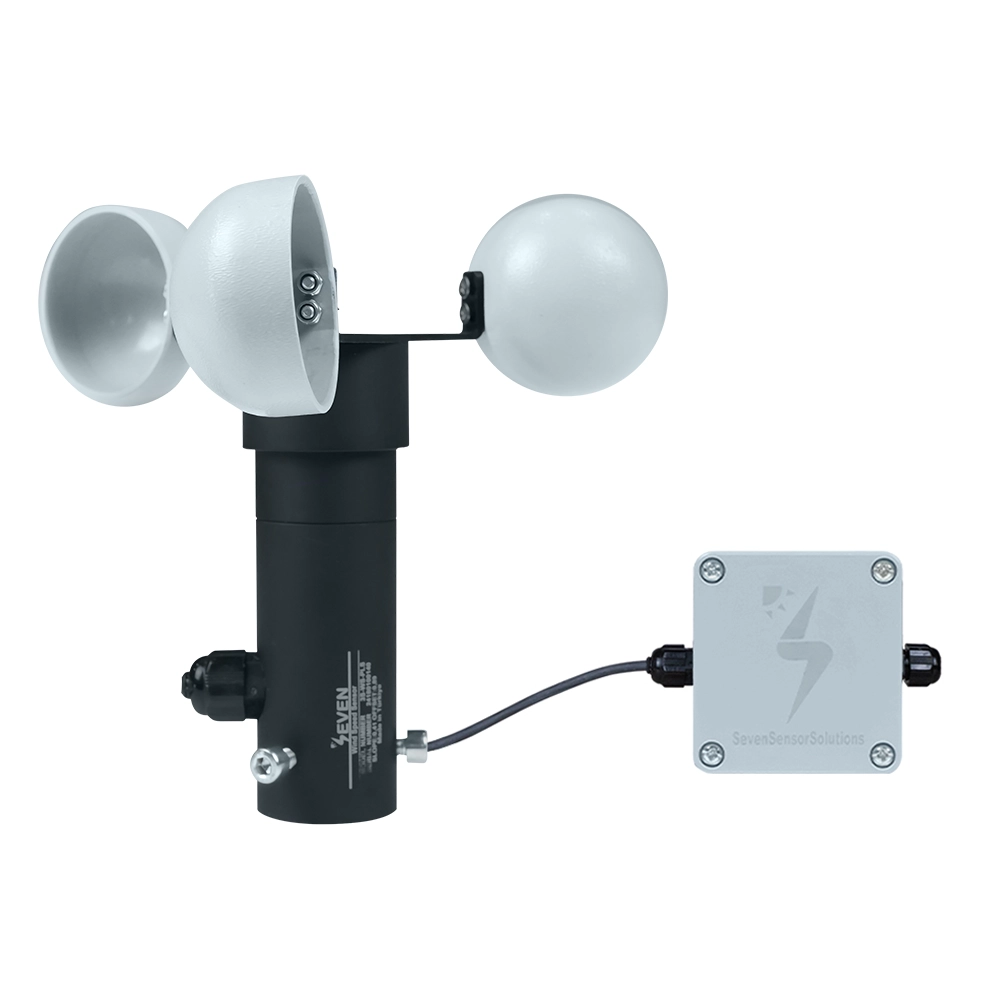

Wind Speed Sensor With Analog Output – 3S-WS-I-A
Wind speed sensor, also known as anemometer, is one of weather station sensors. This Sensor measures wind speed by converting it into an electrical signal in m/s. The Wind Speed Sensor is designed to measure horizontal wind speed independently of direction. The measuring electronic element in the wind speed sensor is the reed relay driven by the rotating magnet connected to the wind bowls.The Wind Speed Sensor with Analog Output is compatible with all Dataloggers, Gateways, and PLCs with Analog input port. It is supplied with mounting facility and cable. Heating option is available for locations where there is a risk of icing.
Technical Specifications of Wind Speed Sensor
| Item Code | 3S-WS-I-A |
| Sensor Type | Cup Star Anemometer (Reed Switch) |
| Measuring Range | 0,9 to 60 m/s |
| Accuracy | Below 5m/s 0.5 m/s and 10% of reading above 5m/s |
| Resolution | 0,1 m/s |
| Threshold | 0,9 m/s |
| Survival Speed | 60 m/s |
| Data Output | Analog (4-20 mA) |
| Power Supply | 12 to 30 V DC |
| Cable’s Length & Features | 3m LIYYC11Y PUR Cable, UV and Weather Resistant |
| Operating Temperature Range | -40°C … +85°C (Ice Free) |
| Dimensions | Ø 180 x 145 mm |
| Transducer Box Dimensions | 82 x 80 x 55 mm (L x W x H) |
| Weight | 0,34 kg |
| Body Material | Anodized Aluminum |
| Cup Material | ABS |
| Mounting Method | Pipe or Ground Mounting |
| Standard | Compliant to IEC 61724-1:2021 |
What is Wind Speed Sensor and how does it work?
One of the key parts of weather monitoring stations, the anemometer, also called the wind speed sensor, is vital to the analysis of environmental conditions. After measuring wind speed, this sensor transforms the result into an electrical signal in meters per second (m/s). Its design allows it to measure horizontal wind speed without regard to wind direction. Because the housing is made of anodized aluminum that is resistant to seawater, the sensor is incredibly resilient and long-lasting. The Wind Speed Sensor with 4-20 mA Output (3S-WS-I) consists of two parts: a cup-star anemometer with reed switch technology, and a transducer box containing the electronic card that converts the pulse signal into 4-20 mA Output.
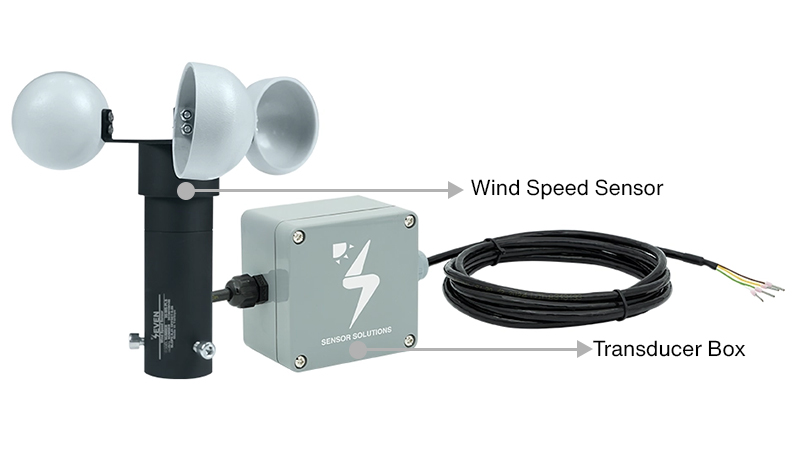
With the finest price/performance ratio, it is the best option for meeting the standard criteria of environmental and industrial applications, including photovoltaic plants. The Wind Speed Sensor with analog output is compatible with all Dataloggers, Gateways, and PLCs with 4-20 mA output.
What is the importance of Wind Speed Sensors?
The standard IEC 61724-1:2021 states that wind speed is crucial for substantiating warranty claims for wind-related damage in addition to being utilized for analyzing the module temperatures. More specifically, wind is a crucial factor for structural safety and can indirectly alter system efficiency by influencing module temperature. Wind sensors, for instance, evaluate the possibility that panels will be harmed by strong winds. Systems that support loads may sustain damage from excessive wind. We can therefore utilize the wind speed sensor as proof of excessive wind for such damages.
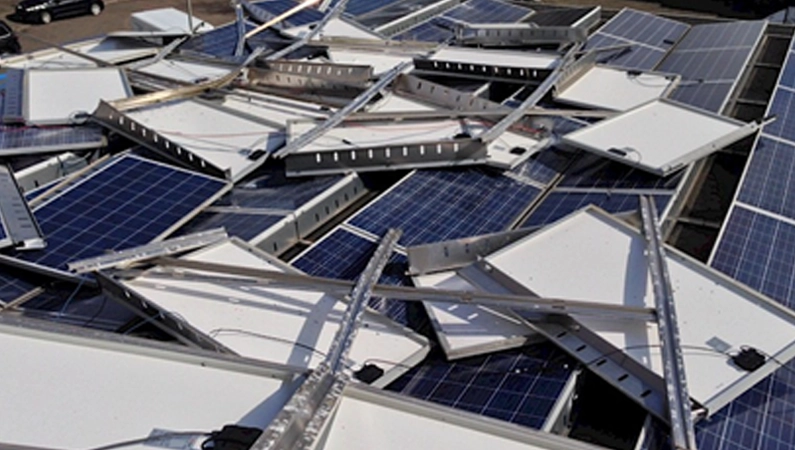
The consequences of excessive wind on solar panels
How to install the wind speed sensor?
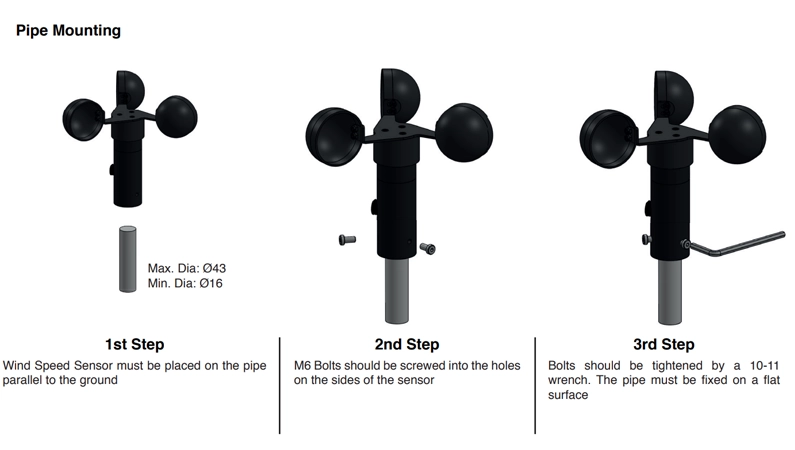
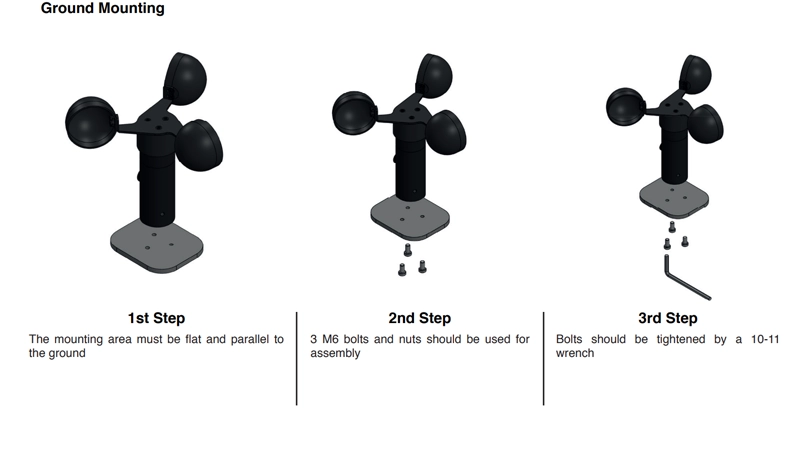
There are two different mounting methods for wind speed sensor installation: pipe and ground mounting. These mounting methods are explained in more details below.
Why Choose SEVEN Wind Sensors?
SEVEN products use reliable, high-quality components to provide accurate meteorological information in environmental and industrial applications. The main features of SEVEN Wind Speed Sensors that make them the preferred choice are as follows:
High Accuracy: Accuracy varies according to wind speed. If the sensor indicates a value below 5 m/s (e.g., 4 m/s), an error of ±0.5 m/s is considered accurate, meaning a range of 3.5–4.5 m/s is considered accurate. If the sensor indicates a value above 5 m/s (e.g., 10 m/s), the accuracy is 10%, meaning a range of 9–11 m/s is considered accurate.
Weather-Resistant Design: Made from anodized aluminium and ABS materials that can survive a range of environmental conditions, including deserts, coastal regions, and remote locations. There is an optional IP66 variant available, however the normal IP rating is IP54.
Lower Maintenance: Because there are no external moving parts and the housing is enclosed, there is less chance of wear and less maintenance needed.
Factory Calibration: Prior to delivery, every sensor is thoroughly checked and calibrated using BallastCo wind tunnel system.
Frequently Asked Questions (FAQ)
What is the measurement principle and sensor type of the 3S-WS-I-A?
It is a mechanical cup anemometer of the “Cup Star Anemometer (Reed Switch)” type. Wind rotates the cups; the rotation speed is detected by a reed switch and converted to wind speed. Aluminum Wind Speed Sensor designed to measure the wind speed in m/s with 4-20 mA output.
What is the wind speed measurement range?
It measures wind speed from 0.9 to 50 m/s.
What does 4-20 mA mean?
4 mA means minimum value (0,9 m/s), while 20 mA means maximum value (50 m/s).
What does the “threshold” value mean and what is it for Aluminum Wind Speed Sensor with 4-20 mA Output?
Threshold is the minimum wind speed at which the sensor starts detecting wind. For this model it is 0.9 m/s.
What does “survival speed” mean and what is its value?
Survival speed is the maximum wind speed the sensor can withstand structurally without damage. It is specified as 50 m/s.
What materials for wind speed sensor are supplied by SEVEN Sensor Solutions?
SEVEN supplies screws and wind speed sensor.
What is the function of the transducer box?
The transducer box contains the electronic card that converts the pulse signal to 4-20 mA Output.
What mounting methods are supported?
There are two different mounting methods for Wind Speed Sensor with 4-20 mA output installation: pipe and ground mounting.
What is the required power supply of Aluminum Wind Speed Sensor with 4-20 mA Output?
The required power supply for Aluminum Wind Speed Sensor with 4-20 mA Output is from 12 to 30 V DC. SEVEN recommends 24 V DC power supply.
What is the IP protection class, and what is the optional version?
The standard version of IP protection class for Wind Speed Sensor with 4-20 mA output is IP54. Also, IP66 protection class option is available.
Where is Aluminum Wind Speed Sensor with 4-20 mA Output installed?
According to IEC 61724-1:2021 standard, wind measurement equipment should not shade the pv system at any time of day or year and should be located at a point that is sufficiently far from obstructions. Wind speed sensor should be placed no closer than 10 times the height of any obstruction. For more details refer to the following aricle: https://www.sevensensor.com/best-practices-for-installing-sensors-in-pv-projects
What is the warranty of Aluminum Wind Speed Sensor with 4-20 mA Output?
All 3S-WS-I-A sensors come with a 2-year warranty against manufacturer defects.
What is the price of wind speed sensor with analog output?
The price of wind speed sensor with analog output is between 187 EUR and 340 EUR.
What are the delivery times of Aluminum Wind Speed Sensor with 4-20 mA Output?
The delivery time of Aluminum Wind Speed Sensor with 4-20 mA Output varies as per the order quantity as follows:
Small Orders: approx. 2-3 weeks
Bulk orders (100 pcs): approx. 7-9 weeks
How do I set up the sensor?
Follow our user manual which include step-by-step instructions. The user manual link for 3S-WS-I-A is https://www.sevensensor.com/files/d/en/3S-WS_User_Manual.pdf
Does the sensor include a cable?
Each unit comes with a 3m LIYYC11Y PUR Cable (UV and weather resistant). Other lengths are available on request.