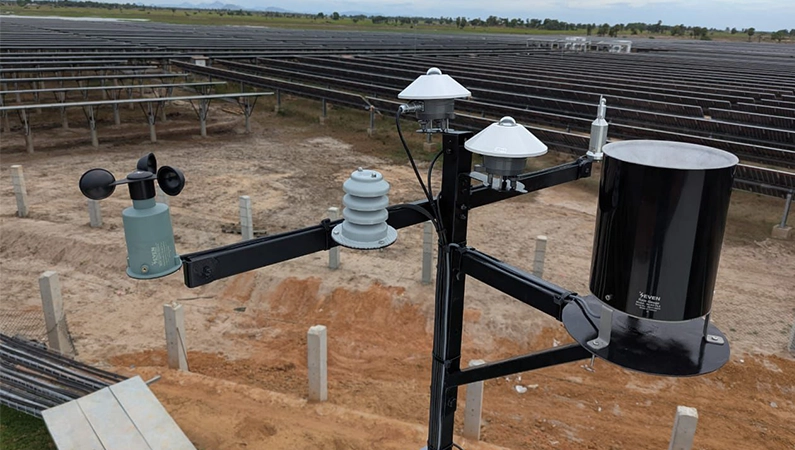
Generally, when designing a PV plant monitoring system, we need to answer two main questions: which sensors are necessary and how many sensors should be installed.
This sounds rather straightforward, yet the answer is conditioned not only by the size of the plant but also by the class of monitoring, layout of the PV power plant, type of the module used, mounting structures, and local weather conditions.
The standard for all this is IEC 61724-1:2021, which outlines guidelines for developing a PV monitoring system as well as the parameters that should be monitored. This standard was updated in 2021 and the new version includes bifacial monitoring, changed some irradiance and soiling conditions and excluded Class C.
In order to fully understand how to select sensors, it is better to go step-by-step so everything turns out clearer after asking the proper questions.
Which Class Does the Plant Require; Class A or Class B?
This question concerns the monitoring class, which is either Class A or Class B in IEC 61724-1:2021.
The selection must be done as per the needed accuracy. Class A monitoring system is more appropriate in utility-scale solar projects and contractual checks, etc.
Class B is a simpler option. It is often used when a basic monitoring system is enough.
This choice is important because it affects the full monitoring design. It does not only affect the sensor type. It also affects calibration, maintenance, and the quality of the final data.
What Is the AC Size of the PV Plant?
After the monitoring class is selected, the next question is plant size.
IEC uses Table 3 as a multiplier for several measurements listed in Table 2. This means the number of sensors increases with plant AC size.
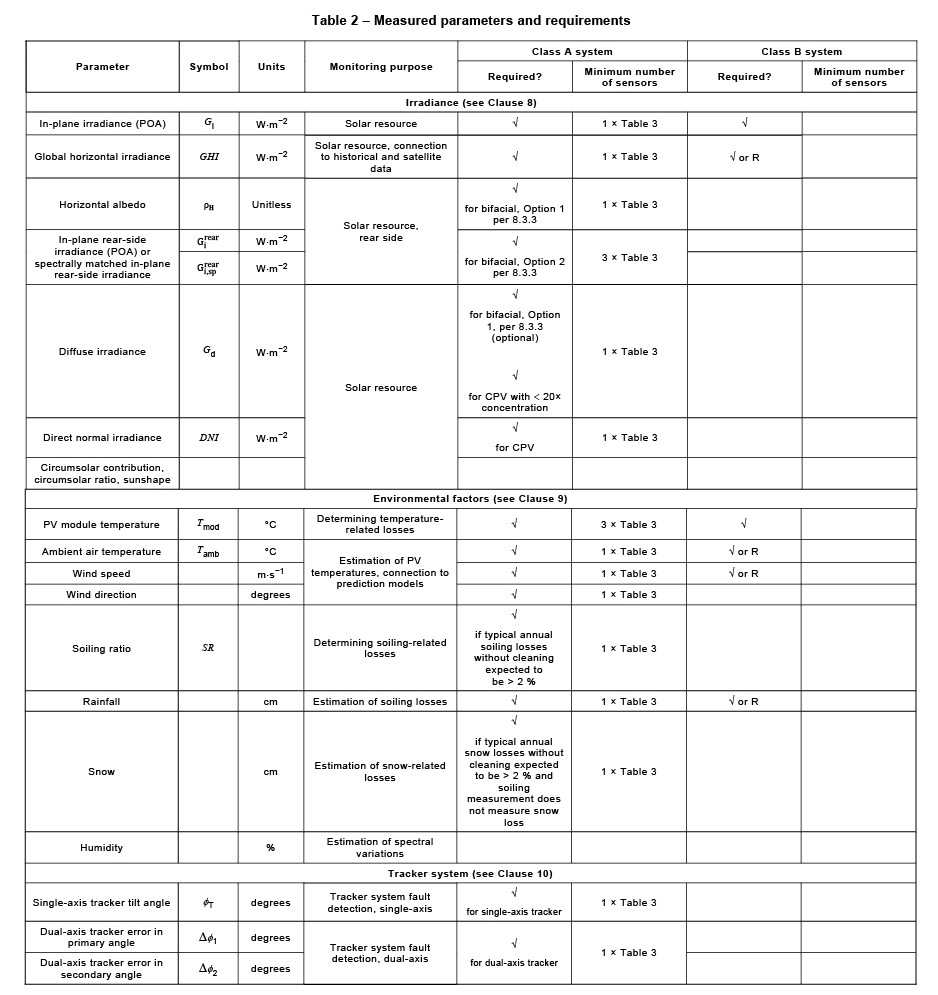
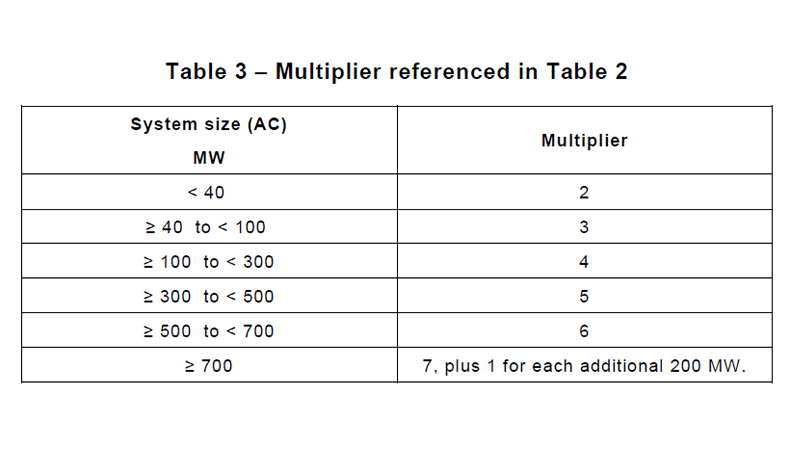
So, plant size gives the first estimate. But it should not be the only thing used to decide sensor quantity. Two plants with the same size may still need different monitoring layouts if the site conditions are different.
Is the PV Plant Uniform, or Does It Have Different Sections?
It is certainly one of the most crucial questions.
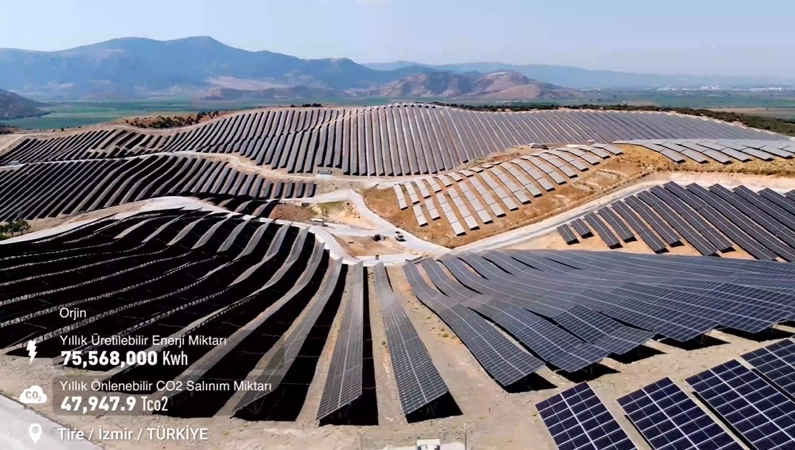
In some PV power plants, the equipment configuration will be completely homogeneous. In others, there will be various zones due to the topography of the site, the module used, inter-row distance, orientation, tracker design, or different climatic conditions.
When the plant clearly has different zones, then at least one weather station needs to be deployed per zone. Additional sensors can be deployed depending on the difference between two zones.
The monitoring network must therefore reflect the behavior of the PV power plant itself, not just its MW capacity.
What Are the Standard Sensors in a PV Power Plant?
For many PV plants, the basic monitoring package includes:
- Plane Of Array Irradiance Sensor (POA)
- Global Horizontal Irradiance Sensor (GHI)
- Module Temperature Sensor
- Ambient Temperature Sensor
- Wind Speed Sensor
- Wind Direction Sensor
- Soiling Sensor
These measurements give the main information needed to understand plant performance.
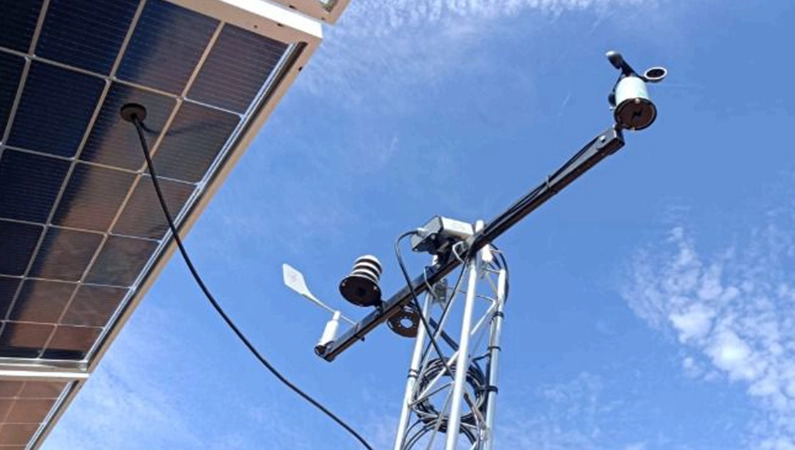
SEVEN offers these products in its portfolio, including Irradiance Sensors, Pyranometers, Module Temperature Sensor, Wind Sensors, and Soiling Sensor
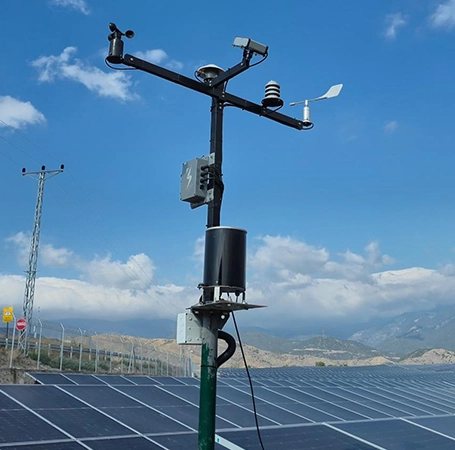
This basic package is a good starting point. But IEC 61724-1:2021 includes more than the usual core sensors. It also covers:
- horizontal albedo
- rear-side irradiance for bifacial systems
- spectrally matched rear-side irradiance
- diffuse irradiance
- direct normal irradiance (DNI)
- circumsolar contribution or sunshape for CPV cases
- rainfall
- snow
- humidity
- tracker position or tracker error
Not every plant needs all of these. But they should all be checked during design.
How Many Sensors for Measuring Module Temperatures?
Module temperature is one of the key metrics in PV power stations, as the temperature affects power generation directly.
It is not recommended to locate all the sensors at one convenient location. Instead, the sensors should be distributed throughout the station so that their measurements reflect the actual station operation.
This becomes especially important when there are multiple modules or other plant components of various types installed on the site. In such cases, designers should decide a proper coverage rather than trying to minimize the number of sensors used.
Is It Necessary to Monitor Soiling at This Location?
This is quite a practical issue.
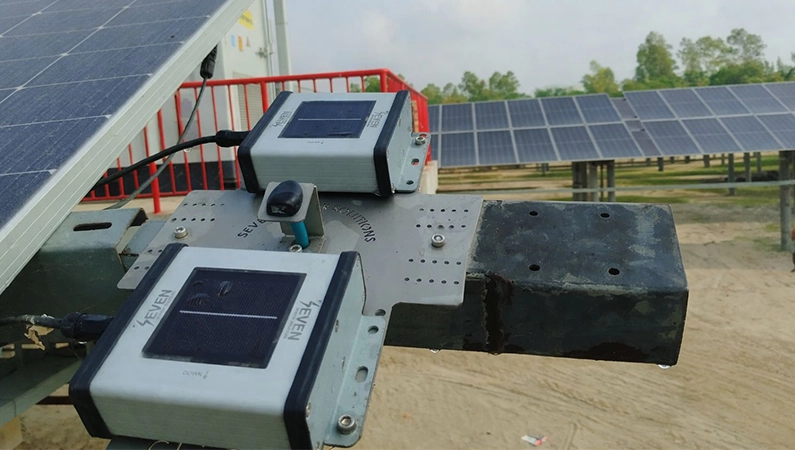
In case the location is dusty, dry, agricultural, industrial, or pollen-filled, soiling becomes an important cause of energy loss. In such conditions, monitoring soiling is highly advised.
Here it is possible to use a simple rule: in case the dirt is expected to influence production negatively, then it makes sense to have at least one point to monitor soiling. However, if soiling varies at the location, it might be necessary to have several points to measure it.
Is the Plant Bifacial?
If the answer is yes, the monitoring system should not stop at the usual front-side measurements.
IEC 61724-1:2021 clearly includes bifacial monitoring. This means bifacial plants should also consider measurements such as horizontal albedo and rear-side irradiance.
SEVEN offers an Albedometer for this purpose.
This is important because bifacial plants do not behave like normal monofacial plants. If only front-side irradiance is measured, the rear-side contribution may be missed. That makes performance analysis less reliable.
Does the Plant Need More Than POA and GHI?
Sometimes the answer is yes.
POA and GHI provide sufficient information on the irradiance side for many conventional PV installations. However, some PV installations require further details about the solar resources.
Based on the characteristics of the project and analysis requirements, the designer may also need to evaluate:
- diffuse irradiance
- direct normal irradiance (DNI)
- circumsolar contribution
- sunshape
These measurements are especially important for some advanced studies, bifacial performance work, or CPV-related applications.
So, the safe approach is to ask whether the project needs only basic irradiance monitoring or a more detailed solar breakdown.
Does the Site Need Humidity Monitoring?
Although humidity might not be one of the top considerations when designing sensors, it remains very important.
Humidity provides more details about conditions at the site, and, in some cases, helps with spectral changes monitoring.
SEVEN offers also different models of relative humidity sensors.
To summarize, although humidity might be not a must for each project, it should be considered during design.
Does the Plant Use Trackers?
If the answer is yes, the monitoring system design requires greater consideration.
The tracker plants operate differently from the fixed tilt plants, as the tracker plant moves during the day. This fact explains why additional monitoring and measurements become necessary.
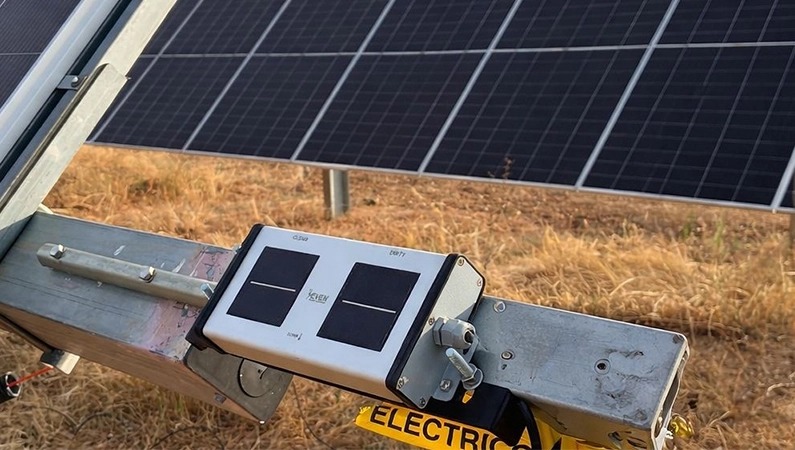
IEC 61724-1:2021 takes into account tracker-based measurements within its monitoring scheme. In such cases, tracker plants should be assessed with a number of additional questions.
Are the trackers single axis or dual axis?
This is the initial tracker question.
In case of single-axis tracker facilities, one needs to verify the true tilt angle of the trackers.
In case of dual-axis tracker facilities, tracker misalignment errors in both axes need to be checked.
This will help the operator understand if the issue is in the tracker operation, i.e., if there are some controller or mechanical problems causing reduced efficiency.
Does the facility operate in a snowy environment?
This is a vital question when installing trackers in cold locations.
Snow is not just a problem of reduced production. In addition, it affects the tracking capacity, recovery after snowfall, cleaning, and losses assessment.
When working in snowy environments, SEVEN Snow Sensor for Tracker Systems becomes a great choice. It has been created specifically for tracker facilities to provide more accurate insight into snow impact on production by comparing two references: snow-covered and heated.
This sensor is practical in the operational phase because instead of guessing whether reduced efficiency is the result of weather conditions or due to snow-covered modules, you get a clear understanding of the reason.
Does the tracking control require cloud information?
This is yet another valuable question to consider regarding trackers.
In instances where the site experiences rapid variations in weather, cloud movements will lead to fluctuations in energy generation. Here, cloud detection will provide additional insight into the situation.
In the case of trackers, the SEVEN Cloud Sensor would make an ideal recommendation too. This sensor provides the cloud ratio in Okta.
This will be especially important in large-scale tracker facilities where there is a desire for better performance evaluation or accurate predictions.
Are the tracker blocks different from each other in terms of operation?
The larger tracker-based power plants might vary depending on terrain, row spacing, wind exposure, accumulation of snow, local soiling or other characteristics.
Thus, one single measuring point cannot be a proper representative of a whole tracker field under these circumstances.
The configuration of irradiance sensors, therefore, should correspond to actual trackers in a plant.
How Many Tilt Angles Does the Power Plant Have?
This aspect is sometimes overlooked.
If the arrays all have identical tilting angles, it will be easy to select POA measurement. However, if there are several tilt angles, there might be a problem with one POA measurement representing the whole site.
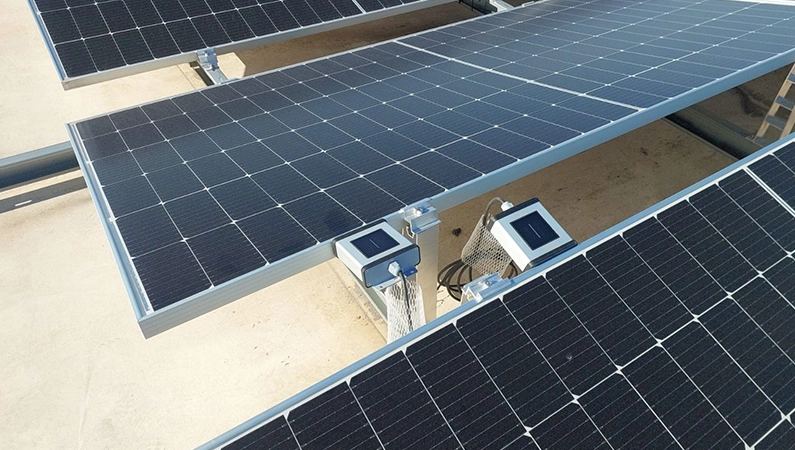
Arrays tilted at different angles cannot have the same level of irradiance in-plane irradiance, thus they cannot necessarily use the same POA sensors. This is why the number of POA Irradiance Sensors must be defined as per the number of tilt angles in the site.
How Many Possible Azimuth Orientations Exist For This Plant?
Azimuth has the same level of importance as tilt.
Not all current solar installations have a consistent orientation. For instance, east-west rooftops, carports, canopies, and phase construction of the plants in different orientations.
In the case when different azimuth orientations exist in the plant, every orientation requires its own irradiance reading. Otherwise, a single sensor might misrepresent the whole plant.
How Should the Sensor Package Be Best Defined?
The best way to define it is by answering the design questions in the right sequence.
First, select the monitoring class. Next, evaluate plant size. Lastly, verify whether the plant is indeed uniform or non-uniform due to factors such as topography, technology, tilt, azimuth, trackers, bifaciality, or soiling issues.
Subsequently, allocate the principal sensor suite at every representative site while adding any additional IEC metrics if necessary:
- albedo and rear-side irradiance for bifacial installations
- diffuse irradiance or direct normal irradiance (DNI) for detailed solar information
- soiling ratio when dirt losses become relevant
- snow detection in colder, snowy climates
- tracker angle/tracker misalignment for tracker systems
- cloud observation when rapidly changing clouds impact tracker control or prediction
This methodology is far superior to characterizing the entire monitoring system solely based on the power plant capacity (MW).
Conclusion: Choose the Right Sensors in the Right Quantity
Defining the right sensor package for a PV plant does not need to be complicated.
The most practical method is to follow a simple order. Start with monitoring class. Then check plant size. Then review site uniformity. After that, check tilt, azimuth, trackers, bifacial behavior, soiling conditions, and weather risks such as snow.
A good monitoring system should match the real behavior of the plant. The best designs are not the ones with the longest sensor list. They are the ones where every sensor has a clear purpose and every monitoring point represents the field correctly.
To understand the guide easily, check our next article treating cases step by step.
Frequently Asked Questions (FAQ)
What standards are used for PV plant monitoring sensors?
Main standard is IEC 61724-1:2021. This standard defines monitoring classes and gives information regarding required measurements for monitoring PV plant operation.
Does Class C exist in IEC 61724-1:2021?
No. The 2021 version does not contain Class C anymore. Only Classes A and B are listed now.
How many monitoring stations should a PV plant have?
Depends on AC capacity of the PV plant and requirements of IEC Table 3, but also takes into account specific parameters of the site itself.
Can the size of the plant alone help to determine the number of sensors?
Size alone is just a starting point. One must also consider other parameters such as terrain features, technology, tilt, azimuth, presence of trackers, and weather conditions.
Which sensors can be found in a monitoring station?
Basic sensors that are typically found include:
POA irradiance
GHI
module temperature
ambient temperature
wind speed
wind direction
Soiling
For different projects, other sensors could be added to the measurement, including albedo, rear side irradiance, diffuse irradiance, DNI, rainfall, snow, humidity, and tracker sensors.
How many module temperature sensors should be used?
The required number will vary according to the IEC class and the plant size. As well as quantity, position should also be considered carefully since the sensors should cover representative zones of the power plant.
When should soiling sensors be installed?
Soiling sensors are required when there is a possibility of reduced output due to dust on the modules, which is common at dusty, arid, agricultural, or industrial locations.
Do bifacial plants require additional sensors?
Yes. Typically, bifacial solar projects require additional sensors to record parameters like horizontal albedo and rear side irradiance.
Do tracker plants require additional sensors?
Yes. Usually, tracking projects require additional tests such as tracking tilt angle or tracking errors.
Does snow monitoring need to be performed in photovoltaic plants?
Yes, when the project is located in a region with heavy snowfall, as snow could have a significant effect on output and tracking system performance. For the tracker projects, the SEVEN Snow Sensor for Tracker Systems is a good suggestion since it facilitates an evaluation of snow loss.
Why do we need a cloud sensor in a tracker system?
The usage of a cloud sensor is important when there are frequent clouds moving above or rapid variations in the sky. This will give further information on production fluctuation. This is why the use of SEVEN Cloud Sensor may be beneficial in tracker installations.
Are tilt and azimuth important in sensor selection?
Yes. When multiple tilt and azimuth values exist in the plant, separate irradiance sensors should be installed for each tilt and azimuth value.