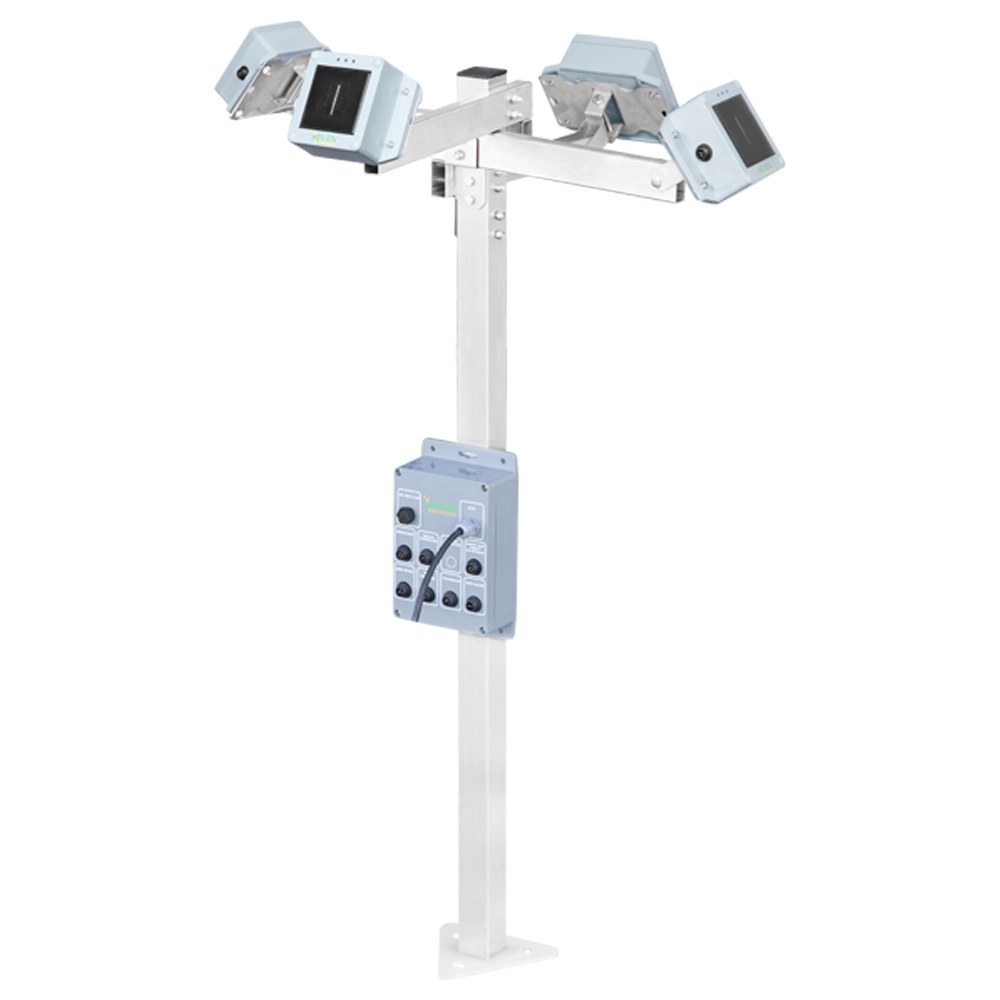
Multi-Orientation Irradiance Sensor – 3S-4IS
The 3S-4IS Multi-Orientation Irradiance Sensor is developed for PV plants with three or four different orientations. It supports accurate Performance Ratio (PR) calculations by producing a single effective irradiance value based on the number of panels installed in each direction. The panel count is set for each orientation, allowing the sensor to reflect the real distribution of the plant. Panel numbers for each orientation are entered through the 3S-4IS Configuration Tool. Using these inputs, the system calculates total effective irradiance and total effective module temperature and communicates them to the datalogger via Modbus RTU, enabling monitoring systems to calculate PR correctly for multi-orientation PV sites.
TECHNICAL SPECIFICATIONS OF MULTI ORIENTATION IRRADIANCE SENSOR
| Item Code | 3S-4IS |
| Electronic Box | |
| Connected Sensors |
Four Irradiance Sensors (3S-IS-mV)
Four Module Temperature Sensors (3S-MT-PT1000)
Ambient Temperature Sensor (3S-AT-PT1000)
Wind Speed Sensor (3S-WS-PLS)
Wind Direction Sensor (3S-WD)
|
| Data Output | RS485 up to 38400 Baud |
| Communication Protocol | Modbus RTU |
| Output Rate | 1/s |
| Operating Temperature Range | -40°C to +85°C |
| Box Metarial | ABS |
| Box Dimensions | 211 mm x 123 mm x 60 mm (LxWxH) |
| Box Weight | 450 gr |
| Box IP Rating | IP67 |
| Power Supply | 12 to 30 V DC |
| Power Consumption | 40 mA max @24 VDC |
| Electrical Connection | 3 m LIYYC11Y PUR Cable, UV and Weather Resistant |
| Galvanic Isolation | 1000 V between power supply and RS485 bus |
| Irradiance Sensors (3S-IS-mV) | |
| Reference Cell | Monocrystalline Silicon (31 mm x 31 mm) |
| Current Shunt | High precision shunt resistor directly soldered to the terminals of the cell |
| Irradiance Range | 0 – 1600 W/m² |
| Uncertainty | ≤1% (less than 2%; as per IEC61724-1 standard Class A) |
| Resolution | 0.1 W/m2 (less than 1W/m²; as per IEC61724-1 standard Class A) |
| Response Time | 1 sec. (less than 3 sec; as per IEC61724-1 standard Class A) |
| Drift | Very small drift of <0.3%/ year |
| Field of View | Larger than 160° as per IEC61724-1 standard Class A |
| Tilt-Azimuthal Angle | 0°- 0° , ≤ 1°; ° as per IEC61724-1 standard Class A |
| Data Output | mV Signal |
| Cell Temperature Sensor Type | PT1000 Class A as per EN 60751 |
| Box Dimensions | 140 mm x 110 mm x 42 mm (W x L x H) |
| Weight | 260 gr |
| IP Rating | IP54 (IP68 optional) |
| Sensor Housing Material | Aluminum |
| Standard | IEC 61724-1:2021 and IEC 60904 |
| Calibration | Each sensor is calibrated under Class AAA Sun Simulator as per IEC 60904-2 and IEC 60904-4 by using a reference cell calibrated by ISFH-Germany |
Why Do Multi-Orientation Plants Need Total Effective Irradiance?
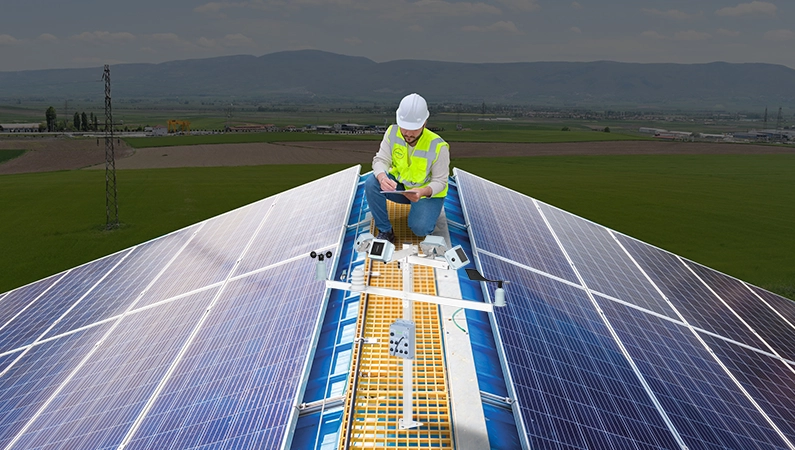
Many sites no longer point in a single direction. Common examples:
- industrial roofs with east / west / south faces
- ground plants expanded in phases with mixed azimuths or tilts
- carports and canopies with several planes
- sites with different tracker blocks or fixed-tilt islands
In these layouts, each sub-array receives different POA irradiance at different times of day. If PR is calculated using only one POA sensor, the “solar input” is mismatched to the real plant.
3S-4IS avoids this by measuring each POA plane separately and then creating one effective irradiance value that represents the whole field based on the plant’s orientation split.
How Does the 3S-4IS Work?
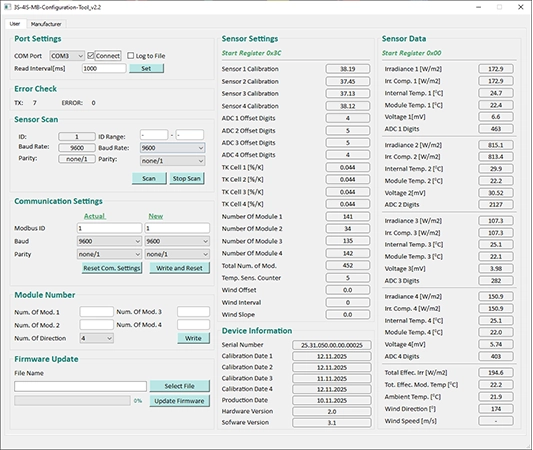
The 3S-4IS and 3S-3IS are designed for PV plants where modules face three or four different directions. Each irradiance sensor is installed in the same plane as the panels, so the system measures real plane-of-array irradiance separately for every orientation.
During commissioning, you enter the number of panels for each direction using the 3S-4IS Configuration Tool. The electronic box then combines the individual POA readings into one Total Compensated Effective Irradiance value that represents the whole plant, based on your actual layout. The same calculation is also made with the module temperature allowing you to monitor Total Effective Module Temperature.
All per-orientation measurements and the Total Effective values are sent to your datalogger through RS-485 Modbus RTU, so your monitoring system can calculate PR correctly without any manual averaging or extra scripting.
What Can the 3S-4IS Multi Orientation Irradiance Sensor Measure?
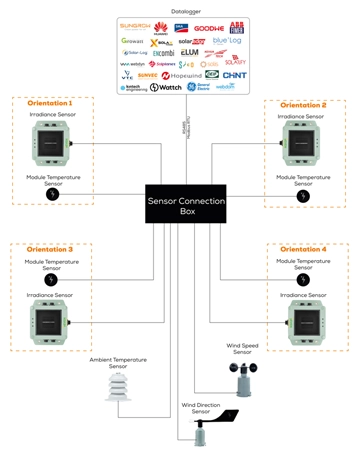
The 3S-4IS transmits both per-orientation values and plant-level effective values.
Typical measured/derived data include:
- POA irradiance and internal cell temperature for each orientation (up to 4 planes)
- Total Effective Temperature Compensated Irradiance (single plant input for PR)
- Module temperature per orientation (if module temp sensors are connected)
- Total Effective Module Temperature
- Ambient temperature
- Wind speed
- Wind direction
All values are communicated through RS-485 Modbus RTU (SunSpec compatible).
What are the Key Features of the Multi Orientation Irradiance Sensor?
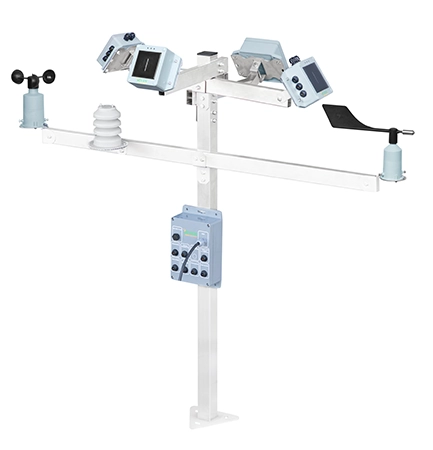
The SEVEN Multi Orientation Irradiance Sensor is designed to deliver reliable POA irradiance measurement with easy installation and seamless integration.
- PR that matches the real plant layout: Especially important for contractual performance tests and long-term benchmarking.
- Simple commissioning: Enter panel counts per direction once via the configuration tool. No external averaging scripts required.
- One communication line for all sensors: Cleaner wiring, fewer Modbus nodes, less chance of site-level integration drift.
- IEC-aligned accuracy: Designed to meet IEC 61724-1:2021 Class A requirements for PV monitoring.
- Cost effective: An alternative solution for seperating the site into independent sites for each orientation.
Frequently Asked Questions (FAQ)
What is the accuracy of the 3S-4IS Multi Orientation Irradiance Sensor?
The sensor has <1 % uncertainty, compliant with IEC 61724-1 Class A.
Is the multi orientation irradiance sensor Class A?
Yes. 3S-4IS sensor is Class A as per IEC standards.
Can I use the 3S-4IS with only three orientations?
Yes. The controller can operate with three irradiance sensors as well. You still enter the panel counts for the used orientations and the effective values are calculated accordingly. The model is 3S-3IS.
What does “Total Effective Irradiance” mean in practice?
The total Effective Irradiance is the single irradiance value your monitoring system should use for PR, created from the POA readings in each direction and the panel distribution you enter. It represents the whole field instead of a single sub-array.
How do I enter the number of panels per direction?
If you share the panel numbers with us at the order stage, we can pre-configure them at our factory before shipment. If you prefer to set or update them yourself later, you can do so using the 3S-4IS Configuration Tool. Simply connect the sensor to your laptop through a USB-to-RS485 converter, then enter the panel count for each connected orientation and save the settings.
How are the 3S-4IS sensors calibrated?
Each irradiance sensor is calibrated under a Class AAA Sun Simulator as per IEC 60904-2 and IEC 60904-4, using a reference cell calibrated by ISFH-Germany.
Can I update the orientation ratios later if the plant expands?
Yes. Re-run the configuration tool and update the panel numbers. The effective calculations will follow the new layout.
Does the multi orientation irradiance sensor work with any datalogger?
If the logger supports RS-485 Modbus RTU, integration is standard. SunSpec compatibility simplifies mapping for many PV platforms.
Can I use separate irradiance sensors to calculate performance instead of the SEVEN multi-orientation irradiance sensor?
In multi-orientation / multi-tilt PV plants, each orientation receives different POA irradiance and contributes differently to energy production. To obtain an accurate PR, if you use seperate irradiance sensors for each orientation you must treat each orientation as a separate sub-plant:
obtain seperate dataloggers and inverters for each orientation,
measure POA irradiance per orientation, and
combine results and calculate PR.
SEVEN solves this requirement in a simpler and more cost-effective way with the 3S-4IS multi-orientation irradiance sensor. It measures POA irradiance for up to four orientations and then automatically calculates a single Total Effective Temperature Compensated Irradiance using its software.
By entering the number of panels in each orientation, the 3S-4IS calculates a weighted effective irradiance, so orientations with more panels contribute more, matching the way the plant actually produces energy. With this approach, you still get accurate irradiance for each orientation and a correct “plant-level” effective irradiance, without needing separate inverters and dataloggers for each orientation.
How often should I clean or inspect the 3S-4IS?
The multi-orientation irradiance sensor does not require any maintenance or changing of spare parts. However, the solar cell surface cleaning should be done periodically according to the standard followed for site monitoring. According to IEC 61724-1:2021, the monitoring system should be inspected at least annually and preferably at more frequent intervals. For more information on installation and maintenance, you can follow the user manual.
How often is recalibration recommended for the 3S-4IS Sensor?
Recalibration every 2 years is recommended by IEC standards for maximum accuracy.
What external sensors can be connected to the 3S-4IS Sensor?
A 3S-4IS set consists of several components including:
Electronic box / controller
Mounting Structure (optional)
Up to four irradiance sensors
Up to four module temperature sensors can be connected
An ambient temperature sensor can be connected
A wind speed sensor can be connected
A wind direction sensor can be connected
Each sensor is connected to the electronic box allowing the system to have only one cable output. The measured data is then transmitted to receiver units via the Modbus RTU protocol.
Does the multi orientation irradiance sensor come with a cable?
Yes. The electronic box is supplied with a 3 m LIYYC11Y PUR cable that is UV- and weather-resistant. In addition, each irradiance sensor includes its own 1 m cable.
What is the price of the 3S-4IS Multi Orientation Irradiance Sensor?
It falls in the range of €675 to €1225.
Is the multi orientation irradiance sensor suitable for desert / high-temperature sites?
The operating range is −40°C to +85°C, with a sealed IP67 controller box, so it’s designed for harsh PV environments.
What are the delivery times for the Multi Orientation Irradiance Sensor?
Small orders typically ship in approximately 2–3 weeks, while bulk orders (100 pcs) typically ship in approximately 8–10 weeks.
How is the Multi Orientation Irradiance Sensor mounted?
The sensor can be connected directly next to the panels. SEVEN also offers a special mounting structure that allows the connection of all the sensors and have compact structure.