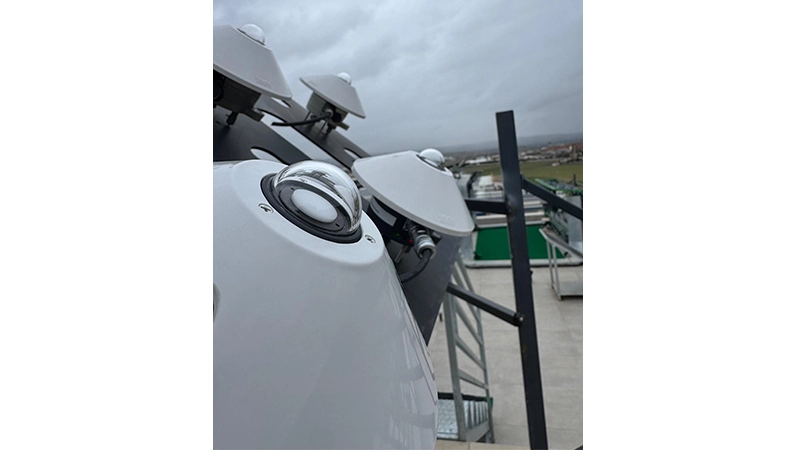
Thermopile pyranometers are supplied not only with an Irradiance Calibration Certificate that includes the sensitivity value, but also with Directional Response and Temperature Response certificates. These two response characteristics are among the key contributors to measurement uncertainty. In this article, we will examine what these certificates—provided with each pyranometer—represent and how they should be interpreted.
According to the sentence taken verbatim from ISO 9060:2021, Section 4.3.3 “Classification criteria”:
“For the classification of a pyranometer in the highest class, individual tests of temperature response and directional response are required.”
What Is a Directional Response Certificate in Pyranometers?
Directional response describes how a pyranometer’s measurement output changes when solar radiation arrives from different incidence angles. An ideal pyranometer should detect irradiance regardless of the angle of incoming radiation and should measure in full compliance with the cosine law.
In practice, however, due to sensor geometry and optical design, some pyranometers can exhibit deviations—particularly at certain zenith angles (for more information on zenith angle, see …). Measurements are taken to quantify these deviations and to calculate the cosine response error.
What Is Cosine Response Error?
The deviation from this physical rule is referred to as cosine error. Solar irradiance incident on a surface follows this principle:
Measured Irradiance (W/m²) = True Irradiance (W/m²) × cos(θ)
Here, θ is the angle of incidence of the beam on the sensor, i.e., the zenith angle.
A directional response plot shows the percentage variation of this deviation at different angles.
How Is Directional Response Measured?
According to the Calibration Procedure section in the Directional Response Certificate of the SEVEN Sensor Solution 3S-TP-MB-A Class A Thermopile Pyranometer, the calibration is performed as follows:
“The directional response of the pyranometer is defined in accordance with ISO 9060:2018, based on the compliance of the output signal with the cosine law as a function of the angle of incidence. The SEVEN pyranometer was subjected to a directional response test dependent on zenith and azimuth angles. During the test, the pyranometer was mounted horizontally on an automated goniometer platform, and measurements were taken at various zenith angles (20°, 40°, 60°, 70°, 80°) under a constant irradiance level (1000 W/m², AM1.5, AAA-class solar simulator). In particular, for the 40° and 70° zenith angles, pyranometer signals were recorded for the azimuth directions (South, West, North, East), and these data were obtained based on measurement results taken within specific temperature ranges (40°C and 70°C) for each direction. In addition, verification was performed according to the cosine error formula. The measurement results were evaluated based on whether they fall within the ±10 W/m² tolerance limits.”
What Is the Relationship Between Directional Response and Standards?
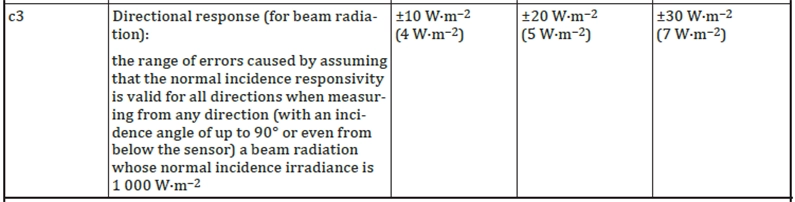
Pyranometer performance classification is carried out in accordance with the ISO 9060 standard.
According to ISO 9060, Table 1 — Pyranometer classification list:
What Is Temperature Response?
Temperature response is a performance parameter that shows how a pyranometer’s sensitivity changes with ambient temperature.
In thermopile-based pyranometers, the sensor output voltage can vary with temperature, or electronic components may be subject to temperature drift. This can introduce a systematic error in the measured irradiance (W/m²).
How Is Temperature Response Measured?
According to the Calibration Procedure section in the Temperature Response Certificate of the SEVEN Sensor Solution 3S-TP-MB-A Class A Thermopile Pyranometer, the calibration is performed as follows:
“The temperature response of the pyranometer is defined by ISO 9060:2018 as the percentage deviation relative to the signal at +20°C, depending on changes in ambient temperature within the -10°C to +40°C range. The SEVEN pyranometer, however, was subjected to a temperature response test from -20°C to +50°C. During the test, the pyranometer was positioned horizontally. While the ambient temperature was varied, the irradiance level was kept constant. The measurement results were obtained by testing the pyranometer in 10°C increments over the temperature range from 50°C down to -20°C.”
Temperature Response and Its Relationship to Standards
Pyranometer performance classification is carried out in accordance with the ISO 9060 standard.
According to ISO 9060, Table 1 — Pyranometer classification list:

What Is the Impact of Directional and Temperature Response Errors on Total Measurement Uncertainty?
The ISO 9901:2021 standard addresses measurement uncertainties more comprehensively when defining performance criteria for pyranometers. It requires the analysis of total measurement uncertainty sources by considering many factors, such as the instrument’s directional response, temperature response, non-linearity, and data logger errors. Figure 4 presents an example of an uncertainty analysis performed according to these criteria.
In the example shown in Figure 4, the pyranometer measures GHI (Global Horizontal Irradiance) around midday on a clear, sunny day, with an irradiance level of approximately 1,000 W/m². The distribution of the total uncertainty from different sources is expressed on the left in W/m² and on the right as a percentage of the irradiance.
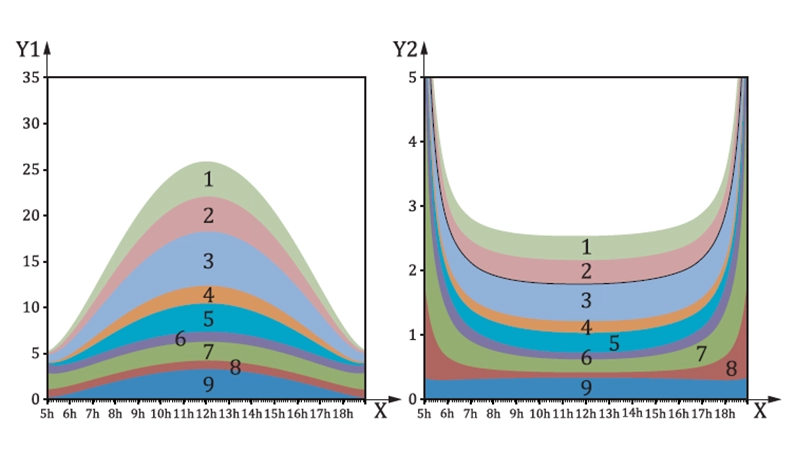
Figure 4 – Example uncertainty assessment of a measurement performed with a spectrally flat Class A pyranometer
“Figure 4” is included in the ISO 9901:2021 standard and has been used directly without any modification.
X: time (hour)
Y1: U95 per uncertainty source, W/m²
Y2: U95 per uncertainty source, expressed as %
1; Maintenance
2; Temperature Response
3; Directional Response
4; Non-linearity
5; Instability
6; Zero offset B
7; Zero offset A
8; Data logger accuracy
9; Calibration uncertainty
Based on this graph, Directional Response and Temperature Response measurements are extremely important for thermopile pyranometers. Directional Response and Temperature Response certificates should be generated for every pyranometer sold and shared with the customer. At SEVEN Sensor, we perform these measurements for our SEVEN 3S-TP-MB-A pyranometer in our laboratories equipped with state-of-the-art technologies.
For more technical information, you can contact SEVEN Sensor Solutions.
Frequently Asked Questions (FAQ)
Are directional response and cosine error the same thing?
No. Cosine error is a component of directional response. Directional response refers to the instrument’s overall angular performance, while cosine error quantifies the deviation from the cosine law.
Should Temperature Response and Directional Response tests be performed for every pyranometer?
Yes. These measurements should be carried out individually for all manufactured thermopile pyranometers. All sensors are affected by temperature and angle of incidence, and the results of these tests are used to determine the quality class.
What is sensitivity in pyranometers?
Sensitivity is typically expressed in microvolts per watt per square meter, i.e., µV/(W/m²). It is related to the calibration factor, which is used to interpret the measured sensor output as total solar irradiance.