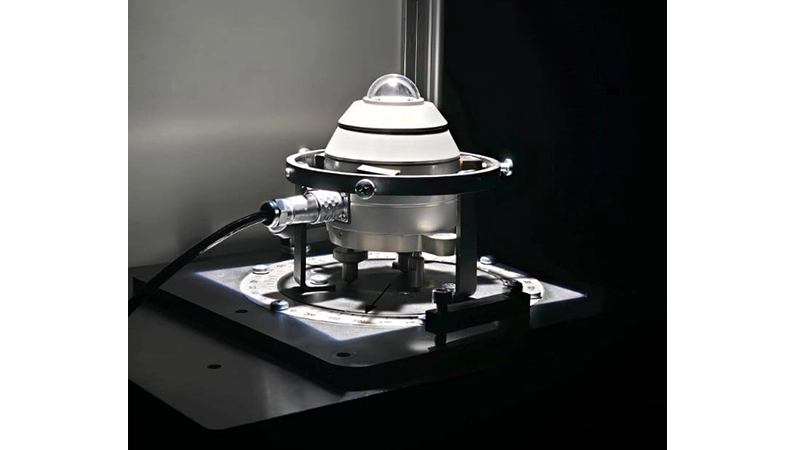
One of the most commonly encountered parameters in technical documentation for pyranometers is the sensitivity value. This is generally referred to as the calibration coefficient. This value indicates how much electrical signal the pyranometer generates in response to solar irradiance. In Thermopile Pyranometers, sensitivity is typically expressed in µV/(W/m²).
To correctly convert pyranometer data to W/m², it is essential to understand the sensitivity (calibration factor). This is because the low-level voltage signal from the pyranometer is converted into a solar irradiance value using this coefficient. In this article, we will explain what the sensitivity value is.
What Is Sensitivity?
Sensitivity tells us how much voltage a pyranometer produces for each 1 W/m² of solar irradiance. If a thermopile pyranometer has a sensitivity of 10 µV/(W/m²), it will generate about 10 µV for each 1 W/m² of incoming irradiance:
- For every 1 W/m² of solar irradiance incident on the pyranometer’s surface, the sensor produces an output signal of about 10 microvolts.
- Therefore, if there is 1000 W/m² of irradiance in the field, the sensor output would be 1000 × 10 µV = 10,000 µV, or 10 mV. This is equal to 10 mV.
Generally, Thermopile Pyranometers generate very small voltage signals.
How Is the Pyranometer Output Signal Converted to W/m²?
The calculation is simple when the sensor’s sensitivity is known:
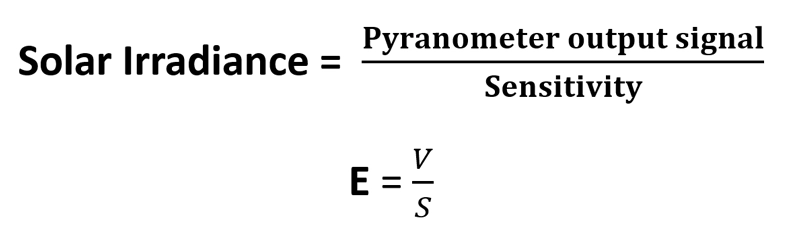
Where:
- E: Solar irradiance, W/m²
- V: Pyranometer output signal, µV
- S: Sensitivity value, µV/(W/m²)
Sample calculation:
- Sensitivity: 10 µV/(W/m²)
- Measured output signal: 8,500 µV
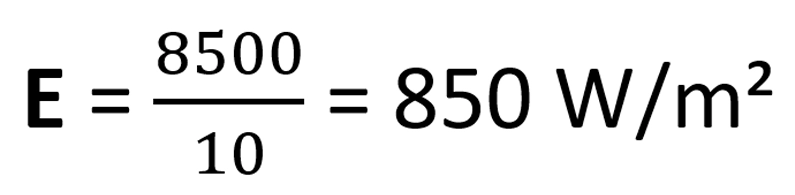
Thus, the solar irradiance incident on the pyranometer surface is calculated to be approximately 850 W/m².
Is a Pyranometer Better If It Has a High Sensitivity Value?
This is a very common misconception.
“A higher sensitivity value does not necessarily mean the pyranometer is better.”
Sensitivity only tells us how much voltage the sensor produces for a given level of irradiance. A higher sensitivity can give a stronger signal, but it does not guarantee better accuracy.
The true measurement quality of a pyranometer should be evaluated based on the following parameters:
- ISO9060 class
- Response time
- Directional response
- Temperature response
- Zero offset
- Non-linearity
- Non-stability
- Spectral response
- Tilt error
- Calibration uncertainty
Therefore, the sensitivity value is an important parameter for pyranometer selection. However, it should not be interpreted as the sole indicator of accuracy.
What is Difference Between Sensitivity and Accuracy?
In pyranometer datasheets, sensitivity and accuracy are often confused.
- Sensitivity is the amount of voltage the sensor produces in response to incident irradiance.
- Accuracy indicates how close the measured value is to the true value.
For example, let’s consider two different pyranometers. Their sensitivities are:
- Pyranometer A: 7 µV/(W/m²)
- Pyranometer B: 15 µV/(W/m²)
In this case, we cannot say that Pyranometer B produces a higher output signal. This is because Pyranometer B is calibrated based on its sensitivity value and the irradiance value. So the only thing we can conclude from this is that Pyranometer B provides a higher electrical output. Therefore, the correct assessment should be made as follows:
- Sensitivity is the signal conversion factor; accuracy is the measurement quality.
Therefore, by looking at sensitivity values alone, it is impossible to determine which pyranometer has better measurement quality.
How Do You Read the Sensitivity on a Calibration Certificate?
The “Sensitivity” value on a pyranometer’s calibration certificate is typically provided in the following formats:
- Sensitivity: 10.25 µV/(W/m²)
- Sensitivity: 10.25 µV per W/m²
- Sensitivity: 10.25 µV/(W.m-²)
- Calibration factor: 10.25 µV/(W/m²)

SEVEN 3S-TP-MB-A Thermopile Pyranometer Calibration Certificate: Sensitivity and Uncertainty Values
Why Is Sensitivity Important When Selecting a Data Logger?
If thermopile pyranometers with analog outputs are used, the selection of a data logger is very important because the output signal is in the microvolt and millivolt range.
For example, in a pyranometer with a sensitivity of 10 µV/(W/m²), a change of just 1 W/m² corresponds to a signal change of approximately 10 µV.
Therefore, a data logger used with mV-output pyranometers must:
- Be capable of reading signals at the microvolt level
- Have sufficient resolution
- Offer low-noise analog inputs
- Have low thermal drift
- Have appropriate input impedance
- Not cause signal loss when using long cables
Does Sensitivity Change Over Time?
Yes. The sensitivity value of a pyranometer can change over time. The following factors may cause this change:
- UV exposure
- Aging of the sensor surface
- Long-term drift in the thermopile structure
- Changes in electronic components
- Decrease in dome transmittance
- Contamination and environmental effects
- Mechanical impact or field conditions
For this reason, pyranometers must be calibrated regularly. After calibration, a new sensitivity coefficient is assigned to the pyranometer. This coefficient must be entered into the measurement system. The recalibration interval for the SEVEN 3S-TP-MB-A Class A Pyranometer is 5 years. One of the key advantages of the SEVEN Pyranometer is that the customer can enter the sensitivity value determined after recalibration into the device themselves using the configuration tool. This is not possible with pyranometers from other brands, and the pyranometer must be sent to the manufacturer. However, this results in both a time loss and additional costs.
The Relationship Between Sensitivity and Calibration
One of the primary objectives of pyranometer calibration is to determine the sensor’s current sensitivity value.
During calibration, the pyranometer under test is compared to a traceable reference pyranometer or a controlled irradiance source. This comparison determines how much output signal the sensor produces at specific irradiance levels.
SEVEN pyranometer calibration can be performed at irradiance values below 1000 W/m² using a system designed in accordance with the ISO 9847 standard and an AAA-class Sun Simulator. The data from the reference pyranometer and the operational pyranometer are evaluated comparatively. As a result of this process, a new calibration coefficient is obtained for use in the pyranometer’s measurement system.
Differences in Sensitivity Between Analog and Digital Pyranometers
In analog thermopile pyranometers, the sensitivity value is typically expressed directly in µV/(W/m²). The sensor generates a raw voltage signal, which is read by a data logger.
In digital pyranometers, however, this conversion is often performed internally within the device. The sensor may output the value directly in W/m². However, digital models also utilize a calibration factor within the device.
Therefore, even if the user does not always see the µV/(W/m²) value manually on a digital pyranometer, the measurement is still based on the calibration factor.
Result
In pyranometers, the sensitivity value is the fundamental calibration coefficient that represents the electrical signal generated by the sensor in response to solar irradiance. It is typically expressed in µV/(W/m²) and enables the conversion of the raw voltage signal from the pyranometer into solar irradiance in W/m².
However, the sensitivity value alone does not indicate the pyranometer’s accuracy. For accurate measurements, parameters such as ISO class, directional response, spectral response, temperature response, zero offset, data logger accuracy, and calibration uncertainty must also be evaluated together.
In PV power plants, test laboratories, and meteorological measurement systems, obtaining accurate irradiance data requires the sensitivity coefficient to be correctly read, accurately calculated, and kept up-to-date through regular calibration.
SEVEN Thermopile Pyranometer offers a robust technical solution for applications aimed at precise solar irradiance measurement and reliable data tracking. A pyranometer system configured with the correct sensitivity value enables more accurate and traceable results in PV performance analyses. Please contact us for further technical information.
Frequently Asked Questions
What is the sensitivity value of a pyranometer?
Sensitivity is the output signal in microvolts produced by the pyranometer in response to 1 W/m² of solar irradiance.
What does µV/(W/m²) mean?
It is the unit indicating how many microvolts of output are produced per 1 W/m² of irradiance. In other words, it is the sensitivity value.
How is the pyranometer output converted to W/m²?
The pyranometer output voltage is divided by the sensitivity value provided in the calibration certificate.
Is a pyranometer with a higher sensitivity value more accurate?
No, that’s a misconception. A high sensitivity value may indicate a higher signal, but accuracy depends on factors such as calibration, ISO class, directional response, and measurement uncertainty.
Does the sensitivity value change over time?
It can change due to UV exposure, aging, contamination, and environmental effects. Therefore, regular calibration is necessary.