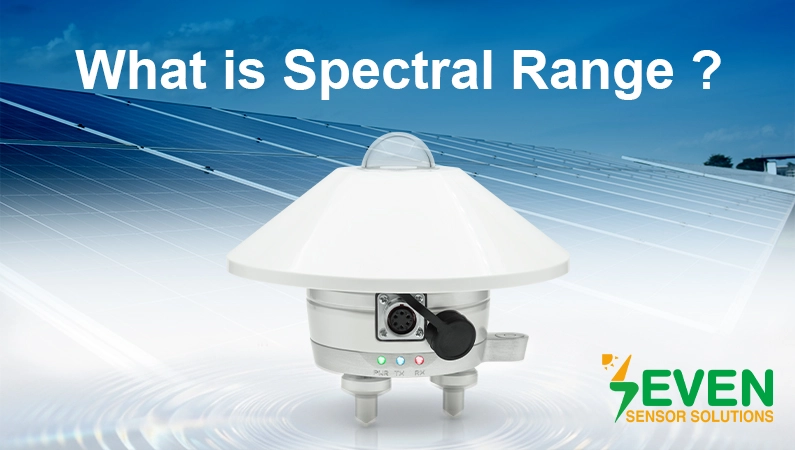
Thermopile pyranometers are among the most widely used sensors for measuring solar irradiance. The fact that pyranometers typically operate over the 280–3000 nm (nanometer) wavelength range is directly related to the spectral characteristics of solar radiation. Our SEVEN 3S-TP-MB-A thermopile pyranometer also performs measurements within the 280–3000 nm range.
Some thermopile pyranometer users may assume that these instruments measure the entire spectrum, or that they can separately quantify UV (ultraviolet) and IR (infrared) irradiance. In this article, we examine the spectral responsivity of pyranometers and assess how suitable they are for UV/IR irradiance measurements.
What Is the Spectral Distribution of Sunlight?
The Sun behaves approximately like a blackbody radiator, and the majority of the energy it emits is concentrated within the following wavelength bands:
- Ultraviolet (UV-A and UV-B): 280–400 nm
- Visible light (VIS): 400–700 nm
- Near-Infrared (NIR): 700–2500–3000 nm
In other words, more than 95% of the solar energy lies within the 280–3000 nm range.
What Does a Pyranometer Measure?
Pyranometers are designed to measure the total shortwave solar irradiance received from the Sun. This includes:
- Direct (beam) irradiance
- Diffuse irradiance
- Reflected irradiance
These components are generally contained within the 280–3000 nm wavelength range. A pyranometer therefore responds to radiation in both the UV and IR regions within this band. For a more detailed explanation of what these Irradiance components are, you can refer to our previously published article.
So Why Are There Separate UV and IR Measurement Instruments?
Pyranometers measure the spectrum as a single combined signal. They do not provide information on how much each wavelength band contributes to the total irradiance. If UV or IR needs to be monitored independently, dedicated UV sensors or IR radiometers with spectrally selective filters and band-specific responsivity are used for those regions.
Why Aren’t Wavelengths Shorter than 280 nm or Longer than 3000 nm Included?
From a meteorological perspective, the spectrally relevant range is between 280 nm and 3000 nm, which is classified as shortwave radiation. Approximately 96% of the extraterrestrial solar radiation lies within this spectral interval. The peak irradiance intensity in the solar spectrum occurs around 500 nm, near the blue end of the visible spectrum.
< 280 nm (UVC and beyond): These wavelengths are largely filtered by the atmosphere—especially by the ozone layer—and therefore do not reach the Earth’s surface.
> 3000 nm (mid- and far-IR): These wavelengths fall into the longwave infrared category and are dominated not by solar input but by terrestrial thermal radiation (e.g., emission from building surfaces and soil). This is typically measured using instruments such as thermal radiometers, rather than pyranometers.
Which Sensors Are Used for UV or IR Measurements?
Recommended instruments depending on the measurement requirement:
- UV only (290–400 nm): Use UV-B / UV-A sensors.
- Visible vs. NIR separation: Use a spectroradiometer.
- IR (2500–50,000+ nm) measurement: Use a thermal radiometer.
- UV + Visible + IR (280–3000 nm) combined measurement: Use a spectrally flat thermopile pyranometer.
What Does Spectrally Flat Mean in Thermopile Pyranometers?
According to the ISO 9060:2021 standard, pyranometers classified as “spectrally flat” respond proportionally and accurately to incoming radiation across the 280–3000 nm wavelength range. For more detailed information on spectrally flat, you can refer to our related article.
In spectrally flat thermopile pyranometers, the UV and IR components are represented fairly in the measurement. However, pyranometers measure only the total irradiance and do not separate the signal into individual spectral bands.
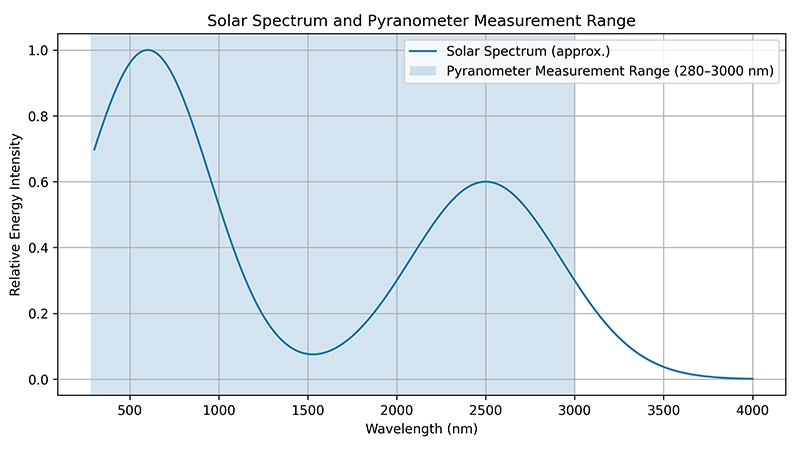
The graph above illustrates the approximate distribution of solar irradiance as a function of wavelength and the 280–3000 nm measurement range of pyranometers (shown in blue).
- The orange curve represents the spectral irradiance of sunlight.
- The blue shaded area indicates the wavelength range detectable by the pyranometer. The region where solar energy is most intense falls within this blue band.
In conclusion, the SEVEN 3S-TP-MB-A Thermopile Pyranometer is highly effective at measuring total shortwave solar irradiance, including both UV and IR contributions. SEVEN pyranometers are designed to operate over the 280–3000 nm wavelength range. This range:
- Covers the vast majority of the Sun’s total shortwave radiation,
- Represents the portion of radiation that can pass through the atmosphere and reach the Earth’s surface,
- Is the most meaningful spectral band for applications such as energy efficiency, climate data collection, and solar PV performance monitoring.
At Seven Sensor, we provide reliable shortwave irradiance measurements by ensuring spectrally flat with our ISO 9060 Class A thermopile pyranometers. Let’s select the right sensor solution for your needs together. You can contact us for our thermopile pyranometers and all of our meteorological sensors.
Frequently Asked Questions
Why do pyranometers have similar spectral ranges?
Because pyranometers are designed to measure total shortwave solar irradiance. For this reason, their spectral response is typically specified around the 280–3000 nm wavelength range.
What does “spectral range” mean?
It refers to the specific portion of the electromagnetic spectrum to which an imaging system or sensor is sensitive. This range defines which types of electromagnetic waves the system can detect and use for measurement or imaging purposes.
What is the spectral range of a pyranometer?
SEVEN pyranometers are designed to measure within the 280–3000 nm wavelength range.