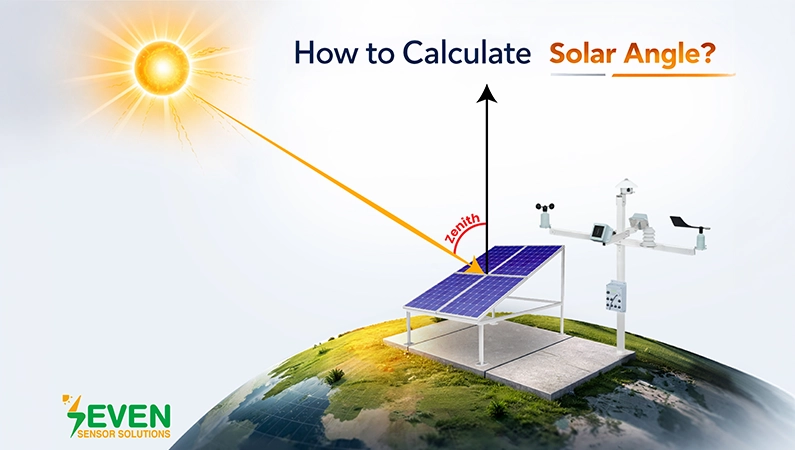
In solar energy systems, efficiency depends not only on panel quality but also on how accurately the sun’s position throughout the day is calculated. Especially in solar power plants (SPPs), calculating the sun’s angle is crucial for the correct placement of panels and the proper functioning of solar tracking systems.
This article discusses what the sun’s angle is, how it is calculated, and why it is considered important in solar energy applications.
What is Sun Angle?
Sun angle refers to the position of the sun in the sky at a given moment. Because the Earth rotates on its axis and also moves around the sun, this position constantly changes throughout the day and year. Therefore, the following information is taken into account when calculating sun angle:
- date
- time
- geographical location (latitude and longitude)
- Earth’s axial tilt
Using this data, the position of the sun in the sky, i.e., its angular position, is determined.
What is Zenith Angle?
The zenith angle is the angle between the sun and the point directly above the observation point. In other words, it shows how far the sun is from its zenith.
- If the sun is directly overhead, the zenith angle is 0°.
- When the sun is near the horizon, the zenith angle reaches 90°.
This angle is particularly used in solar radiation calculations. The zenith angle is calculated using variables such as latitude, solar declination, and hour angle. The calculation shows how high the sun is in the sky.
What is Azimuth Angle?
The azimuth angle shows the direction of the sun in the horizontal plane. It is usually measured using north as a reference:
- North: 0°
- East: 90°
- South: 180°
- West: 270°
In solar energy systems, this angle is important for determining which direction the panels should face. In Turkey, fixed solar panels are mostly oriented towards the south.
What is Solar Altitude Angle?
The solar elevation angle indicates how far above the horizon the sun is. There is a direct relationship between this angle and the zenith angle. The sum of elevation and zenith angle is 90°. As the solar elevation angle increases, the amount of radiation reaching the panel surface generally increases as well. Therefore, it is one of the important parameters in terms of energy production.
What Is the Tilt Angle?
The tilt angle indicates the angle at which the panel surface is positioned relative to the ground in solar power plant sites. This angle is one of the key factors determining how efficiently the panels capture sunlight throughout the day and year. When determining the tilt angle, various technical parameters such; as geographic location, terrain, system type, row layout, and climatic conditions are evaluated together.
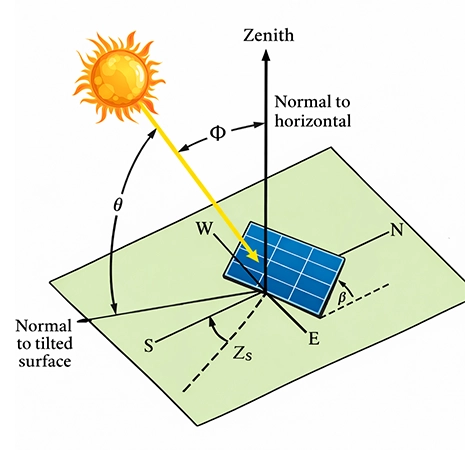
| Tilt angle | β |
| Surface azimuth angle | Zs |
| Solar zenith angle | ϕ |
| Solar altitute angle | θ |
How to Calculate Sun Angle?
One practical way to calculate the sun angle is to use online calculation tools. Tools like Sun Angle Calculator usually ask the user for the following information:
- Latitude
- Longitude
- Date
- Time
- Time zone
When this information is entered, the system automatically calculates the position of the sun at that specific moment. The results screen usually displays the sun’s elevation angle, azimuth angle, and in some tools, the zenith angle as well.
These kinds of tools are especially useful for planning the placement of solar panels. They are also widely used in architectural design, shading analysis, energy efficiency studies, and academic research. By selecting different dates and times, it becomes easy to observe the sun’s movement throughout the day, making it simpler to determine the most suitable angle and time range.
Why is Calculating the Sun Angle Important?
Accurate calculation of the sun angle directly affects efficiency in many applications.
1. Solar Panel Placement
More sunlight can be received when panels are placed at the correct angle. In systems installed at the wrong angle, significant efficiency losses can be observed. However, in some areas there may be restrictions on the panel angle due to topographical reasons. In such cases installation should be performed at angles as close as possible to the calculated angle provided that site conditions permit.
2. Solar Tracker Systems
Solar tracking systems increase production by enabling panels to track the sun throughout the day. For these systems to function correctly, the instantaneous position of the sun must be known. At this point, zenith and azimuth angles are among the basic data.
3. Solar Radiation Measurement
When interpreting data measured with equipment such as thermopile pyranometers and Irradiance sensors, sun angle information is also taken into account. In this way:
- The solar power plant performance ratio (PR) can be calculated
- Production predictions can be made
- System performance can be analyzed more accurately
What are Solar Position Algorithms (SPA)?
In modern solar energy applications, solar angle calculations are mostly done using Solar Position Algorithms (SPA). This algorithm calculates the position of the sun with high accuracy using data such as:
- Latitude
- Longitude
- Date
- Time
- Atmospheric Conditions
These algorithms provide significant advantages in terms of design and performance analysis, especially in large-scale systems.
The Role of Meteorological Sensors in Solar Power Systems
The solar angle can be calculated theoretically; however, meteorological data from the field is also of great importance when performing actual production analysis.
The following sensors stand out in this regard:
- 3S-TP-MB-A Thermopile Pyranometer
- 3S-IS Irradiance Sensor
- 3S-CS-MB Cloud Sensor
- 3S-AT/MT-PT1000 temperature sensors
- 3S-WS/WD Wind Sensors
Thanks to the data obtained from these SEVEN sensors, theoretical calculations can be compared with real field conditions, and system performance can be evaluated more accurately.
Calculations of solar angle are fundamental to the correct design and efficient operation of solar energy systems. Values such as zenith angle, azimuth angle, and solar altitude angle allow us to determine the sun’s position in the sky. This information is used in many areas, from panel placement to solar tracking systems, from radiation analysis to performance measurement. Especially in large-scale solar power projects, when correct calculation methods and meteorological sensor data are evaluated together, system performance can be optimized and energy production increased.
For more information about meteorological sensors used in solar power systems, you can contact SEVEN Sensor Solution.
Frequently Asked Questions (FAQ)
What is the difference between zenith angle and azimuth angle?
The zenith angle refers to the angle between the sun and the point directly overhead in the sky. The azimuth angle, on the other hand, indicates the sun’s position along the horizontal plane.
Why is solar angle important?
Because it ensures that solar panels are positioned in the correct direction and at the correct angle. This directly affects energy production.
How is solar angle calculated?
The solar angle is calculated using data such as the date, time, latitude, and longitude. Additional astronomical parameters, such as the solar declination angle, are also taken into account in the calculations.
In which fields is solar declination angle calculation used?
Sun declination angle calculation is widely used in solar power plants, solar tracking systems, building design, shading analysis, and meteorological measurement applications.