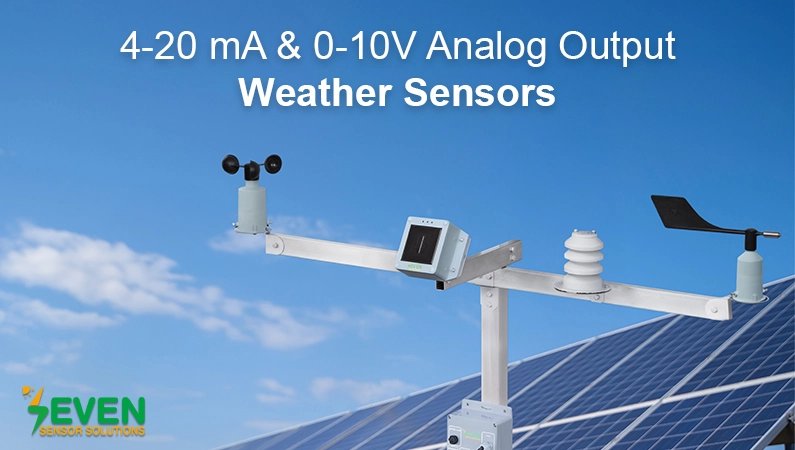
Reliable data transmission is of vital importance in industrial automation systems. At this point, SEVEN Sensor offers its users analog sensor solutions with both 4-20 mA and 0-10V analog output options in addition to Modbus RTU RS485 communication, providing flexible alternatives suitable for various applications. As SEVEN, the temperature, humidity, wind, and various environmental sensors in our extensive product range are available with either analog or digital output types, depending on your application requirements.
What is a 4-20 mA Analog Output?
4-20 mA is a current-based analog output. The signal range starts at 4 mA and goes up to 20 mA. “4 mA” means live zero and indicates that the system is working; 0 mA indicates a broken cable or malfunction. It is preferred in industrial applications because it minimizes signal loss in long-distance and noisy environments.
Advantages:
- Reliability in long-distance transmission
- Resistance to noise and interference
- Easy fault detection
SEVEN Sensor products supporting 4-20 mA:
- 3S-IS-T-I Irradiance Sensors
- 3S-MT-PT1000-I Temperature Sensor
- 3S-RH-I Relative Humidty Sensor
- 3S-WS-I Wind Speed and 3S-WD-I Wind Direction Sensors
What is 0-10V Analog Output?
0-10V output is a voltage-based analog signal. It transmits values ranging from 0V to 10V. It is generally preferred in short-range and simple systems. It is widely used in areas such as building automation and HVAC systems.
Advantages:
- Easy integration in simple systems
- Low hardware cost
- Suitable for panel-mounted applications
SEVEN Sensor products supporting 0-10V:
When to Use Which Sensor Output Type?
- Choose 4-20 mA: For long cable lengths, industrial field environments, and when high accuracy and reliability are required.
- Choose 0-10V: For short transmission distances, cost sensitivity, and environments with low risk of interference.
Why are analog output meteorological sensors used in PV systems?
In practice, the situation is often as follows:
In new-generation PV systems, Modbus RTU/RS-485 output sensors are more commonly preferred for meteorological sensors (irradiation, panel temperature, wind, ambient temperature).
The reason for this is:
- Multiple sensors can be connected to a single cable line (RS-485 bus),
- Digital transmission ensures no interference or signal loss over long distances,
- A single sensor can provide significantly more parameters (e.g., not just irradiance, but also temperature, humidity, voltage, fault status, etc., all in one).
Analog sensors are typically used in the following situations:
- If the number of RS-485 ports on the logger/SCADA device is insufficient or the ports are used by other devices (inverters, string monitoring devices, etc.), the remaining inputs are analog, so an analog sensor is selected.
- If the existing infrastructure is designed for analog measurement (e.g., older-style data loggers, analog inputs on inverters).
- If the measurement is critical and requires a quick response (e.g., real-time cooling fan control).
- The field maintenance team is not experienced in resolving digital communication issues.
Modbus sensors are now the primary choice in PV systems, but analog sensors are still used due to port constraints, compatibility, or field conditions. They serve as a sort of “fallback” option.
Why SEVEN Sensor?
SEVEN Sensor Solution offers field-tested, reliable sensor technologies with both 4-20 mA and 0-10V output options. Our products are used in a wide range of applications, from power plants to HVAC systems, agriculture to building automation. Our analog output sensors deliver the right data for your application in the right format.
For detailed product information: https://www.sevensensor.com/products
FAQ – Frequently Asked Questions
Why doesn't the 4-20 mA signal start at 0?
There is an important reason why the 4-20 mA signal starts at 4 mA:
With the “live zero” principle, a 0 mA signal can be interpreted as a system error (disconnection, malfunction). This provides a significant advantage in terms of fault detection.
Why are 4-20 mA signals preferred over 0-10 V signals?
Because current signals are not affected by voltage drop over long cables and provide more reliable data transmission.
In which cases are 0-10 V sensors more suitable?
0-10 V sensors can be preferred in applications where the cable distance is short, low cost is desired, and noise risk is low.