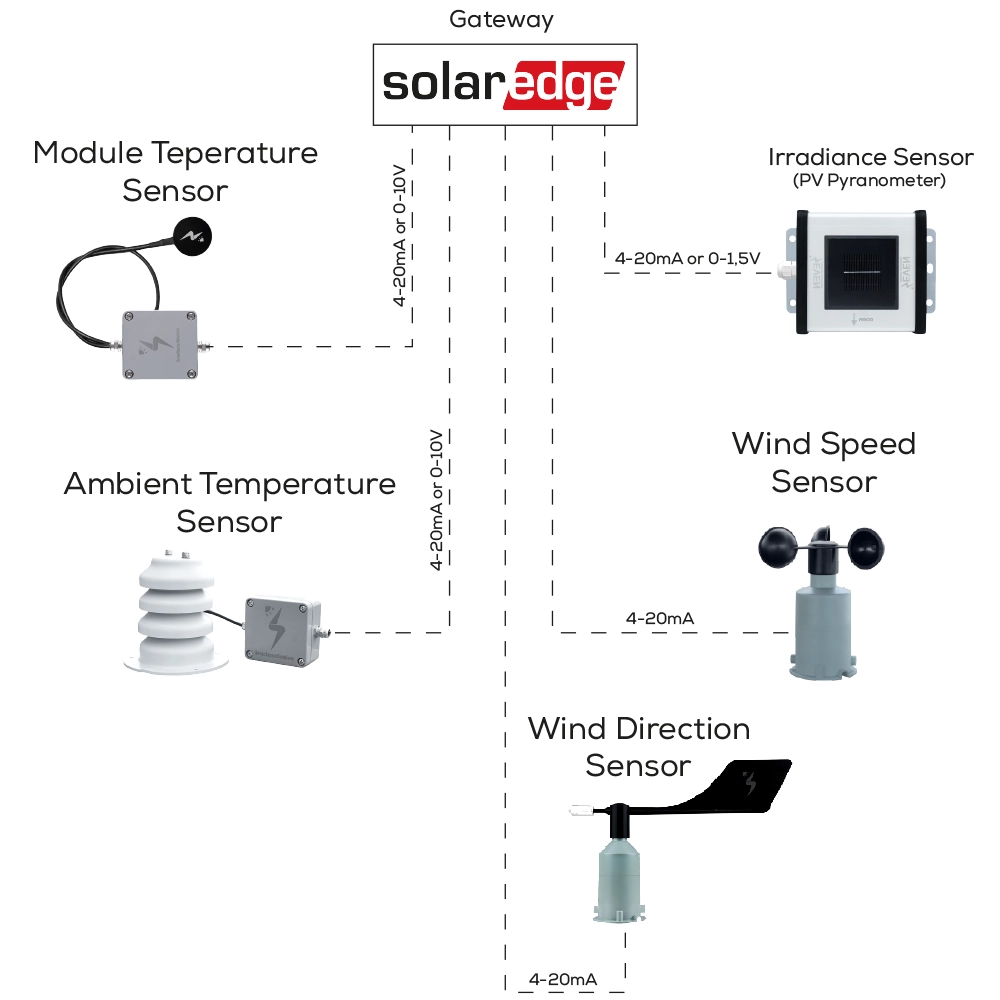
SolarEdge Weather Station
SEVEN provides a full set of weather station for Solar Power Plants compatible with SolarEdge Dataloggers. It includes different sensors required to monitor the Solar PV Plant using SolarEdge Monitoring Portal. SEVEN Sensor Solutions provides a complete set of SolarEdge weather station, whose sensors report a series of weather data at specific intervals without human intervention. These sensors are completely compatible with the SolarEdge Gateway, which has three connection ports that allows to connect three analog sensors.
Founded in 2006, SolarEdge specializes in smart energy technology and is the creator of the DC-optimized inverter solution, which has improved the way PV systems gather and manage energy.
In order to monitor its PV power plants, SolarEdge needs a set of sensors that work with its datalogger. SEVEN offers a whole set of weather stations for solar PV power plants that work with SolarEdge dataloggers. Only three connection ports on this Datalogger, also known as the gateway, allow it to be connected to three analog sensors.
What are the SolarEdge Weather Station components?
The SolarEdge weather station consists of the following sensors:
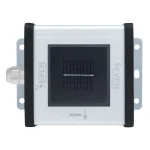
PV Pyranometer with Analog Output: Also known as a reference cell or PV pyranometer, the irradiation sensor is a device used to measure the irradiation exposure of panels throughout the day.
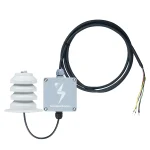
Ambient Temperature Sensor with Analog Output: This sensor is used to monitor the effect of temperature on production. The sensor is housed in a shield to protect it from radiation and external factors.
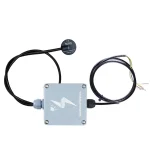
Module Temperature Sensor with Analog Output: This sensor measures the panel surface temperature used for performance calculations.
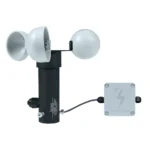
Wind Speed Sensor with Analog Output: Used to measure wind distribution in solar power plants.
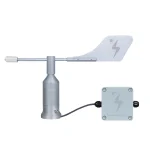
Wind Direction Sensor with Analog Output: Used to monitor wind direction.
It is noted that in general, customers prefer the standard set that includes a PV pyranometer, a wind speed sensor and a module temperature or ambient temperature sensor.
| Product Photo | Sensor |
|---|---|
|
|
|
|
|
|
|
|
|
|
What is the working principle?
An interface for tracking the SolarEdge inverters’ power and communications is built into the Datalogger. Additionally, it offers a variety of wireless networking options. The RS485 connection is used to link the SolarEdge Monitoring Gateway to the PV systems. A string (bus) of 31 SolarEdge slaves is created by the RS485 connection and connected to a master, which could be the data logger or another SolarEdge device.
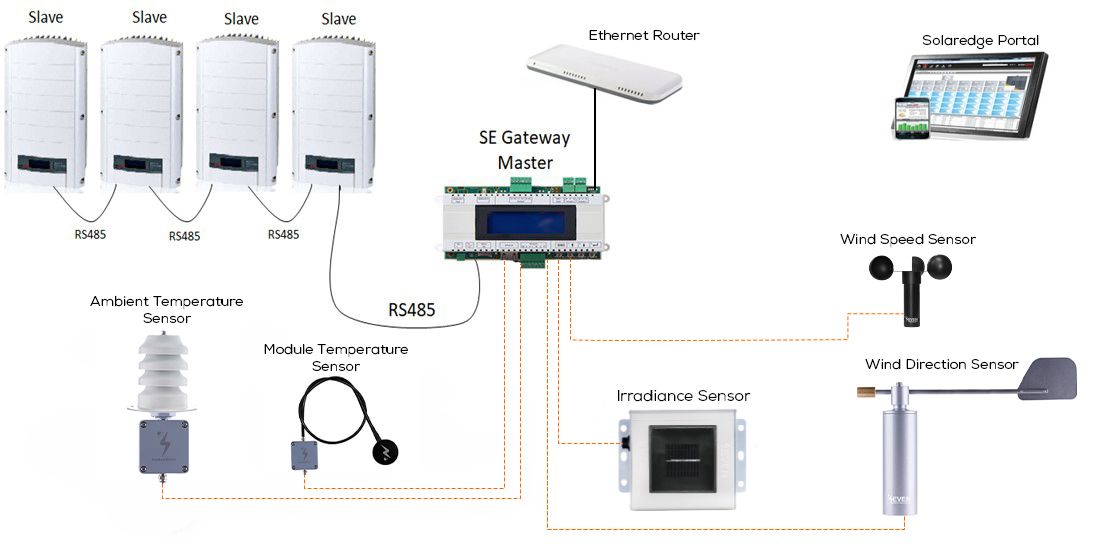
Solaredge Monitoring Platform
The SolarEdge Monitoring Platform offers precise information on the system’s overall performance as well as the past and present performance of each module separately. Then, it enables users to locate, identify, and fix malfunctions, manage maintenance tasks efficiently, and assess site effectiveness.
All PV sites powered by SolarEdge devices can have their financial and technical progress tracked thanks to the SolarEdge monitoring platform.
Frequently Asked Questions (FAQ)
1- Which sensors does 1 set of SolarEdge meteorological weather station include?
The SolarEdge weather station include the wind speed sensor, wind direction sensor, the ambient temperature sensor, the module temperature sensor and the PV Reference Cell.
2- How many sensors can be connected one SolarEdge datalogger?
Since SolarEdge Datalogger, called gateway, has only three connection ports, only three analog sensors can be connected.
3- What is the name of SolarEdge monitoring system?
The name of SolarEdge monitoring system is SolarEdge Portal.
4- Who do we contact if we have any problems?
You can contact with our Technical Support Team. Their phone numbers are +90 553 892 26 70 / +90 501 102 88 70, and their email is teknik@sevensensor.com.
5- What are the delivery times?
- Small Orders: approx. 2-3 weeks
- Bulk orders (100 pcs): approx. 7-9 weeks
6- Can the SolarEdge datalogger read relative humidity data?
No, it cannot, but it can read irradiance, module temperature, wind speed, wind direction and ambient temperature.