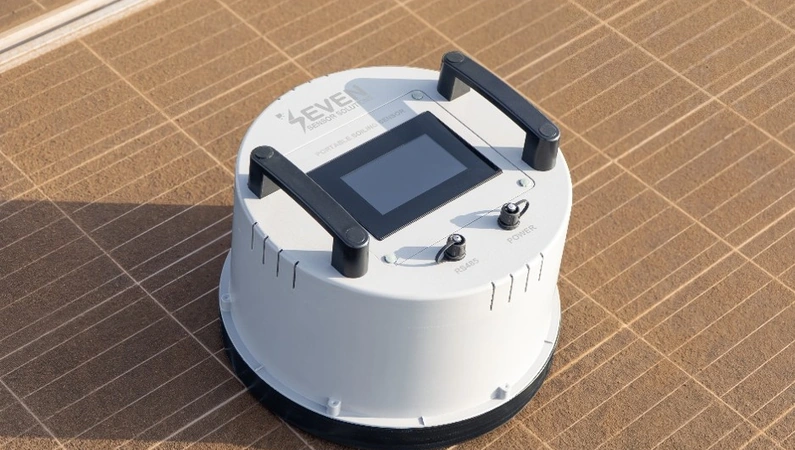
The 3S-SMS-P Soiling Sensor is invented and patented by SEVEN Sensor to measure the amount of soiling on a solar panel through the measurement of light reflection and scattering from the solar panel surface. It differs from the fixed soiling sensor since it makes instantaneous measurements and does not need a day’s data collection and favorable environmental conditions.
Has the 3S-SMS-P been tested with soiling sensors from other brands?
Yes. Both direct and indirect comparative validation studies have been conducted for the 3S-SMS-P. SEVEN Automatic Soiling Sensor models were compared with each other and with Campbell and Fracsun soiling sensors under the same field conditions.
The table below contains our most recent field data. Soiling levels reached approximately 4%. After this point, rainfall occurred in the area, and the soiling rate returned to zero. The results show that the sensors are consistent with each other within 1% measurement uncertainty limits. SEVEN Automatic Soiling Sensors provide compatible measurements both among themselves and with sensors from other brands.
Table 1. Field comparison data (soiling rate, %). ID63-ID67 represent SEVEN Automatic Soiling Sensor models.
In addition, a separate measurement consistency study was conducted between the 3S-SMS-P and the SEVEN Automatic Soiling Sensor, and the results were published as an article (https://www.sevensensor.com/does-the-portable-soiling-sensor-measure-accurately). In this study, the 3S-SMS-P results were compared with both Automatic Soiling Sensor data and direct short-circuit current (ISC) measurements taken from soiled and clean PV panels. Comparing the short-circuit currents of the panels is one of the most reliable reference methods to verify the effect of soiling, and the results were found to be consistent.
Does it have third-party calibration or certification?
The 3S-SMS-P is a unique technology developed and patented by SEVEN Sensor, both in terms of product design and measurement method. Since there is no directly similar product on the market operating on the same principle, there is no independent method or service established for calibrating or testing the device through a third-party organization. Therefore, a third-party calibration or test certificate is not currently offered for this product. The same applies to other soiling sensors as well. There is no accredited calibration laboratory or testing centre that certifies these devices.
However, each device is calibrated by SEVEN Sensor according to product-specific procedures, and a calibration certificate can be provided with the device upon request. Our standard calibration certificate includes: certificate number, sensor model and serial number, calibration date, reference and test cell measurement results, calibration value (mV), device measurement range (1%-20%) and resolution (0.1), and the environmental conditions (temperature and relative humidity) under which the calibration was performed.
The field accuracy of the 3S-SMS-P was also independently witnessed by TÜV SÜD in September 2026. In three test runs against short-circuit current reference measurements, the sensor stayed within its specified ±2% uncertainty. The full report is available here: Field Performance Test of Portable Soiling Sensor.
What is the measurement range of the Portable Soiling Sensor? Why can’t it measure below 1%?
First, it should be noted that the lower limit of the 3S-SMS-P measurement range has recently been lowered from 2% to 1%. Since the current measurement method does not provide sufficient accuracy and repeatability below 1% soiling, reliable measurements cannot be offered below this level.
This limit is directly related to the measurement principle of the 3S-SMS-P. The device measures the light reflected and scattered from the panel surface and processes these values using a special algorithm and software to determine the soiling rate. It takes three measurements on a soiled panel and another three on the same panel after cleaning. However, even on a completely clean panel, different areas can produce different reflection values due to differences in glass and cell structure. This can lead to readings in the range of approximately 0.5%-1%. Due to this natural surface variability, values below 1% cannot be reliably distinguished from actual contamination. Therefore, the verified and reliable measurement range of the 3S-SMS-P is 1%-20%.
Can the Portable Soiling Sensor be used to verify fixed sensors?
Yes. The 3S-SMS-P can be used to check and compare the measurement results of fixed-type soiling sensors in the field. Its biggest advantage is that, unlike fixed sensors, it provides fast and instantaneous measurements without being dependent on external conditions and without requiring at least a day’s worth of data accumulation. It was developed specifically for taking quick measurements at sites where there are no installed soiling sensors and for evaluating the results of existing fixed sensors with an independent field measurement.
However, the difference in measurement uncertainty between the two systems must be considered. While the measurement uncertainty of most fixed sensors on the market, including the SEVEN Automatic Soiling Sensor, is generally ±1%, the measurement uncertainty of the 3S-SMS-P is ±2% due to its reflected and scattered light measurement principle. Therefore, a measurement difference of up to 2% may occur between the devices. Taking this tolerance into account, the 3S-SMS-P can be safely used for field verification of fixed-type soiling sensors.
Why are three measurements taken on a soiled panel?
The main reason for taking three measurements is that the soiling is not distributed completely homogeneously across the panel surface. In our R&D studies, we observed that even when using the same glass and cell structure, different spots of the same panel can produce different reflection and scattering values. In addition, dust can accumulate unevenly depending on the panel’s tilt and environmental conditions.
Therefore, to minimize the effect of local surface differences and provide a more representative result for the entire panel, the 3S-SMS-P takes measurements from three separate points. It is recommended that measurements be taken from the bottom-middle, centre, and top-middle points of the panel, avoiding the corners. Once the panel is cleaned, measurements need to be taken at the same three spots as close as possible. In this way, the dirty and clean panels can be compared directly, the impact of surface differences will be reduced, and an accurate soiling rate will be achieved.
How are measurement accuracy and traceability ensured with the Portable Soiling Sensor?
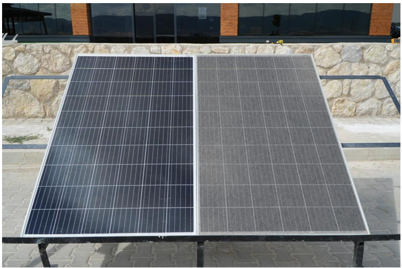
Clean and Soiled Solar Panels
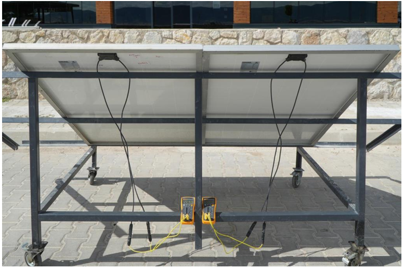
Measurement of Solar Panel Current Values
The overall measurement uncertainty of the device is ±2%. During the product’s R&D and validation process, the actual soiling rates of the panels were determined by comparing the short-circuit current (ISC) values of clean and soiled panels under stable environmental conditions as defined in the IEC 61724-1:2021 standard. The reflected and scattered light values obtained from the panel surface were correlated with these reference results. The device software and calculation algorithm were developed and validated accordingly.
The table below is a sample table which contains data obtained from R&D measurements carried out using dusts of various colors and tones on panels of various brands and cell colors. The table gives the soiling rate obtained through ISC currents and the soiling rate obtained through the portable sensor.
Table 2. Comparison data of sample soiling rates from the R&D process.
As can be seen, the values obtained with the portable sensor are highly consistent with the real soiling rates derived from ISC currents. The accuracy of the measuring device has been confirmed with the help of reference measurements, comparison tests, and field tests carried out during the research and development process.
Frequently Asked Questions
What does 3S-SMS-P measure?
By measuring the light reflected and scattered from the surface of the solar panel, it determines the soiling rate (%) of the panel.
What is the measurement range of Portable Soiling Sensor?
It measures within the range of 1%-20%.
What is the measurement uncertainty of Portable Soiling Sensor?
It measures with an uncertainty of ±2%.
Why can't Portable Soiling Sensor measure below 1%?
Even on a perfectly clean panel, surface variability can produce readings of approximately 0.5%–1%, so values below 1% cannot be reliably distinguished from actual contamination.
How many measurements are taken?
Three measurements are taken on the soiled panel, and three more at the same points after cleaning. Measurements are taken from the bottom-middle, centre, and top-middle regions of the panel, avoiding the corners.
Can Portable Soiling Sensor replace a fixed soiling sensor?
No. It is used to check and compare the results of fixed sensors with a quick and instantaneous field measurement, as well as to take measurements in areas without installed sensors.
Is a calibration certificate provided with Portable Soiling Sensor?
Yes. Each device is calibrated by SEVEN Sensor using product-specific procedures, and a calibration certificate is provided with the device upon request.