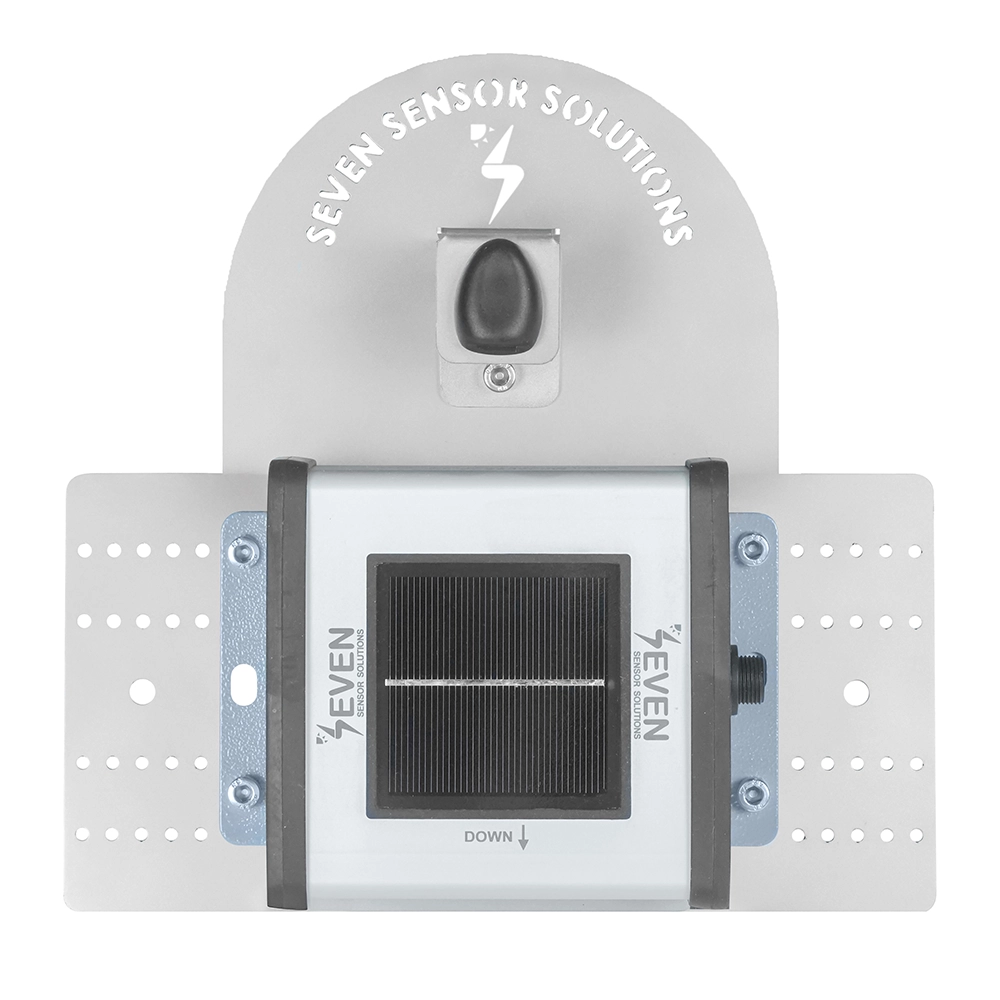
Self Cleaning Irradiance Sensor – 3S-SCIS
3S-SCIS is a Class A irradiance sensor with an automatic cleaning system designed for photovoltaic installations. It measures the solar irradiance on POA in W/m² and is used to calculate the plant's performance ratio (PR). Thanks to its self-cleaning system, it regularly cleans itself, thus reducing measurement deviations caused by dirt accumulation and minimizing the need for manual cleaning. All measured data is transmitted to data loggers via Modbus RTU over RS485.
Technical Specifications of Self Cleaning Irradiance Sensor
| Item Code | 3S-SCIS |
| Measured Data | Irradiance and Cell Temp. |
| Irradiance Range | 0…1600 W/m² |
| Uncertainty | ≤1% (Less than 2%; as per IEC 61724-1 standard Class A) |
| Resolution | 0,1 W/m² (Less than 1 W/m²; as per IEC 61724-1 standard Class A) |
| Response Time | 1 sec. (Less than 3 sec; as per IEC 61724-1 standard Class A) |
| Drift | <0,3% / year |
| Field of View | 170° (Larger than 160° as per IEC 61724-1 standard Class A) |
| Tilt-Azimuthal Angle | 0°- 0° (≤1°; as per IEC 61724-1 standard Class A) |
| Output Rate | 1/s |
| Data Output | RS485 up to 38400 Baud |
| Communication Protocol | Modbus RTU |
| Power Supply | 110-240V AC or 24V 5A DC |
| Power Consumption | Pump Passive: Max. 20 mA @ 24V DC; Pump Active: Max. 3 A @ 24V DC |
| Cabel Length and Features | 3 m LI2Y(st)C11Y PUR Cable, UV and Weather Resistant |
| Galvanic Isolation | 1000 V between power supply and RS485 bus |
| Cell Temperature Sensor Type | PT1000 Class A as per EN 60751 |
| Operating Temperature Range | -20°C…85°C |
| Operating Humidity Range | 0%…100% RH |
| Water Tank Capacity | 18 Liters |
| Water Consumption | 36 Liters/year (Refilling required twice a year for daily cleaning) |
| Washing Liquid | Pure Water: 100% (Should be used when the ambient temperature is above 0°C); Pure Water: 65% + Antifreeze: 35% (Should be used when the ambient temperature is below 0°C) |
| Water Hose Length | 5 m (up to 20m on request) |
| Max. Water Line Height | 5 m |
| Weight | 10 kg |
| IP Rating | IP54 (Optional IP 65, IP 68) |
| Sensor Housing Material | Aluminium |
| Standard | IEC 61724-1:2021 and IEC 60904 |
| Calibration | Each sensor is calibrated under a Class AAA Sun Simulator according to IEC 60904-2 and IEC 60904-4 standards using a reference cell calibrated by the ISFH Institute in Germany. |
| Origin | Türkiye |
Why is Sensor Cleaning Important for Accurate Readings?
The surface of the irradiance sensor becomes dusty and dirty over time. A dirty sensor will read lower irradiance levels, which can falsify calculations such as the performance ratio. Therefore, keeping the sensor clean is essential in Class A monitoring.
The IEC 61724-1:2021 standard (clause 8.2.5 and Table 7) mandates the reduction of contamination effects on irradiance sensors within the scope of Class A monitoring and requires at least weekly cleaning in typical installations. Technologies that provide contamination reduction equivalent to weekly cleaning are also accepted. 3S-SCIS is designed precisely to meet this requirement.
Automatic cleaning eliminates the need for regular field visits to manually clean the sensor. This reduces labour costs and ensures the sensor remains clean and provides consistently accurate measurements.
How Does the 3S-SCIS Cleaning System Work?
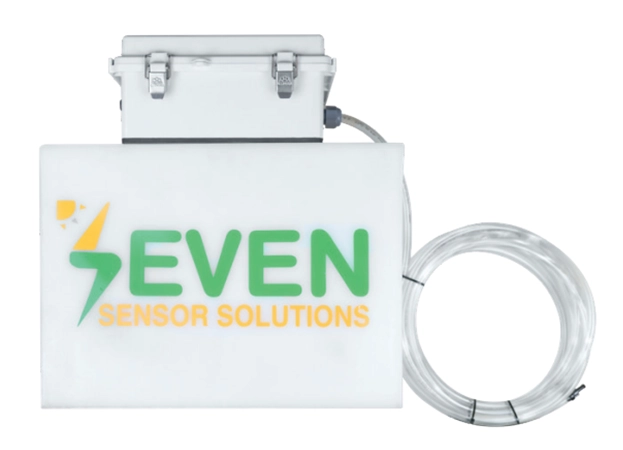
A cleaning system consisting of a water tank, pump, and hose line is connected to the sensor. The system washes the sensor surface at a time determined via a user interface (GUI).
- Scheduling: By default, cleaning runs once a day at a time specified by the user. If desired, the number of daily cleanings can be increased to three by defining three different times via the GUI.
- Water consumption: An 18-liter tank is typically refilled twice a year, with an annual water consumption of approximately 36 litres for daily cleaned sensors.
- Water hose: The standard hose length is 5 meters and can be extended up to 20 meters upon request. The maximum height of the water line is 5 meters.
Washing fluid is selected according to the air temperature. When the temperature drops below 0°C, antifreeze is added to prevent freezing.
| Washing Liquid | Terms of Use |
| 100% pure water | When the air temperature is above 0°C |
| Pure water 65% + antifreeze 35% | When the air temperature is below 0°C |
How Does 3S-SCIS Irradiance Measurement Work?
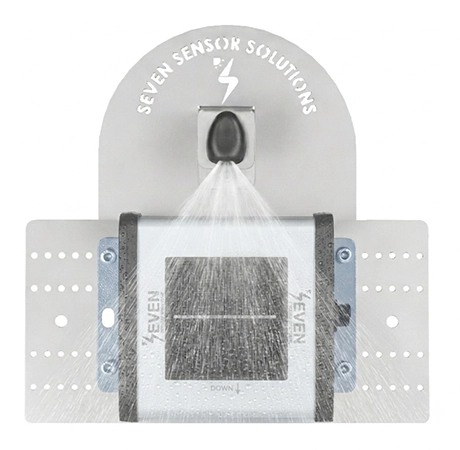
The 3S-SCIS incorporates a real photovoltaic reference cell. This cell reacts to light just like a solar panel, so the sensor mirrors the conditions that the panels actually see. A Class A PT1000 temperature sensor behind the cell corrects for the effect of temperature on the measurement.
The device calculates the temperature-compensated irradiance value in W/m² and transmits it to data loggers via Modbus RTU over an RS485 line. Each sensor is calibrated under a Class AAA Sun Simulator according to IEC 60904-2 and IEC 60904-4 standards using a reference cell calibrated by the ISFH Institute in Germany.
What Are the Advantages of Self Cleaning Irradiance Sensor?
The self-cleaning irradiance sensor offers several advantages for reliable and low-maintenance solar monitoring as outlined below.
- Automatic cleaning: It cleans the sensor automatically at regular intervals, reducing labour costs by eliminating the need for manual cleaning and field visits.
- Class A compliant: Meets IEC 61724-1:2021 Class A monitoring requirements with an uncertainty of <1%.
- Similar behaviour to with panels: The PV reference cell has a similar structure to the panels and responds to light in the same way.
- Easy integration: Connects to data loggers via Modbus RTU output over RS485 and SunSpec compatibility.
- Flexible power supply: Operates with 110-240 V AC or 24 V DC.
- Backed by SEVEN: Comes with remote installation service, free software updates and a 2-year warranty.
How to Install the Self Cleaning Irradiance Sensor?
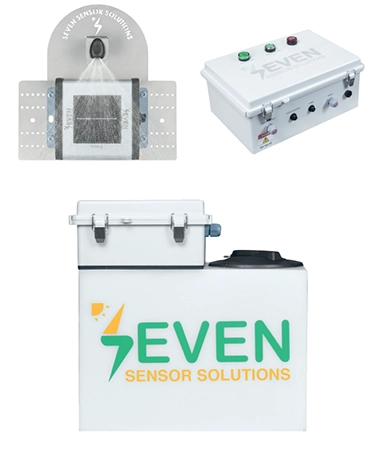
Pay attention to the following points when installing the system.
- Mount the irradiance sensor next to the solar panels, ensuring it is aligned at the same angle and orientation as the solar panels.
- Place the water tank under the solar panel or in another suitable area to protect it from sunlight and reduce evaporation.
- If the air temperature drops below 0°C, add antifreeze to the washer fluid (65% distilled water + 35% antifreeze).
- Mount the electronic panel under the solar panel or in another protected area using appropriate equipment and the mounting brackets on the back of the panel.
- Set cleaning times and the number of daily cleanings (maximum three) via the user interface.
- Fill the tank periodically, depending on the number of daily cleaning.
Frequently Asked Questions (FAQ)
How does 3S-SCIS differ from a standard irradiance sensor?
Both are Class A irradiance sensors and use the same measurement logic. The 3S-SCIS also includes an automatic cleaning system. It cleans the sensor regularly, reducing the need for manual cleaning.
How often is cleaning done for Self Cleaning Irradiance Sensor?
By default, it runs once a day at a time specified by the manufacturer (morning). This can be increased to three times a day by defining extra two different times through the user interface.
How much water does Self Cleaning Irradiance Sensor consume and how often is the tank refilled?
With one cleaning cycle per day, the system consumes approximately 36 litres of water per year. An 18-liter tank will therefore typically need to be refilled about twice a year. Water consumption will increase if the cleaning frequency is set to more than once per day.
Will there be a problem with Self Cleaning Irradiance Sensor freezing in winter?
Pure water should be used when the air temperature is above 0°C. Below 0°C, a mixture of 65% pure water and 35% antifreeze should be used to prevent freezing.
Why is automatic cleaning necessary for irradiance sensor?
For Class A monitoring IEC 61724-1:2021 requires that the contamination effect on the irradiance sensor be reduced and that cleaning be performed at least weekly. Automatic cleaning meets this requirement without the need for a site visit.
Which output and protocol does Self Cleaning Irradiance Sensor use?
It uses Modbus RTU (up to 38400 baud) over RS485 and is SunSpec compliant.
What power supply does Self Cleaning Irradiance Sensor need?
It operates with 110-240 V AC or 24 V 5 A DC. When the pump is active, the consumption reaches a maximum of 3 A at 24 V DC.
What is the operating temperature range of Self Cleaning Irradiance Sensor?
It operates between -20°C and +85°C.
What is the price of Self Cleaning Irradiance Sensor?
3S-SCIS is offered between 960 EUR and 1750 EUR.
What is the delivery time of Self Cleaning Irradiance Sensor?
Delivery time varies depending on the order quantity. For small order it can vary between 2-4 weeks. Please contact us for the exact timeframe.
What is the warranty of Self Cleaning Irradiance Sensor?
Two years warranty for each product.