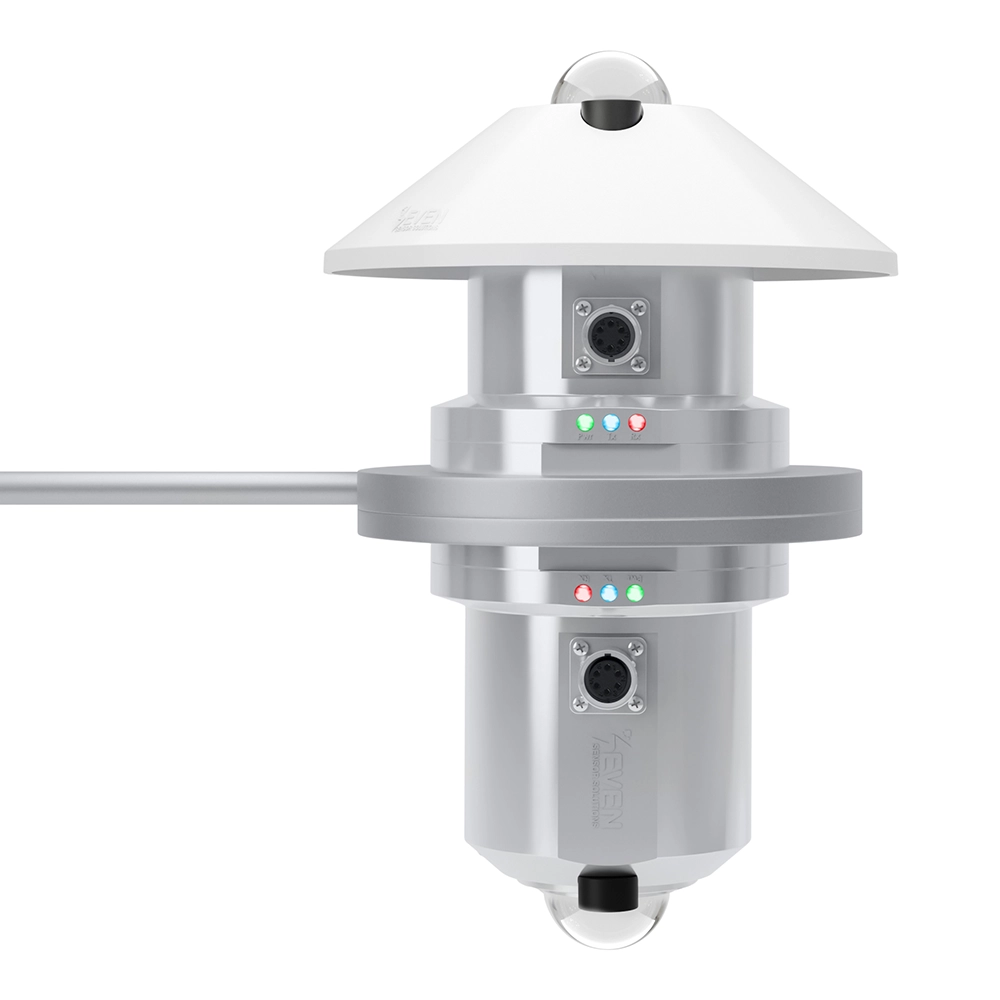
Thermopile Albedometer – 3S-TP-ALBEDO-A
The (3S-TP-ALBEDO-A) Thermopile Albedometer is a sensor designed to measure both incoming solar irradiance and irradiance reflected from the ground with high accuracy. Thanks to two Class A thermopile pyranometers, one facing upwards and the other downwards, it accurately measures the albedo value in photovoltaic performance monitoring, meteorological applications and solar resource evaluation studies.
The sensor supports RS485 Modbus RTU communication protocol. In this way, it can easily be integrated into SCADA systems, dataloggers, and monitoring systems. It is made to withstand harsh outdoor environments due to its IP68 rating, anodized aluminum construction, and compatibility with ISO 9060:2018 and IEC 61724-1:2021 Class A monitoring specifications.
Technical Specifications of Thermopile Albedometer
| Item Code | 3S-TP-ALBEDO-A |
| Measured Parameters | GHI or POA irradiance, reflected irradiance, internal and housing temperature, internal humidity |
| Sensor Type | Thermopile |
| Spectral Range | 280 to 3000 nm |
| Irradiance Range | 0 to 4000 W/m² |
| Nominal Sensitivity | 8 to 14 µV/(W/m²) |
| Response Time | 0,5 s |
| Zero Offset A – Thermal Radiation | ±1 W/m² |
| Zero Offset B – Temperature Change | ±1,5 W/m² |
| Total Zero Offset C | ±3 W/m² |
| Non-Stability | <0,5% change/year |
| Non-Linearity | ±0,2% from 100 to 1000 W/m² |
| Directional Response | ±10 W/m² at 1000 W/m², 0 to 80° |
| Spectral Error | ±0,2% |
| Temperature Response | ±0,4% from -20°C to 50°C |
| Irradiance Resolution | 0,1 W/m² |
| Internal Humidity Range | 0% to 100% |
| Internal Humidity Accuracy | ±1% RH from 20% to 70% at 25°C |
| Internal Temperature Range | -40°C to +85°C |
| Internal Temperature Accuracy | ±0,1°C from 5°C to 60°C |
| Housing Temperature Range | -40°C to +85°C |
| Housing Temperature Accuracy | ±0,2°C |
| Spirit Level Accuracy | ±0,1° |
| Viewing Angle | 2π sr |
| Data Output | RS485 up to 38400 baud |
| Communication Protocol | Modbus RTU, optional Modbus TCP/IP |
| Output Rate | 1/s |
| Operating Temperature | -40°C to 85°C |
| Power Supply | 12 to 30 V DC |
| Power Consumption | 20 mA at 24 V DC |
| Cable Features | 3x2x0,14 mm², 26 AWG LI2Y(st)CTP PUR cable, UV and weather resistant |
| Standard Cable Length | 3 m, custom length available |
| Galvanic Isolation | 1000 V between power supply and RS485 bus |
| IP Rating | IP68 |
| Dimensions | Ø140 mm x 209 mm |
| Sensor Housing Material | Anodized aluminum |
| Mounting Bracket Material | Alloy aluminum |
| Shade Disk Material | ABS |
| Weight | 2,6 kg |
| Standards | ISO 9060:2018, IEC 61724-1:2021 Class A, ISO/TR 9901:1990, ISO 9847 |
| Origin | Türkiye |
What Does the 3S-TP-ALBEDO-A Thermopile Albedometer Measure?
The 3S-TP-ALBEDO-A measures both the incoming solar irradiance from the sky and the irradiance reflected from the surface under the sensor.
Parameters it can measure:
- Global Horizontal Irradiance (GHI)
- Plane of Array Irradiance (POA)
- Irradiance reflected from the ground, roof, snow, soil, vegetation or PV installation surface
- Internal temperature
- Housing temperature
- Internal humidity
This combination allows users to calculate albedo, which is the ratio of reflected solar irradiance to incident solar irradiance. In solar power plants, this data is very valuable for understanding ground reflection, bifacial module gain, surface conditions and possible energy losses.
How Does a Thermopile Albedometer Work?
The thermopile albedometer consists of two pyranometers mounted in opposite directions.
The upper pyranometer reads irradiation from the atmosphere, and the lower pyranometer reads irradiation from the surface. The monitoring system then compares these two readings to determine the albedo value.
It is done using the formula:
Albedo = Reflected Irradiance / Global Irradiance
For instance, if the upper pyranometer reads 1000 W/m² and the lower pyranometer reads 250 W/m², then the albedo value will be 0,25. It is a useful piece of data in solar projects. The surface reflectivity has direct impacts on the performance of photovoltaic modules.
Why Choose 3S-TP-ALBEDO-A for Solar Monitoring?
3S-TP-ALBEDO-A has been developed for solar monitoring applications that require both standard solar irradiance data and reflected irradiance data. Key advantages:
- Class A measurement performance: Uses two SEVEN 3S-TP-MB-A pyranometers designed to meet ISO 9060:2018 Fast Response, Spectrally Flat, Class A requirements.
- Bi-facial irradiation measurement: Measures incident and reflected irradiation simultaneously.
- Fast response time: Offers a response time of 0,5 seconds in dynamic solar conditions.
- Low zero offset behavior: Provides stable and accurate irradiation data over the long term.
- Digital integration: Features RS485 Modbus RTU output for connection to data loggers and SCADA systems.
- Outdoor-suitable design: IP68 protection class
- UV and weather-resistant cable, anodized aluminum housing.
- Professional support: SEVEN remote installation service includes customer support, free software updates, and a 5-year warranty.
Where is 3S-TP-ALBEDO-A Used?
3S-TP-ALBEDO-A is used in applications where both incident and reflected solar irradiance need to be accurately measured.
Common application areas:
- Industrial-scale solar power plants
- Bi-facial PV system monitoring
- Solar resource evaluation stations
- Meteorological measurement stations
- Ground reflectance studies
- Agricultural solar monitoring
- Snow, desert, roof, and soil reflectance measurements
- Performance ratio and energy loss analysis in solar power plants
Albedo monitoring is particularly important in double-sided PV projects. Reflected radiation provides additional production from the back of the module. Accurate albedo data allows operators to understand how ground material, snow cover, vegetation, and seasonal variations affect PV performance.
How to Install a Thermopile Albedometer?
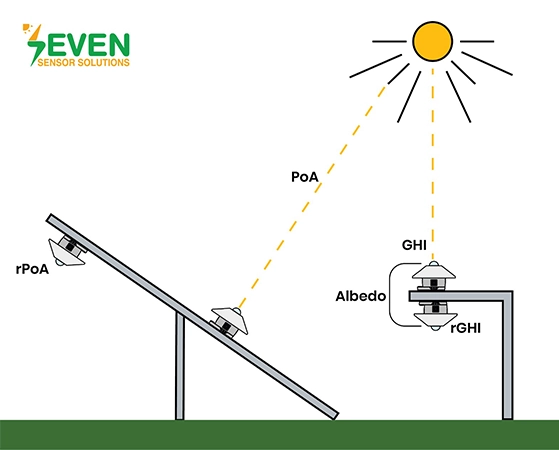
The albedometer must be mounted in a place where both pyranometers can take reliable measurements. Installation recommendations:
Select an appropriate mounting place: Find a place for mounting the upper pyranometer that will provide a free view of the sky, and find a place for the lower pyranometer that will represent the ground or the surface.
Avoid any obstacles to measurement: Avoid placing the sensor close to mounting devices, walls, cables, and other equipment that can create a shadow or reflect the solar radiation.
Mount the sensor properly: Mount the sensor on the bracket using the mounting rod.
Level the sensor: Level the sensor using the built-in bubble level device.
Connect power and communications cables: Power the sensor by a 12-30 V DC power source and connect it to the data logger via RS485 Modbus RTU port.
Configure Modbus parameters: Configure Modbus RTU parameters depending on the specific project and logger’s setup.
When used in PV systems, the sensor must be mounted so that the measurement of the reflected radiation corresponds to the real conditions on the surface.
How to Maintain the 3S-TP-ALBEDO-A?
Regular maintenance helps maintain the accuracy of irradiance and albedo data. Recommended maintenance schedule:
- Daily or field inspection: Check for visible damage, heavy dirt, snow, bird droppings, or shading
- Weekly: Clean the top and bottom sensor domes if there is dust or contamination
- Monthly: Check sensor leveling, mounting integrity, cabling condition, and data output
- Annual: Review measurement performance and inspect the entire installation
- Every 2 years: Recalibration is recommended every 2 years according to IEC 61724-1:2021
- Up to 5 years: SEVEN recommends recalibration every 5 years depending on project requirements due to its high-precision diffuser technology
For accurate calculation of the reflected albedo value, both the up-facing and down-facing sensors must be kept clean. Contamination in both pyranometers can affect the albedo value.
Frequently Asked Questions (FAQ)
What is a thermopile albedometer?
A thermopile albedometer is a solar radiation sensor that measures both incident solar irradiance and reflected irradiance. It consists of two pyranometers, one facing upwards and the other downwards.
What is albedo?
Albedo is the ratio of reflected solar irradiance to incident solar irradiance. A high albedo means the surface reflects more sunlight. Snow, light-colored gravel, and reflective roofing materials generally have higher albedo values compared to dark soil or asphalt.
Is 3S-TP-ALBEDO-A Thermopile Albedometer Class A?
Yes. The 3S-TP-ALBEDO-A uses two SEVEN 3S-TP-MB-A pyranometers designed to meet ISO 9060:2018 Fast Response, Spectrally Flat, Class A and IEC 61724-1:2021 Class A monitoring requirements.
Can the SEVEN thermopile albedometer be used in bifacial PV sites?
Yes. The 3S-TP-ALBEDO-A is particularly useful in bifacial PV monitoring as it measures irradiance reflected from the ground or mounting surface. This irradiance can contribute to additional energy generation from the back of the module.
What communication protocol does the thermopile albedometer use?
The sensor uses RS485 Modbus RTU communication. Modbus TCP/IP is also available as an option.
What is the irradiance range of the thermopile albedometer?
The 3S-TP-ALBEDO-A measures irradiance in the range of 0 to 4000 W/m².
What is the spectral range of the Thermopile Albedometer?
The spectral range is 280 - 3000 nm.
What is the IP protection class of the Thermopile Albedometer?
The albedometer has an IP68 protection class, making it suitable for harsh outdoor conditions.
What is the standard cable length of the Thermopile Albedometer?
The standard cable length is 3 meters. Different cable lengths are available upon request.
What is the standard mounting rod length of the Thermopile Albedometer?
The standard mounting rod length is 20 cm. Different lengths are available upon request.
How often should the SEVEN Thermopile Albedometer be calibrated?
In PV monitoring applications, according to the IEC 61724-1:2021 standard, it is generally calibrated every two years. Thanks to SEVEN’s high-precision diffuser technology, calibration every 5 years may be sufficient depending on the application.
Can the albedometer be configured with different pyranometer classes?
Yes. The Thermopile Albedometer can be optionally configured with SEVEN 3S-TP-MB-B or SEVEN 3S-TP-MB-C thermopile pyranometers.
What is the warranty period for the Thermopile Albedometer?
The warranty period for the Thermopile Albedometer is 5 years.
What is the price of the SEVEN Thermopile Albedometer?
The unit price of the sensor ranges from 1800 EUR to 3270 EUR.