
Plastic Wind Direction Sensor With Modbus Output – 3S-WD-MB-P
The Wind Direction Sensor with Modbus Output is designed for accurate horizontal wind direction measurement in degrees (°) over a 0 to 359 range in compliance with IEC 61724-1:2021 Standards. The sensor body and wind vane work together to detect vane position and transmit wind direction digitally via RS-485 Modbus RTU. This makes integration straightforward with Modbus-enabled dataloggers, SCADA, and PLC systems. It is commonly used in PV monitoring to support module temperature interpretation and in reporting for wind-related warranty cases. The sensor is supplied with a mounting facility and cable.
TECHNICAL SPECIFICATIONS OF PLATIC WIND DIRECTION SENSOR WITH MODBUS OUTPUT
| Item Code | 3S-WD-MB-P |
| Sensor Type | Vane-Driven Hall Effect Position Sensor |
| Measuring Range | 0 to 359° |
| Accuracy | ±1% of Measuring Value |
| Resolution | 0.1° |
| Threshold | 1 m/s |
| Data Output | RS485 up to 38400 Baud |
| Communication Protocol | Modbus RTU |
| Power Supply | 12 to 30 V DC (24 V DC recommended) |
| Power Consumption | Typically 20 mA @ 24 V DC |
| Electrical Connection | 1 m 3x2x0,22 mm² – LI2Y(st)C11Y Cable, UV and Weather Resistant |
| Operating Temperature Range | -40°C to +85°C (Ice Free) |
| Dimensions | 265 mm x 190 mm |
| Box Dimensions | 80 x 82 x 55 mm (W x L x H) |
| Weight | 0,33 kg |
| Box Weight | 0,25 kg |
| IP Rating | IP 54 |
| Housing Material | ASA |
| Vane Material | P6GF20 |
| Box Material | ABS |
| Mounting Method | Pipe or Ground Mounting |
| Standard | Compliant to IEC 61724-1:2021 |
Why Use a Plastic Modbus Wind Direction Sensor?
In larger installations, analog signals can degrade over distance or suffer from electrical noise. Modbus communication solves this problem by transmitting digital data reliably across long cable runs.
Choosing a plastic housing adds practical benefits outdoors, and it is usually a more economical option compared to metal-bodied alternatives, especially when you are deploying multiple sensors across a site.
What are the Key Advantages of Plastic Modbus Wind Direction Sensor?
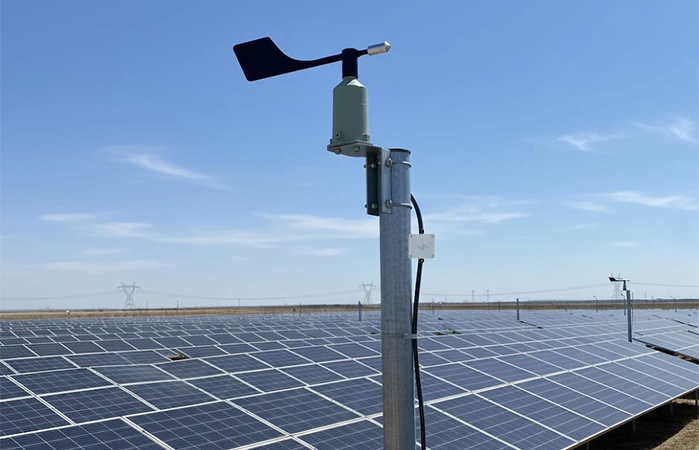
The SEVEN Plastic Wind Direction Sensor with Modbus output is designed to deliver reliable wind direction measurement with easy installation and seamless integration.
- Reliable data over long distances: Modbus RTU over RS-485 keeps readings stable, even with long cable runs.
- Less electrical noise: Digital communication is less affected by interference from inverters, transformers, and other industrial equipment.
- Easy system integration: Works smoothly with SCADA, PLCs, and dataloggers that support Modbus RTU.
- Multiple sensors on one line: You can connect several devices to the same RS-485 bus by assigning different Modbus addresses.
- Corrosion resistance: Plastic housing is a strong choice for coastal regions and humid climates where metal parts may corrode over time.
- UV and weather durability: Quality outdoor plastics handle sun exposure well and help reduce long-term surface degradation.
- Lightweight and easier handling: Plastic construction makes installation simpler, especially on masts and rooftops.
- More economical at scale: A cost-effective choice when you need consistent wind direction data across multiple locations.
This makes the 3S-WD-MB-P especially suitable for utility-scale PV plants and remote monitoring sites.
How Does the Plastic Modbus Wind Direction Sensor Work?
The sensor measures wind direction by tracking the position of the wind vane and transmitting the value digitally via Modbus RTU.
- Wind turns the vane so it points into the wind direction.
- A built-in Hall Effect sensor detects the vane’s angle without physical contact, which helps reduce wear and keeps readings stable over time.
- The sensor converts the measured angle into a wind direction value in degrees (0 to 359).
- This value is sent as digital data using Modbus RTU over RS-485, which is reliable for long cable runs and electrically noisy environments.
- The wind direction data is stored in Modbus registers, so your datalogger, PLC, inverter, or SCADA system can read it at regular intervals.
This working principle makes the sensor well suited for PV plants, weather stations, and remote monitoring sites, where long cable runs, low maintenance, and reliable data transmission are essential.
Where Is the 3S-WD-MB-P Commonly Used?
This Modbus wind direction sensor is widely deployed in:
- Utility-scale solar PV plants
- Hybrid solar-wind installations
- Meteorological stations
- Environmental and climate monitoring systems
- Agricultural PV and smart farming projects
In PV applications, wind direction data supports thermal loss analysis, soiling assessment, and structural risk evaluation, as required by IEC 61724-1.
How Do You Install and Maintain the Sensor?
Installation Guidelines
Each site is different and has its own unique challenges. For this reason, the installation of the product may differ in each site.
- Install the sensor in an unobstructed location, away from buildings or trees
- Align the north reference mark using a compass
- Mount on a pipe or ground structure using the supplied hardware
- Connect RS-485 lines according to the Modbus wiring diagram
Maintenance
- No regular calibration required
- Periodic visual inspection recommended
For PV plants, IEC 61724-1 recommends annual inspections, or more frequent checks in harsh environments.
Frequently Asked Questions (FAQ)
What is the accuracy of the 3S-WD-MB-P Plastic Wind Direction Sensor?
The accuracy is ±1% of measuring value, fully compliant with IEC 61724-1 Class A requirements.
Is Plastic Wind Direction Sensor with Moudbus Output compatible with my SCADA or datalogger?
Yes. The sensor uses Modbus RTU over RS-485, which is supported by most industrial dataloggers, PLCs, and SCADA systems.
What power supply does the 3S-WD-MB-P sensor require?
3S-WD-MB-P operates on 12–30 V DC, with 24 V DC recommended for stable performance.
What is the typical price range of the Plastic Wind Direction Sensor?
The 3S-WD-MB-P is typically priced between €185 and €335.
Is the Plastic Wind Direction Sensor suitable for harsh outdoor environments?
Yes. The UV-resistant plastic housing and optional IP54 protection make it suitable for long-term outdoor use. It can also be upgraded to IP65 upon request.
What is the warranty period of the 3S-WD-MB-P?
All 3S-WD-MB sensors come with a 2-year warranty against manufacturer defects, extendable upon request.
What are the delivery times for the Plastic Wind Direction Sensor with Modbus Output?
Lead times for the plastic wind direction sensor with modbus output are typically 5–7 days for small orders and around 6–7 weeks for bulk orders (100 pcs).
Does the Plastic Wind Direction Sensor include a cable?
Each unit comes with a 1 m 3x2x0,22 mm² - LI2Y(st)C11Y Cable (UV and weather resistant) with 6 wires twisted (including ground for both Data & Power). Other lengths are available on request.