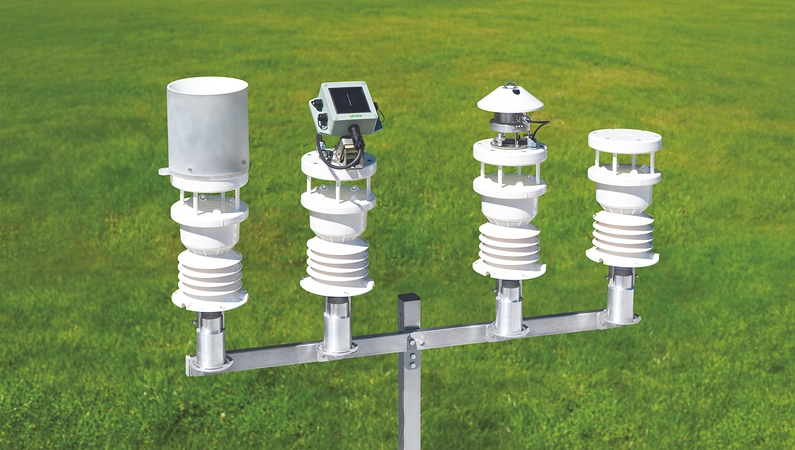
The SEVEN 3S-ACWS family: 3S-ACWS-RG, 3S-ACWS-IS, 3S-ACWS-TP and the base 3S-ACWS
The typical weather station consists of a forest of sensors including a temperature and humidity probe inside a radiation shield, a cup anemometer, a wind vane, sometimes a barometer, and a rain gauge, all with their own brackets and cables. It does the job, but it requires a while to set up, and any additional cable and bracket adds another potential point of failure in the field.
At SEVEN, we have tried to come up with a simpler solution. The 3S-ACWS All-in-One Compact Weather Station, soon to be available, combines air temperature, relative humidity, atmospheric pressure, wind speed, and wind direction in one unit with one cable. In certain models, the device can also measure precipitation, plane-of-array irradiance, and/or global horizontal irradiance.
The 3S-ACWS is a small and all-in-one unit without any moving parts. All units monitor temperature, humidity, air pressure, wind speed, and wind direction. The -RG unit includes a tipping bucket rain gauge, the -IS unit has a class A photovoltaic cell to monitor POA Irradiance (IEC 61724-1:2021), while the -TP unit has a class A thermopile to monitor GHI (ISO 9060:2018). It uses the RS485 Modbus RTU protocol, while Modbus TCP/IP is an optional choice.
What Is an All-in-One Compact Weather Station?
This is an all-in-one weather station, which is made up of different sensors in one unit. This means you will be setting up one sensor instead of having to install five or six individual sensors.
As the name implies, the 3S-ACWS uses ultrasonic technology to measure the wind speed and direction. Thus, there are no cups and vanes in the weather station.
Which 3S-ACWS Models Will Be Available?
The 3S-ACWS family will have four models, so you can choose the measurement set that matches your project:
For the irradiance models, it is possible to use an external PT1000 module temperature sensor. It is optional and should be ordered together with the product.
3S-ACWS: Basic configuration, includes five core parameters and does not have any movable parts. Cost-effective device which is suitable for monitoring weather conditions in general on meteorological stations, farms and industries.
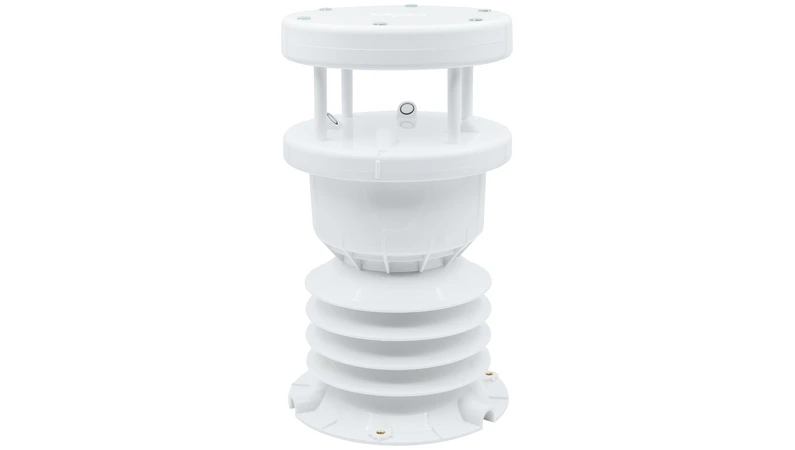
3S-ACWS
3S-ACWS-RG: Includes a tipping bucket rain gauge for measuring the amount and intensity of rainfall. Suitable for irrigation planning, meteorological observations and for studying water erosion where rain measurements are required in combination with the other weather parameters.
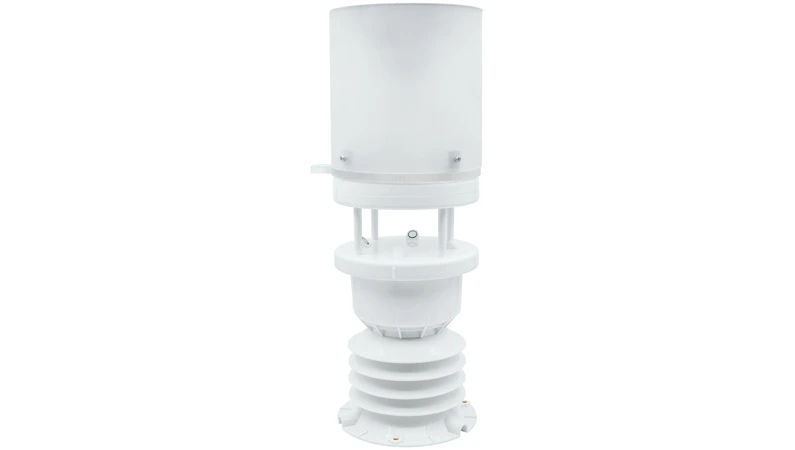
3S-ACWS-RG
3S-ACWS-IS: Includes PV reference cell irradiance sensor with spectral and angular responsivity similar to PV modules. Measures plane-of-array irradiance with Class A accuracy according to IEC 61724-1:2021 standard. Together with optional PT1000 module temperature sensor provides all weather data necessary for calculation of the performance ratio of a solar plant.
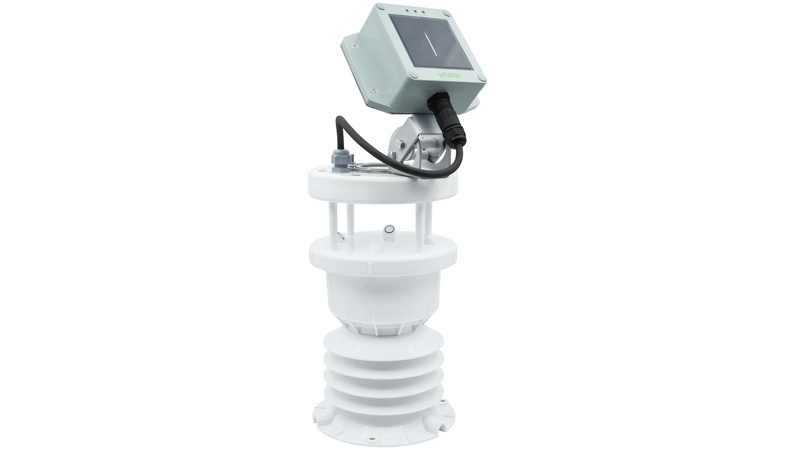
3S-ACWS-IS
3S-ACWS-TP: Includes a thermopile pyranometer measuring the global horizontal irradiance with Class A accuracy according to ISO 9060:2018 standard. Appropriate for solar resource assessment and feasibility studies.
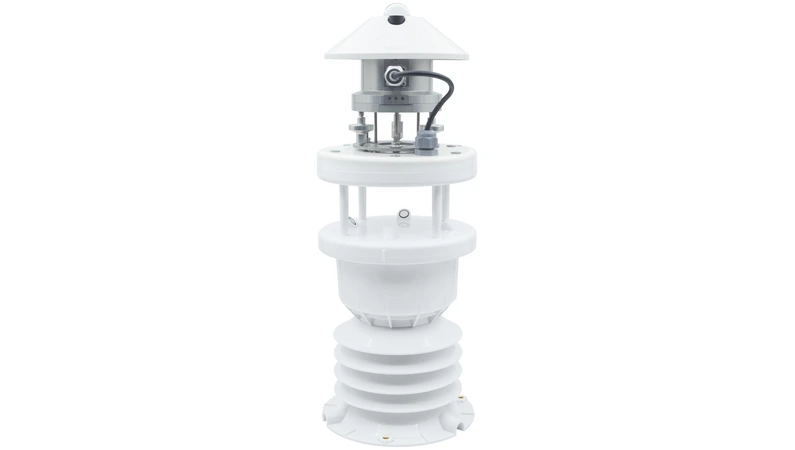
3S-ACWS-TP
Key Technical Specifications:
The wind measurement in the 3S-ACWS uses the same specifications as our 3S-UA Ultrasonic Anemometer. Detailed specifications of the irradiance sensors can be found on the irradiance sensors and thermopile pyranometer pages.
Why Choose an All-in-One Weather Station?
- Quick installation: 1 body, 1 cable, and 2 mounting options; ground or pipe mounting.
- Reduced maintenance: no moving parts and no mechanical wear.
- Proven performance in the field: IP66 rating and large temperature range of operation.
- Class A irradiance in the solar variants; POA or GHI.
- Easy to integrate: Modbus RTU via RS485, optionally Modbus TCP/IP, SunSpec compliant and configurable termination resistor.
- SEVEN support: remote configuration and after-sales support, 2 years warranty.
Where Can the 3S-ACWS Be Used?
- Solar power plants: The 3S-ACWS-IS measures POA irradiance, module temperature, ambient temperature, relative humidity, air pressure and wind information all in one instrument for the calculation of performance ratios. This makes it very suitable for rooftop and commercial solar plants because of lack of space.
- Meteorological stations: Seven parameters of core importance in a single unit, and the -TP version offers Class A GHI.
- Agro-meteorology: The -RG version is an instrument that measures rainfall along with other parameters like temperature, humidity, and wind.
- Industries: Weather monitoring in general with low maintenance requirements.
If you are planning a solar project, our guide on selecting sensors for a PV plant according to IEC 61724-1:2021 explains which measurements each monitoring class requires.
How Will the 3S-ACWS Be Installed?
Installation of the 3S-ACWS may be done directly on a level surface or on pipes through the use of an anodized aluminum mounting adapter. Here are some considerations for gathering reliable data:
- Ensure that the north indicator of the unit body is aligned with true north for correct wind direction.
- Select a location that will allow access to wind, rainfall, and sunlight.
- For the –IS version, make sure that the reference cell is tilted in the same manner as the modules.
- Grounding should be done through the mounting adapter and keep cables away from AC/DC power lines.
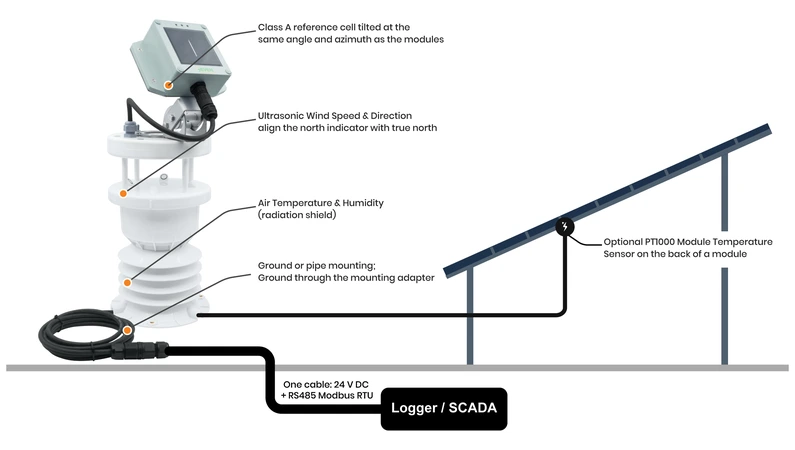
Typical 3S-ACWS-IS set-up in a solar plant
Be the First to Know
Would you like to use the 3S-ACWS in an upcoming project? Contact the SEVEN sales team to discuss your requirements.
Frequently Asked Questions (FAQ) about the 3S-ACWS
1. When will the 3S-ACWS be available?
The 3S-ACWS is soon to be released. You can contact SEVEN sales team right now and get your project discussed and receive information on release date once it becomes available.
2. What does the 3S-ACWS measure?
Temperature, humidity, atmospheric pressure, wind speed and wind direction are always measured. In addition, depending on the model, rain, POA irradiance or GHI can be measured as well. Irradiance models allow measuring temperature by PT1000 module sensor optionally.
3. Are there any moving parts in the 3S-ACWS?
No. It uses ultrasonic technology for measuring the wind, so there are no moving elements like cups or vanes.
4. Can 3S-ACWS be used to calculate the performance ratio of a solar plant?
Yes. 3S-ACWS-IS with the optional PT1000 module allows measuring all weather parameters necessary for calculation of performance ratio.
5. What communication options does it support?
Standard RS485 with Modbus RTU, Modbus TCP/IP optionally and SunSpec for Modbus RTU.
6. Is the cable included?
The power and communication cable is sold separately. Standard lengths are 3 m, 5 m and 10 m. Other lengths are available upon request.
References
6
View Sources
Close
-
SEVEN Sensor Solutions, 3S-ACWS All-in-One Compact Weather Station Datasheet, Revision 0.0, 20.10.2026.
-
IEC 61724-1:2021, Photovoltaic system performance — Part 1: Monitoring.
-
ISO 9060:2018, Solar energy — Specification and classification of instruments for measuring hemispherical solar and direct solar radiation.
-
IEC 60751:2022, Industrial platinum resistance thermometers and platinum temperature sensors.
-
WMO-No. 8, Guide to Instruments and Methods of Observation, World Meteorological Organization.
-
SEVEN Sensor Solutions, Ultrasonic Anemometer – 3S-UA. https://www.sevensensor.com/ultrasonic-anemometer