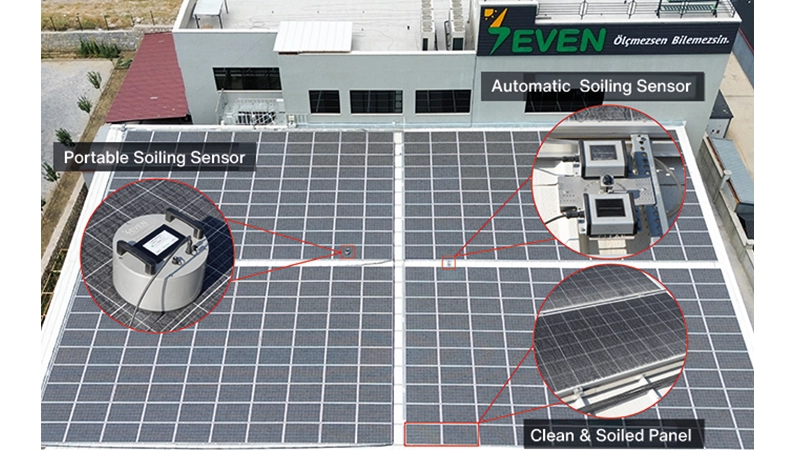
Soiling sensors are devices used in solar power plants to determine and monitor the soiling ratio. Developed by SEVEN Sensor, the unique Portable Soiling Sensor is a portable product that can quickly and instantly measure the soiling ratio on solar panels on-site.
In this study, an application was carried out on 21 August 2025 at the 128 kWp solar power plant located on the roof of SEVEN Sensor’s factory on 11th Street in the Çorum Organized Industrial Zone, in order to confirm the measurement accuracy of the Portable Soiling Sensor.
Data obtained from the Portable Soiling Sensor was compared with data obtained from the Automatic Soiling Sensor installed in the same field, and this comparison was confirmed by measurements taken on the solar panels in the field.
Why is the Automatic Soiling Sensor Used as a Reference?
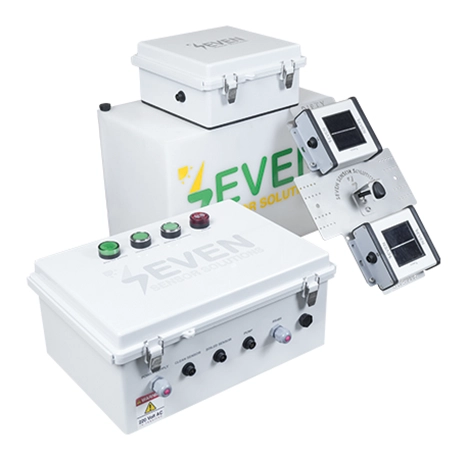
The Automatic Soiling Sensor has two irradiance sensors, one clean and the other left soiled. The soiled sensor naturally accumulates dust under the same conditions as the panels in the field, while the clean sensor is cleaned daily by an automatic water spray system. The device evaluates the data received from these two sensors according to the IEC 61724 standard and calculates the soiling ratio as a single daily average value within a ±2 hour time frame from local noon, excluding low irradiance values and unstable weather conditions. Thus, measurement is only performed based on the most stable data and within the defined time interval. Due to all these features, the Automatic Soiling Sensor is considered a reliable reference.
What do direct measurements on solar panels provide?
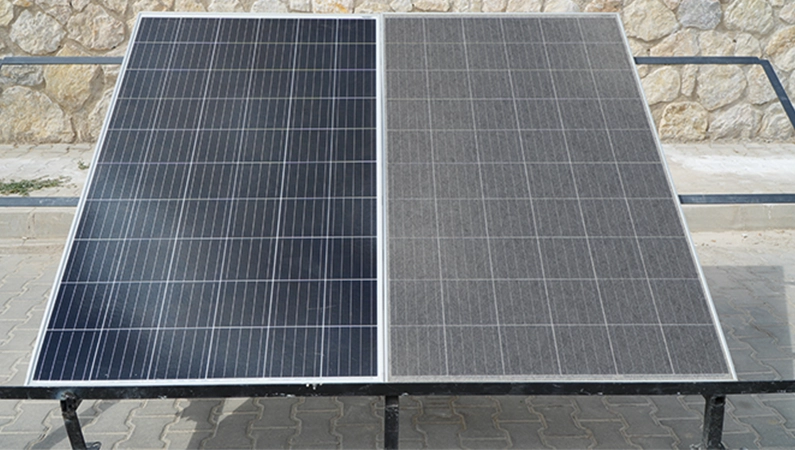
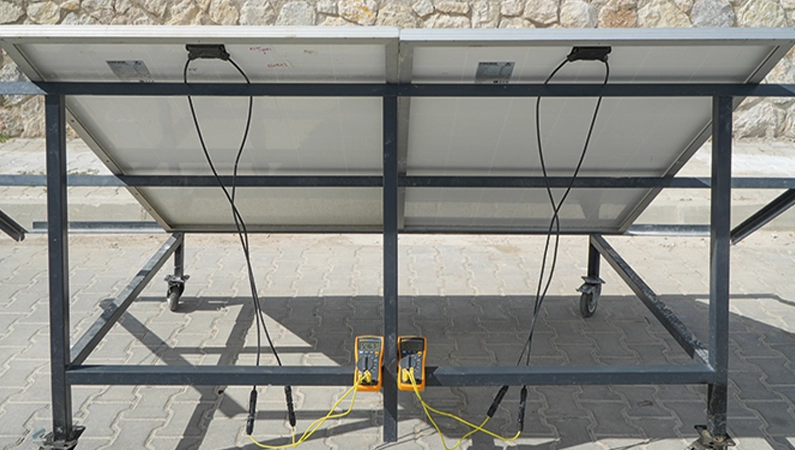
To reinforce the accuracy of the measurements, a comparative test was conducted by removing two panels from the field. One of these panels was completely cleaned, while the other was left soiled in its current state. Subsequently, short-circuit currents of both panels were measured at local midday and under stable weather conditions, in accordance with the IEC 61724 standard. Since the short-circuit current indicates the electrical power that the panel can directly generate, it most reliably reveals the panel’s performance. Therefore, comparing the current values obtained from the clean and soiled panels clearly reflects the effect of dust accumulation on actual energy loss.
How does a portable soiling sensor take measurements?
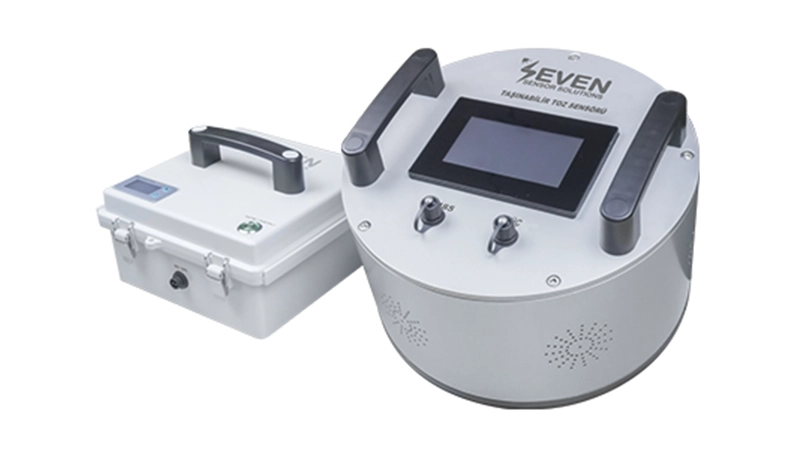
The portable soiling sensor operates based on optical principles. Lamps inside the device emit high-lumen light onto the panel surface; the reflection and scattering of this light from the panel are detected by sensitive sensors. The obtained data is processed by advanced software running on the electronic board within the sensor to calculate the soiling ratio.
Before measurement, parameters about the solar panel and the characteristics of the dust on the panel are selected via the LCD screen on the sensor. Then, to take measurements with the Portable Soiling Sensor, three separate measurements are taken from three different points on the soiled panel, each lasting 1 minute. After this process is completed, the panel is cleaned, and three more measurements are taken from the same points, again for 1 minute each. Based on the measurements and data obtained, the soiling ratio is calculated and the results are displayed on the LCD screen.
Soiling Ratio Measurement Results
Soiling ratios measured on different days with a portable soiling sensor, an automatic soiling sensor, and directly on solar panels are shown in the table below.
| Date | Portable Soiling Sensor | Automatic Soiling Sensor | Plurawatt 330 Wp Soiled and Clean Solar Panels |
| 21 August 2025 | 3,0% | 3,9% | 3,4% |
| 1 September 2025 | 6,5% | 7,0% | 6,3% |
What do the results say about the portable soiling sensor?
Short-circuit current measurements taken from both soiled and clean solar panels are the most reliable method for determining the soiling ratio, as they directly reveal the panel’s performance. The data obtained in this study show an approximate 1% difference between the portable soiling sensor (3,0% – 6,5%) and the panel measurements (3,4% – 6,3%). This difference stems from the sensor’s measurement uncertainty and is acceptable for soiling ratio measurements. In conclusion, the comparisons demonstrate that the portable soiling sensor provides accurate measurements.
Frequently Asked Questions
How long does it take for a portable soiling sensor to take a measurement?
The portable soiling sensor calculates the soiling ratio of a panel based on a 6-minute measurement. The measurement process first takes 1-minute measurements from three different points on the soiled panel; then, after cleaning the panel, 1-minute measurements are taken again from the same three points to complete the calculation.
Can we trust the measurement results of the portable soiling sensor?
During the R&D and product development processes of the Portable Soiling Sensor, extensive tests were conducted on numerous solar panels of different brands and power levels, and on dust of various colors, following processes similar to those presented in this article. The specialized software used in the sensor was developed based on the data obtained from these tests. Both the project work carried out and the results presented in this article demonstrate the reliability of the Portable Soiling Sensor's measurement results.
What is the measurement uncertainty of a portable soiling sensor?
The portable soiling sensor has a measurement uncertainty of 2%. This uncertainty stems from the sensor's measurement technique, which relies on the reflection and scattering of light from the panel surface.
Should the same panels be used for clean and soiled panel measurements?
Yes. The portable soiling sensor bases its calculation on the reflection and scattering properties of light. Even if solar panels are of the same brand and specifications, the light reflected from their clean surfaces can vary. The same applies to different points on the same panel. Therefore, to obtain the most accurate and precise measurement, after taking measurements from soiled panels, subsequent measurements on clean panels should be performed on the same panel and at the same points.
What is the most important feature that distinguishes the Portable Soiling Sensor from other soiling sensors and measurement methods?
The most important feature of the Portable Soiling Sensor is its independence from external conditions during the measurement process. Existing sensors and methods generally require weather conditions, measurement time, or similar environmental factors to calculate the soiling ratio. In contrast, thanks to its measurement technique, the Portable Soiling Sensor can quickly and instantly calculate the soiling ratio independently of external conditions.