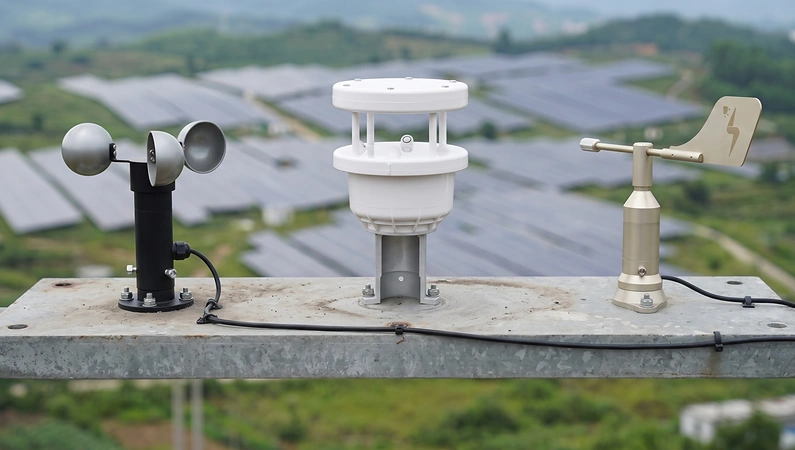
Cup Anemometer vs Ultrasonic Anemometer
For a long time, the measurement of wind was made by three spinning cups and a vane. Cup anemometers can be found everywhere from compact weather stations to wind farm met masts. However, more and more often people decide to use ultrasonic anemometers that don’t have any moving parts.
But what if there is one to choose? As always, there is not such an answer as the right one; everything depends on your requirements. In this article, we are going to analyze both technologies and give some recommendations on which of them to be used for solar power plants, weather stations, and any other application.
As a short answer; Cup anemometer measures the speed of the wind from the movement of its cups and requires a separate vane for direction measurement. The technology is proven, low power and economical. Ultrasonic anemometer measures speed and direction of the wind using a timing of sound waves sent between transducers without any moving parts.
How Does a Cup Anemometer Work?
Three cups mounted around a vertical shaft spin in response to the wind. The faster the cups spin, the faster the wind blows. Magnetic and Hall-effect sensors convert every rotation of the cups into a pulse that is converted into wind speed expressed in m/s. Wind direction is registered separately using the wind vane in degree (o).
As the cups must have enough energy to spin, there is a starting threshold in any cup anemometer. In the case of SEVEN cup anemometers, for example, measurements start at 0.9 m/s. You can find more information about them in our article about SEVEN wind sensors for solar plant performance.
How Does an Ultrasonic Anemometer Work?
In an ultrasonic anemometer, the transducer sends ultrasonic pulses to each other and the wind speeds up its travel in one direction while slowing down the travel in the other. This small variation in the travel times along two axes determines the speed and direction of the wind.
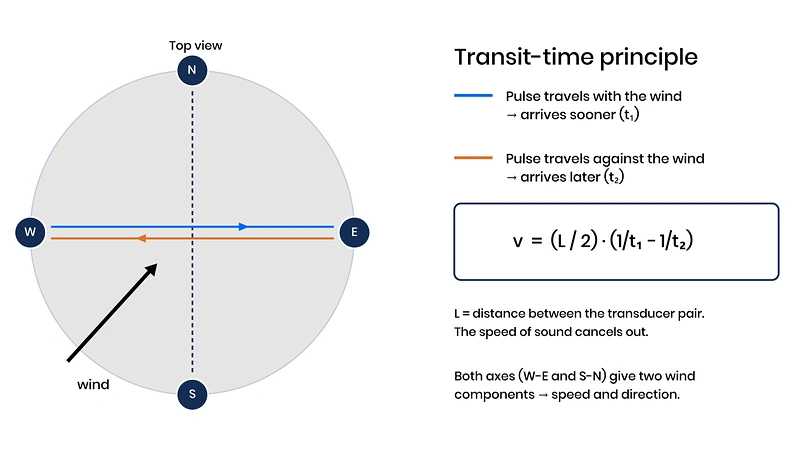
Since there is nothing to rotate here, there is no starting torque required. The SEVEN 3S-UA Ultrasonic Anemometer, for example, measures 0 to 75 m/s and 0 to 360° in one compact body.
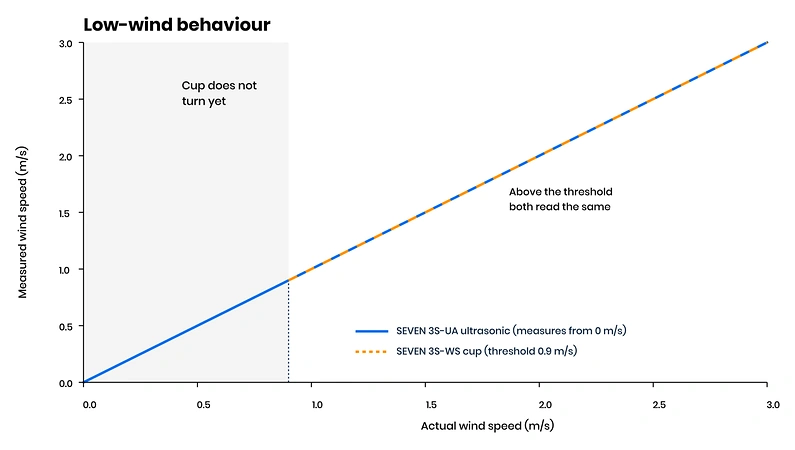
Low-wind behaviour of 3S-WS and 3S-UA
Cup vs Ultrasonic Anemometer: Comparison Table
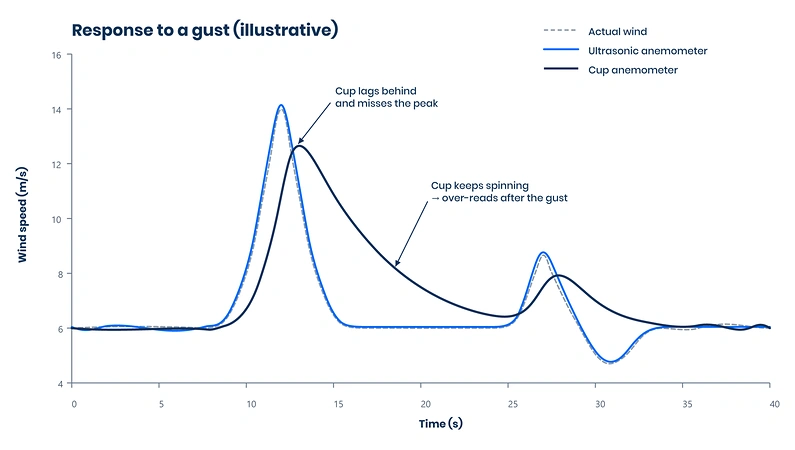
Illustrative response to a gust: the cup anemometer and ultrasonic anemometer
Cup anemometers: what are their advantages and disadvantages?
Advantages
- Proven and long-field-tested design
- Low energy consumption suitable for use on battery or solar powered stations
- Pulse output easily recognized by any datalogger
- Cheap; particularly cheap if wind speed is all that matters
- Still used as the standard wind speed sensor in wind energy, such as performance tests according to IEC 61400-12-1
Disadvantages
- Temperature-sensitive bearings that cause slow deterioration in accuracy and require maintenance
- Cannot measure low winds below the threshold wind speed
- Inertia makes them register false high speeds in gusty wind
- Ice can stop cups from turning if a heated version is not used
- Wind direction requires an additional sensor and cable
What Are the Strengths and Weaknesses of Ultrasonic Anemometers?
Strengths
- No moving parts, therefore no wear, friction and minimal maintenance
- Provides wind speed and direction in one instrument using one cable
- Measurement of calm situations and very low wind speed
- Sensitive to gusts and wind direction change
Weaknesses
- More expensive purchase price
- Strong rain, snowfall, birds and insects could momentarily obstruct the measuring path
Which One Will Suit Solar Plants Better?
In solar power plants, the wind data are collected for two reasons: analysis of the module temperature, since the wind cools the modules, and protection from wind. In single-axis trackers, the module automatically goes to the stow position at the wind speed above the certain threshold. Here the ability of the sensor to react quickly to gusts and not get frozen is a big plus, hence the popularity of ultrasonic anemometers for tracker applications.
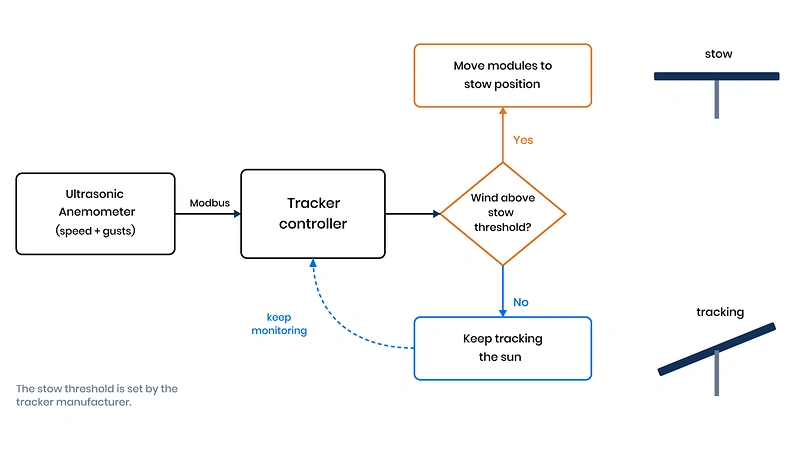
Wind-stow logic in a single-axis tracker plant
For fixed tilt solar plants, where the wind data collection is required primarily for reports, a simple cup anemometer and wind vane combination is more than enough. Requirements for sensors in each class of monitoring are described in our article about selecting sensors according to IEC 61724-1:2021.
Which One Is Superior for Weather Stations and Wind Farms?
Ultrasonic anemometers are highly favored when it comes to ordinary weather stations, ports, airports, and even building surfaces as they offer speed and direction measurements and operate effectively for many years with only minimal servicing. As far as wind resource evaluation and turbine testing goes, cup anemometers are widely used due to established measurement procedures and calibration methods. Our article on how wind sensors are used in wind turbine testing and wind farm measurements covers this in more detail.
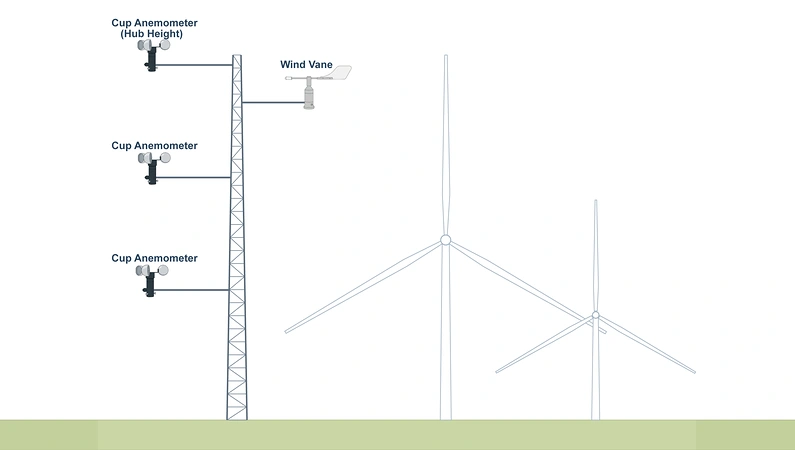
Wind farm met mast with boom-mounted cup anemometers at several heights and a wind vane
Tips for Installing Any Anemometer
- Securely install the anemometer in an area where there is free movement of air without obstruction from any buildings, trees or rows of modules. In meteorological stations, according to the World Meteorological Organization (WMO), the reference height for surface winds is 10 meters above ground level.
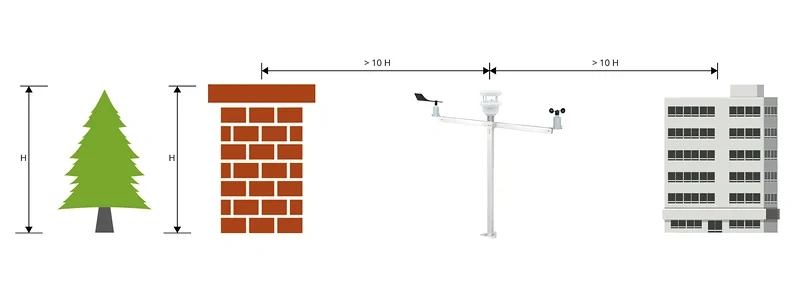
- Point the north indicator in the direction of true north as any deviation in direction will skew the reading of direction.
- Do not route the power and communications cable near any AC or DC power lines.
Choose the Right Wind Sensor for Your Site
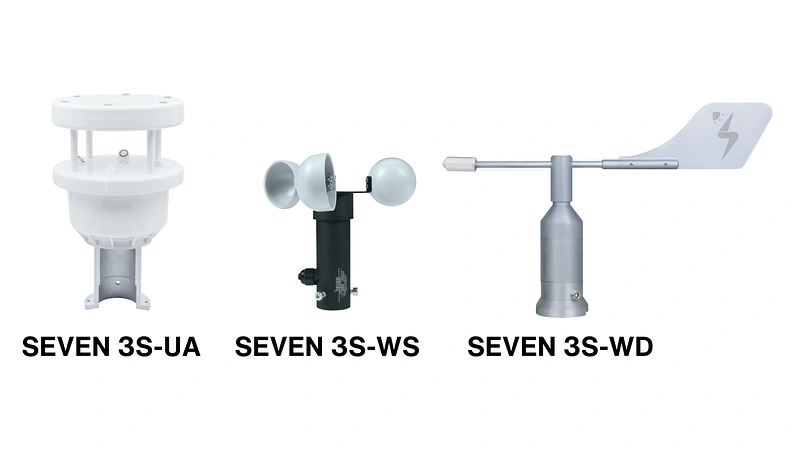
SEVEN offers both cup anemometers and wind vanes with pulse, analog and Modbus outputs, and the 3S-UA Ultrasonic Anemometer with Modbus RTU output. If you are not sure which one suits your project, contact our sales team.
Frequently Asked Questions (FAQ) about Cup and Ultrasonic Anemometers
Is an ultrasonic anemometer more accurate than a cup anemometer?
Usually, yes; because it has no inertia and no start threshold. Under stable wind, a properly calibrated cup anemometer is very accurate.
Can an ultrasonic anemometer measure 0 m/s?
Yes. No rotation is needed, hence calm and even very weak wind can be measured.
Does an ultrasonic anemometer need calibration?
It is factory calibrated and does not require calibration. Like any other sensor, it should be periodically verified.
What happens with anemometers in icing conditions?
The cups freeze and stop rotating. The ultrasonic anemometer is more robust, but there are heated versions of cup anemometers and vane sensor.
Can an ultrasonic anemometer replace the cup anemometer and a wind vane?
Yes. One anemometer will measure both speed and direction in one housing and one cable.
Which anemometer requires less energy?
A cup anemometer with a pulse output works with minimum power consumption. Ultrasonic anemometer requires much more energy.
References
6
View Sources
Close
-
WMO-No. 8, Guide to Instruments and Methods of Observation, World Meteorological Organization.
-
IEC 61400-12-1, Wind energy generation systems — Part 12-1: Power performance measurements of electricity producing wind turbines.
-
IEC 61724-1:2021, Photovoltaic system performance — Part 1: Monitoring.
-
SEVEN Sensor Solutions, Ultrasonic Anemometer – 3S-UA (product page and datasheet). https://www.sevensensor.com/ultrasonic-anemometer
-
SEVEN Sensor Solutions, SEVEN Wind Sensors: Reliable Wind Monitoring for Smarter Solar Plant Performance. https://www.sevensensor.com/seven-wind-sensors-reliable-wind-monitoring-for-smarter-solar-plant-performance
-
SEVEN Sensor Solutions, How Are Wind Sensors Used in Wind Turbine Testing and Wind Farm Measurements? https://www.sevensensor.com/how-are-wind-sensors-used-in-wind-turbine-testing-and-wind-farm-measurements