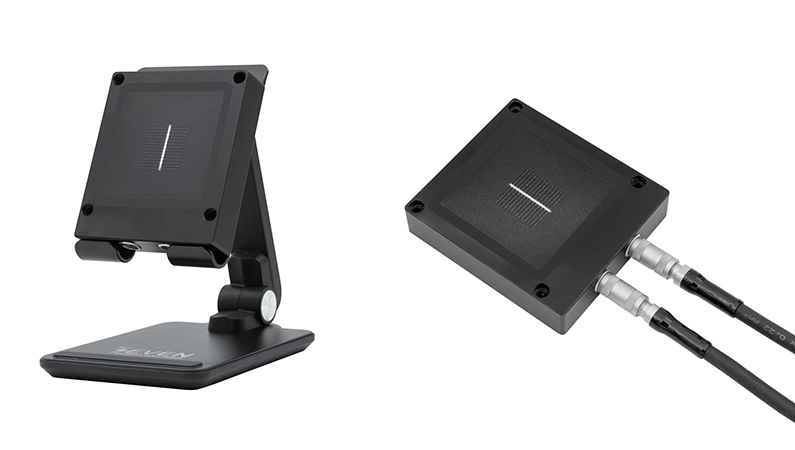
The performance analysis and electrical characteristics of solar cells and modules are measured and tested under standard test conditions. Additionally, the calibration of irradiance sensors and pyranometers used in PV power plants is likewise performed under standard test conditions. In these measurement and calibration procedures, measuring the solar simulator and outdoor irradiance levels with high precision is of paramount importance.
The WPVS – World PV Scale – standard is cited as an international reference standard that defines the mechanical design and electrical parameters of the reference cell used for high-precision irradiance measurement. Because WPVS reference cells comply with the IEC 60904-2 and IEC 60904-4 standards, they minimize measurement uncertainty and spectral mismatch errors of the device.
Seven Sensor 3S-WPVS
Argesim Technology produces and develops the 3S-WPVS reference cell under the Seven Sensor brand using domestic and national capabilities, alongside the meteorological sensors required by solar power plants.
Every step in the manufacturing of Seven Sensor 3S-WPVS reference cells is subjected to quality control processes. Products are individually calibrated under a Class AAA Solar Simulator using secondary reference devices calibrated by ISFH (Institut für Solarenergieforschung Hameln) and Fraunhofer ISE, and are delivered to the customer accordingly.
Because WPVS reference cells are used in high-precision measurements, they contain precision measurement components. Seven Sensor ships the product to customers in specialized protective boxes to ensure the sensors do not lose their calibration and measurement accuracy during transport.
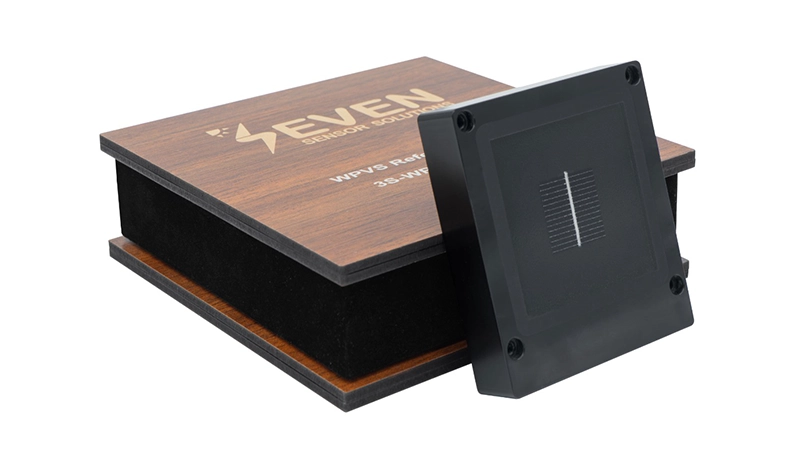
Apart from the standard products offered by Seven Sensor, custom design and production can also be carried out for specific customers or projects. For example, instead of using the PT100 standard temperature sensor depending on the system to be utilized, a PT1000 temperature sensor providing higher precision measurement can be integrated. Furthermore, a milliampere (mA) output option is available instead of millivolts (mV) as data output for specific customer and project requirements.
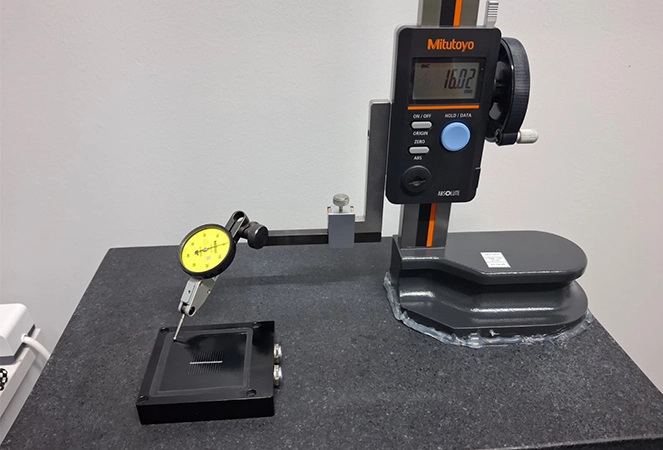
After the WPVS reference cells are manufactured, they undergo a rigorous quality control process by the Quality Department. The distance from the substrate to the cell, which adheres to production standards, is measured using a calibrated precision instrument
Technical Design and Hardware Specifications
The design and hardware specifications of the WPVS reference cell have been implemented based on data accepted by standards. These are:
- Reference Cell Structure: 20×20 mm Monocrystalline Silicon Cell
- Field of View: 162°
- Housing: Anodized aluminum with protective coating
- Protection Class: IP68
- Cell-to-Ground Distance: 8 mm
- Connection: 2x 4-pin Lemo Connector (Cell output, Pt100 Temperature Sensor)
| Parameter | Specification |
| Model Codes | 3S-WPVS-mV / 3S-WPVS-mA |
| Reference Cell | Monocrystalline Silicon – 20×20 mm² |
| Field of View (FOV) | 162° |
| Output Signal | Analog mV (with Internal Precision Shunt Resistor) or Custom Current (mA) Output |
| Temperature Sensor | Pt1000 Class A (EN 60751) / Optional Pt100 |
| Housing Material | Anodized Aluminum |
| Protection Class | IP68 (Water and Dust Proof) |
| Dimensions & Weight | 70 x 79 x 16 mm | 250.8 g, cell-to-ground distance: 12.8 mm |
| Compliant Standards | IEC 60904-2, IEC 60904-4, IEC 60904-7 |
| Calibration Source | Fraunhofer ISE & ISFH (Germany) Accredited Reference Cell Class AAA Simulator |
| Warranty Period | 5 Years |
Application Areas
The WPVS products manufactured by our company are suitable for use in various fields, with production aligned to standards as well as customized for specific customers or projects. Some of these applications include:
- Solar Sun Simulator Calibration: Used to adjust and test the irradiance level of sun simulators to 1000 W/m² STC values in PV module or cell testing laboratories.
- Solar Panel Manufacturing Facilities: Used in the power and efficiency verification of panels produced at manufacturing plants.
- Research & Development (R&D) Laboratories: Preferred for verification, correction, calibration, and characterization studies during tests of newly developed photovoltaic cells or systems.
In addition to these, in field applications outside the laboratory under natural sunlight, verification tests are conducted at solar power plants, and plant efficiency is calculated by measuring plane-of-array (POA) irradiance in solar power plants (SPP).
Frequently Asked Questions (FAQ)
What is Seven Sensor 3S-WPVS?
It is a reference cell that measures solar irradiance with high precision in accordance with the IEC 60904-2 standard.
Which temperature sensor options are available?
The PT100 temperature sensor is used as standard. Additionally, the PT1000 Class A (EN 60751) is available as an option.
What are the output signal types?
Our standard product provides mV output via an internal shunt resistor. An optional mA output product option is also available.
What are the application areas of the WPVS product?
It is used in solar simulator calibration, panel manufacturing quality control, laboratory R&D studies, and outdoor SPP efficiency measurements.
How are the products shipped?
The WPVS reference cell is shipped inside a custom box specially designed according to its dimensions, packaged to prevent any damage.
Is manufacturer calibration performed before the product is shipped?
Yes, the product is calibrated using a Class AAA sun simulator with a secondary reference cell calibrated by an accredited organization.
What is the price of it?
The standard WPVS reference cell is 960 EUR.