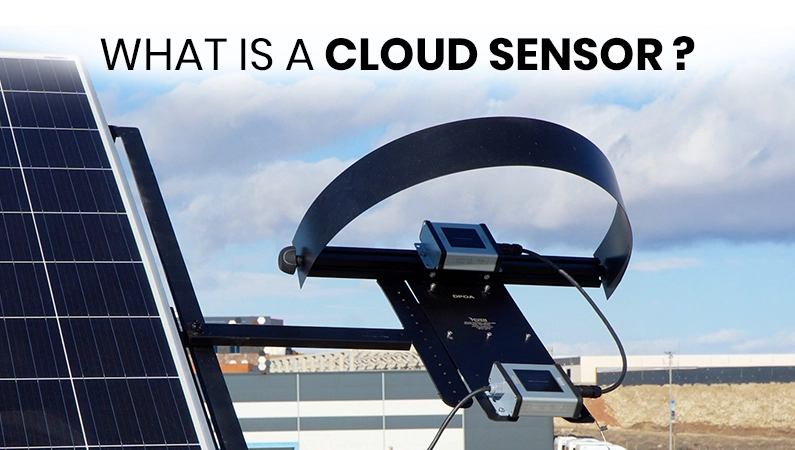
The SEVEN 3S-CS-MB Cloud Sensor measures cloud density in the sky. It is a meteorological sensor that calculates cloud coverage by analyzing how much solar radiation reaches the panels. It is primarily used in solar power plants (SPPs) to improve production forecasts, optimize tracker systems, and accurately analyze plant performance.
How Does a Cloud Sensor Work?
Cloud sensors measure the ratio between Diffuse Irradiance and Planar Oriented Angle (POA) radiation. Instantaneous and daily average cloud cover ratios are calculated based on this ratio. The basic operating principle consists of the following steps:
- The sensor exposed to the sky (POA Sensor) measures POA radiation.
- The other sensor, which is under the shading band (DPOA Sensor), measures diffuse irradiance.
- The cloud cover ratio is calculated from the formula between these two data points.
In other words, the cloud density in the sky is determined by analyzing changes in the sun and clouds in the air.
Why Are Cloud Sensors Used in Solar Power Plants?
Cloud sensors are used in solar power plants because solar energy production is directly affected by atmospheric conditions. Cloud sensors measure changes in solar radiation, helping to analyze plant performance. They serve purposes such as improving energy production forecasts, tracking radiation changes, optimizing tracker systems, increasing meteorological data accuracy, and accurately evaluating plant performance.
Clouds block sunlight, reducing the amount of energy received by the panels and decreasing electricity production. Therefore, cloud sensor data enables the analysis of the reasons for production declines, the identification of atmospheric losses, and a more accurate interpretation of performance. This makes cloud sensors an important part of meteorological measurement systems, especially in large-scale solar power plants.
Is the Cloud Sensor Important in Tracker Systems?
In a solar power plant, panels track the sun using solar tracker systems. However, in heavily cloudy weather, the constant movement of tracker systems can lead to:
- Unnecessary energy consumption
- Mechanical wear
- Maintenance costs, etc.
The cloud sensor ensures energy efficiency and accurate measurements in the tracker system. With the cloud sensor, the tracker system:
- Detects cloud density.
- Optimizes tracker movements.
- Reduces unnecessary panel movements.
What Data Does the Cloud Sensor Measure?
The cloud sensor provides the “cloud cover percentage” as a measurement result. There are three most common units worldwide for cloud cover percentage:
- Octa (0–8): Octa divides the sky into eight equal parts, indicating the covered area of the sky. 0 octa means completely clear, 8 octa means completely overcast.
- Percentage cloud cover (%0–100): Percentage cloud cover is the most common format seen in mobile applications and many weather APIs. 0% means completely clear, 100% means completely overcast.
- Cloud fraction (0–1): Cloud fraction provides the cloud ratio within a grid cell in numerical weather prediction and climate models on a scale of 0–1. 0 means completely clear, 1 means completely overcast.
As a result, cloud sensors instantly analyze changes in solar radiation by measuring cloud density in the sky, thereby increasing the accuracy of energy production forecasts. Production simulations can be made more accurate by monitoring cloud movements in real time. Tracker systems operate more efficiently by avoiding unnecessary movements, and power plant performance is evaluated more accurately, free from meteorological effects. Due to these advantages, cloud sensors are widely used as a critical meteorological data source in many processes, from grid planning to operations management, in modern solar power plants.
For more information about the SEVEN Sensor Solution 3S-CS-MB Cloud Sensor, please contact us.
Frequently Asked Questions (FAQ)
What does the cloud sensor do?
The cloud sensor is used to measure cloud cover in the sky. In solar power plants, this data is used for energy production forecasting, performance analysis (PA), and tracker optimization.
Is the cloud sensor mandatory for solar power plants?
Mandatory status depends on the project specifications and investor/operator objectives. However, especially in large-scale plants, sites using solar trackers, and projects with detailed performance monitoring, using a cloud sensor is very useful for explaining production fluctuations and improving prediction accuracy.
Is there a cloud sensor manufacturer?
SEVEN Sensor Solution is a cloud sensor manufacturer. With its 3S-CS-MB Cloud Sensor model, it provides cloud cover data.
What data does the cloud sensor provide?
Although it varies depending on the application and sensor model, it typically provides the following: Cloud cover percentage, Direct radiation, Diffuse radiation, Radiation on the panel plane (POA)
Why is the cloud sensor important in tracker systems?
In heavily cloudy conditions, continuous movement of tracker systems can lead to unnecessary energy consumption and mechanical wear. With cloud sensor data, tracker control can be made more intelligent; unnecessary movements are reduced, lowering maintenance costs and extending system lifespan.