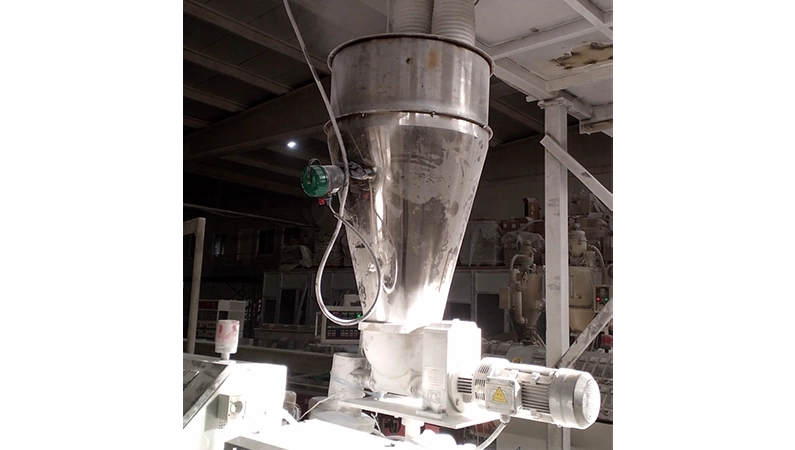
If you store powders or granules, then the silo is the core of your operation. To avoid overfilling or an out-of-stock situation, you will need to use a Silo Level Sensor.
A Silo Level Sensor allows you to know if you reached the maximum capacity of the silo or if you reached the minimum quantity and you need to plan for filling back the silo.
What are Silo Level Sensor models?
At SEVEN Sensor Solutions, we manufacture two practical, proven technologies for point level detection in bulk solids:
- Rotary Paddle Silo Sensors (paddle type)
- Capacitive Silo Level Sensors
How Does a Rotary Paddle Silo Sensor Work?
SEVEN rotary paddle silo sensor works based on a mechanical principle. The motor rotates the paddle when no solid material is present at the paddle level, and the COM–NC connection is active. Although the motor remains active, the paddle stops rotating, and the COM–NO connection is activated. The paddle resumes movement once the level of solid material compressing it decreases, and the COM–NC connection becomes active.
The rotary paddle silo sensor can either be installed vertically or horizontally.
In order to monitor both maximum and minimum fullness levels, you need to use 2 rotary paddle silo sensors as illustrated in the following photo.
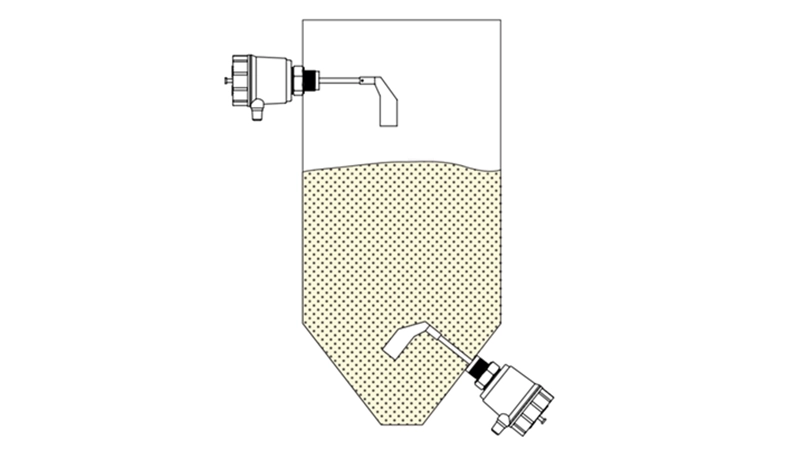
SEVEN can offer an extended length for the shaft as well as Thermal Protection Apparatus upon the end user’s request.
How Does a Capacitive Silo Level Sensor Work
Capacitive sensors detect materials by utilizing the electric field created by electric charges. When the product to be detected comes near or makes contact with the sensor, the capacitance value changes according to the adjustable sensitivity level, and this data is sent to the automation system through the sensor’s relay. The status of the sensor can also be monitored via the warning light on the sensor.
The warning light operates in 3 different modes:
- When the warning light is continuously off, it indicates that there is no power to the sensor.
- When the warning light is flashing, it indicates that the silo is not yet full.
- When the warning light is continuously on, it indicates that the silo is full.
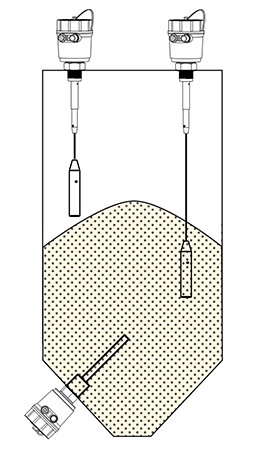
SEVEN offers customized length of the Steel Wire Rope upon the end user’s request.
Installation Notes That Matter in the Field
You can reach the detailed installation instructions by checking SEVEN User Manuals for Rotary Paddle Level Sensor and for Capacitance Silo Sensor. Here are some main points to pay attention to:
- Placement matters: avoid positioning too close to filling zones where material piles, impacts, or coats components unnecessarily.
- Capacitive sensors may need periodic cleaning in dusty products; dust buildup can influence sensing over time.
- Use proper grounding to reduce susceptibility to electrical noise, especially with capacitive sensing.
Frequently Asked Questions (FAQ) about Silo Sensors:
What is a silo level sensor?
A silo level sensor is a device that detects whether material has reached (or dropped below) a specific point inside a silo, tank, or bunker, often used for high-level and low-level alarms to automate filling and discharge.
What’s the difference between point level and continuous level?
Point level sensors detect presence/absence at a fixed height (on/off signal). Continuous level systems measure the ongoing level across the full height (percentage/height output).
How does a rotary paddle level sensor work?
A motor rotates a paddle. When bulk material reaches the paddle, it resists or stops rotation and the sensor switches its relay output to indicate “material present.”
How does a capacitive silo level sensor work?
It monitors changes in capacitance (electric field effect). When material approaches or contacts the sensor, capacitance changes and the device switches output based on sensitivity and calibration.
What power supply do SEVEN silo sensors use?
SEVEN’s rotary paddle silo sensor operates on 18–30 VDC, and SEVEN’s capacitive silo level sensor operates on 18–26 VDC.
What kind of output signal do they provide?
Both SEVEN technologies provide a relay (dry contact) ON/OFF output, rated up to DC max 125V / 10A.
Do capacitive sensors require calibration?
Typically, yes, especially in dusty or variable materials. SEVEN’s capacitive sensor supports calibration via an adjustment potentiometer and recommends periodic cleaning in dusty products.
What is the price range of Rotary paddle silo sensors?
Rotary paddle silo sensors typically range from 70-120 EUR.
What is the price range of Capacitive silo level sensors?
Capacitive silo level sensors generally range from 100-180 EUR.