As SEVEN Sensor, we offer weather stations that are compatible with the monitoring systems of many leading data logger manufacturers.
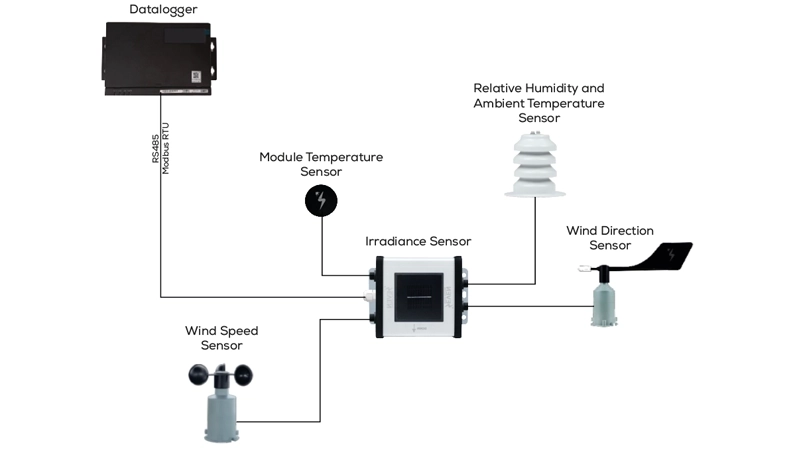
Weather stations measure the site conditions that affect solar power plant performance. Irradiance, temperature, and wind measurements are used to compare expected energy production with actual output. If there is a performance loss, these measurements help operators check whether the reason is weather conditions, temperature effects, soiling, or a technical problem.
What Does a Weather Station Measure in PV Plants?
A typical PV weather station can include the following sensors, depending on the monitoring needs of the plant:
- Solar Radiation Sensor or Irradiance Sensor
- Module Temperature Sensor
- Ambient Temperature Sensor
- Wind Speed Sensor
In some projects, additional measurements may also be required, such as:
- Wind Direction Sensor
- Relative Humidity Sensor
- Precipitation Sensor
- Air Pressure Sensor
How Does It Work?
In a typical PV monitoring setup, the sensors collect meteorological measurements and send them to the data logger through the required output or communication interface. Depending on the project, this can be an analog signal, Modbus RTU, digital output, or a project-specific communication protocol. The data logger then transfers these measurements to the monitoring platform, where they can be evaluated together with production and inverter data.
Which Data Loggers Are SEVEN Weather Stations Compatible With?
In most PV plants, operators use data loggers, inverter platforms, monitoring portals, or SCADA systems to follow plant performance. The data logger records measurements such as irradiance, module temperature, ambient temperature, and wind speed, then sends them to the monitoring system together with production data.
SEVEN Weather Stations can be used with many leading data logger and inverter platforms, including:
- Huawei Smartloggers
- GoodWe EzLoggers
- SMA Data Managers and Cluster Controllers
- SolarEdge Data Loggers
- Bluelog Data Loggers
- Sungrow Data Loggers
- Growatt ShineMaster
- ABB/Fimer Inverter and VSN700 Data Logger
- Encombi Controller
- Elum Data Logger
- General Electric (GE) Inverters
- Kehua Tech’s Datalogger E-Manager Pro
- Wattch Edge Controller
- SolaX DataHub 1000
- Solplanet Data Logger
- Solis Data Logging Box
- Sico Data Logger
- DEIF ASC-4 Solar and ASC 150 Solar Controllers
- HopeComBox1000-G03 and HopePowerBoxSolar
- WebdynSunPM Data Logger
- Sunvec Data Logger
- Solar-Log™ Data Loggers
- Chint Data Logger
- Other data loggers that support Modbus RTU communication
The list above does not cover every possible monitoring platform. A broader range of supported platforms and weather station options can be found on the SEVEN Sensor Weather Stations page.
SEVEN Weather Stations are listed in the supported device and compatibility documents of several leading inverter and data logger manufacturers, including Huawei, Sungrow, Blue’Log, Kehua Tech, Solplanet, Elum, DEIF, Hopewind, Solis, Solar-Log, Chint, and Sigenergy.
If your monitoring platform is not listed above, Contact Us to determine the most suitable weather station configuration for your monitoring infrastructure.
Frequently Asked Questions (FAQ)
Which sensors are required in a PV weather station according to IEC 61724-1?
The required sensors in a PV weather station depend on the monitoring class, project size, and the data needed for performance analysis. Many systems include irradiance, module temperature, ambient temperature, wind speed, wind direction, humidity, precipitation, and air pressure measurements. For IEC 61724-1 performance monitoring, irradiance and module temperature are among the main inputs used to evaluate PV plant performance. You can review SEVEN’s related guide here: IEC 61724-1:2021 Sensor Requirements for PV Plant Performance Monitoring
How does a weather station improve performance ratio (PR) calculations?
A weather station improves PR calculations by providing measured site data such as irradiance, module temperature, ambient temperature, and wind conditions. These measurements are used to compare expected energy output with actual production and to understand whether losses are related to weather, temperature, soiling, or technical issues. This topic is further explained in How to Calculate the Performance Ratio (PR) of a PV Plant?.
Where should sensors be installed in a solar weather station?
Weather station sensors should represent the actual operating conditions of the PV plant. For POA measurement, irradiance sensors should have the same tilt and azimuth angle as the PV modules. Irradiance and module temperature sensors should also be kept away from shading and local disturbances. Wind sensors should be installed in open areas where nearby structures do not block airflow. These installation points are also discussed in Best Practices for Installing Sensors in PV Projects.
What should be considered when selecting a weather station for a solar plant?
Before selecting a weather station, the required sensor set should be checked first. IEC 61724-1 monitoring class, data logger compatibility, communication protocol, calibration requirements, and site conditions are also important. Some PV plants only need a compact configuration, while others require a project-specific setup for the existing monitoring infrastructure. You can compare available solutions on the SEVEN Weather Stations page.