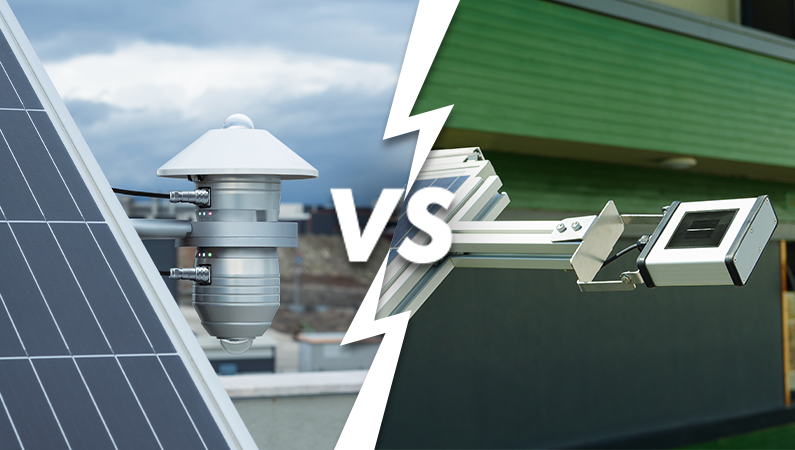
With the increased application of bifacial solar PV in utility scale installations, albedo measuring cannot be overlooked anymore. The reflected ground radiation influences directly the rear side contribution, power output, and performance ratio (PR).
Two types of albedometer measuring devices are typically deployed at PV sites:
- PV Albedometer employing reference cells (silicon sensor)
- Thermopile albedometer using pyranometers
Both devices are considered legitimate measuring instruments, and according to IEC 61724-1:2021, it recognizes the role that albedo plays in bifacial photovoltaic system efficiency. SEVEN offers both reference PV cell albedometers as well as thermopile albedometers, with class A quality performance.
Why is Albedo Measurement Essential in Bifacial PV?
In bifacial PV technology, not only is there power generation from front-side irradiation, but also from reflected irradiation from the ground. Factors that affect the albedo include:
- Type of ground cover (soil, gravel, sand, snow, and concrete)
- Weather conditions
- Seasonal variations
Wrong assumptions about the albedo result in mistakes when calculating the bifacial gain and PR values.
IEC 61724-1:2021 outlines the principles of measurement in bifacial PV and focuses on the importance of rear-side and albedo measurements in the assessment of PV performance.
What Is a PV Albedometer (Reference Cell-Based)?
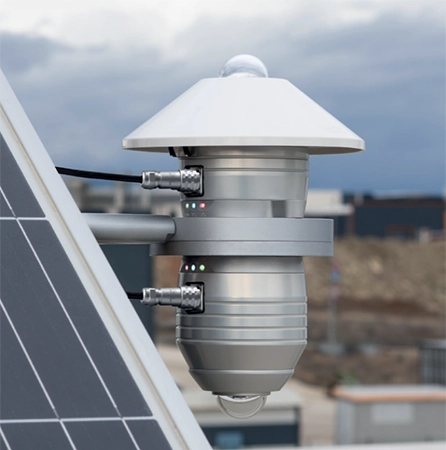
The PV albedometer is a sensor consisting of two silicon reference cells:
- An upward-facing cell that measures the incoming POA irradiance
- A downward-facing cell that measures the reflected irradiance
Principle of Measurement of PV Albedometer
As a result of its spectral response being very similar to that of PV modules, the reference cell will provide a PV representative albedo measurement, indicating the extent to which the reflected radiation may contribute to electrical power generation.
Common Applications of PV Albedometer
- Bifacial PV system monitoring
- Reverse-side irradiance measurements
- Bifacial gain calculation
- Evaluation of PR through irradiance relevant to PV cells
Advantages of PV Albedometer
- PV-representative spectral response
- Extremely fast response times
- Small size and simple integration with PV monitoring system
PV Albedometers are used where there is interest in the PV system behavior, not just meteorological reflectance.
What Is a Thermopile Albedometer?
The thermopile albedometer comprises two thermopile pyranometers installed in a face-to-face arrangement.
Operating Principle of Thermopile Albedometer
Thermopiles provide broadband irradiance measurements that are not dependent on the PV system used. Thus, they are accepted as reference devices for measuring solar irradiance in meteorology and environmental conditions.
Main Applications of Thermopile Albedometer
- Bankability monitoring applications
- Independent assessment of resources and reflectivity of surfaces
- Environmental assessments over a period of time
- Projects that need technology-independent irradiance traceability
Major Features of Thermopile Albedometer
- Broad spectral response range
- Accepted in metrology standard
Thermopile albedometers are preferred when broadband irradiance measurements are needed.
PV Albedometer vs Thermopile Albedometer: Key Differences
The following table summarizes the differences between the PV Albedometer and the Thermopile Albedometer
| Feature | PV Albedometer (Reference Cell) | Thermopile Albedometer |
| Sensor type | Silicon reference cell | Thermopile pyranometer |
| Spectral response | PV-representative | Broadband solar spectrum |
| PV performance relevance | Very high | Indirect |
| Meteorological reference | Limited | Strong |
| Typical focus | Bifacial gain & PR | Comparable to meteorological data |
How IEC 61724-1:2021 Applies
IEC 61724-1:2021 is the primary international standard for PV system performance monitoring. This standard:
- Provides definitions for up-to-date monitoring approaches for PV plants
- Accounts for the consideration of bifacial PV systems
- Prioritizes accurate irradiance and rear irradiance measurements for assessment of performance
Both PV reference cell albedometers and thermopile albedometers can be used within an IEC 61724-1:2021–aligned monitoring concept, provided the selected sensors meet the required accuracy and classification level.
SEVEN Albedometer Solutions: Class A Performance
SEVEN provides:
- Reference cell-based PV albedometers
- Thermopile-based albedometers using pyranometers
Both options can be obtained with class A accuracy, enabling the reliable data collection needed in current PV monitoring applications, including IEC 61724-1:2021-compliant projects.
Such versatility makes SEVEN’s systems ideal for:
- Representative PV measurement
- Meteorological broadband measurement
- And both types of measurement for additional confidence
Frequently Asked Questions: Albedometer
Which albedometer would be more appropriate for a bifacial PV power plant?
A PV albedometer (reference cell) is ideal for PV-specific performance and bifacial gains. However, a thermopile albedometer may be favored for broad-bandwidth measurement.
Is there an IEC requirement that compels the use of a certain technology?
No. It is all about the quality and pertinence of the data; there is no need to compel the use of a particular sensor technology.
Can both technologies be deployed in a PV power plant?
Yes. Some plants deploy both PV and thermopile albedometers to combine PV-specific insight with meteorological traceability.