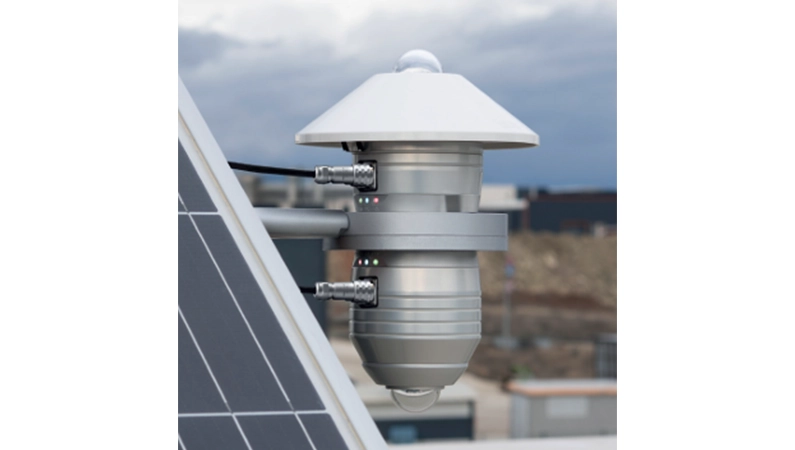
Measuring how much solar irradiance is reflected from a surface is important for meteorology, environmental monitoring, agriculture, snow and ice research, and bifacial solar energy systems. At the heart of this measurement lies the albedometer. An albedometer is a specialized irradiance measurement device used to determine a surface’s albedo value that is, its reflectivity. It essentially consists of two pyranometers. The upper sensor measures incoming global solar irradiance, and the lower sensor measures solar irradiance reflected from the surface. These two data points are evaluated together to calculate the surfaces albedo value.
For those looking for reliable and accurate measurement solutions in the field, meet the new SEVEN 3S-TP-Albedo-A.
What Is Albedo Ratio?
Albedo is a ratio that shows how much of the solar radiation incident on a surface is reflected back. Bright, or snow covered surfaces generally have high albedo values. In contrast, surfaces such as dark soil, asphalt, and dense vegetation tend to have lower albedo values.
This parameter has long been used as an important indicator in surface energy balance studies. In recent years, its importance has increased even further with the wider use of bifacial solar panels. This is because these panels can produce electricity not only from direct and diffuse solar irradiance, but also from irradiance reflected from the ground.
How is Albedo Calculated in SCADA Systems?
The SEVEN Thermopile Albedometers use two separate thermopile pyranometers, one for the upper measurement and one for the lower measurement. Each pyranometer has an independent Modbus RTU output. The two separate irradiance data sets obtained from the upper and lower sensors are evaluated in SCADA systems to calculate the albedo value.
Basic formula for albedo calculation:
 Example:
- One Upper Thermopile Pyranometer: 800 W/m²
- One Lower Thermopile Pyranometer: 160 W/m²

How to Install an Albedometer?
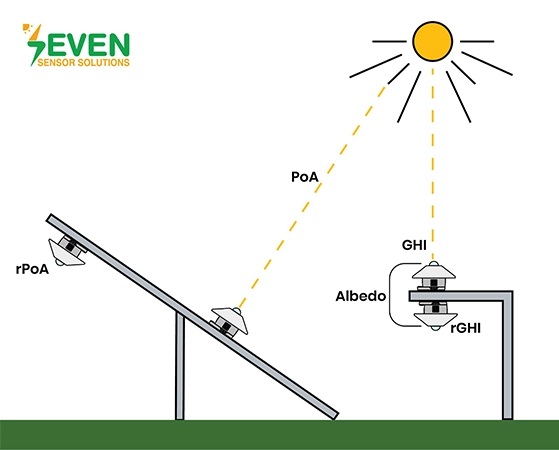
Figure 1 – Albedometer Installed / GHI: Global Horizontal Irradiance – rGHI: Reflected Global Horizontal Irradiance – POA: Plane of Array Irradiance – rPOA: Plane of Array Irradiance Reflected from the Ground
Important considerations for albedometer field installation:
- Select an appropriate mounting height (generally 1,5 – 2 meters)
- The upper sensor must be oriented correctly and properly leveled
- The lower sensor must have a clear view of the ground
- There should be no blocking elements or shadows from structures, etc., within the sensors field of view
- Cable shielding and grounding must be properly installed
- Termination and bias on the RS-485 line must be correct
- Both sensors must be configured according to the same measurement logic
- If they are to be used at the same angle as the panels, the angles must be correct and they must be mounted in the center of the panel
To minimize measurement errors, it is recommended that the poles be coated with a matte, non-reflective paint, and that the albedometer be correctly oriented on the mounting arm.
What are the Applications of an Albedometer?
Albedometers have a wide range of applications:
1. Solar Power Plant (SPP) Project
In bifacial PV systems, irradiance reflected from the ground directly affects energy production. Therefore, accurate albedo measurement plays a key role in site design. Irradiance and albedo data measured at the same angle as the panels can be used in the Performance Ratio (PR) calculation.
2. Meteorology and Climate Observations
Albedo is a main parameter in surface energy balance, climate modeling, and long-term environmental change analysis. One of the classic applications of albedometers is monitoring albedo changes over large areas over the course of years.
3. Agriculture and Land Management
Since changes in soil surface, vegetation cover, and moisture affect reflectivity, albedo data can be useful for agricultural and environmental analyses.
4. Snow and Ice Surfaces
Snow cover exhibits high albedo. Because of this, albedometers are also an important measurement tool in hydrometeorology and polar research.
The 3S-TP-ALBEDO-A Thermopile Albedometer is a very important measurement instrument used to determine the amount of solar irradiance reflected by a surface. In practice, selecting the right device alone is not sufficient to obtain accurate results, particularly in small and limited-area sites. Installation height, sensor field of view, mounting geometry, and shading effects must all be evaluated together. Therefore, a successful albedo measurement depends as much on proper site design as it does on the right device.
To discuss, evaluate and determine your site-specific needs, please contact SEVEN Sensor Solution.
Frequently Asked Questions (FAQ)
What is an albedometer used for?
An albedometer measures how much of the solar radiation reaching a surface is reflected back. This measurement is used to calculate the surfaces albedo value and evaluate its reflectivity.
Why is albedo measurement important in the field applications?
Albedo measurement is important for solar energy systems, meteorological observations, environmental analyses, and surface energy balance studies. It is very important for bifacial solar panels. Because the intensity of light reflected from the ground affects the energy production of these panels.
How does an albedometer work?
An albedometer typically consists of two sensors; upper and lower. The upper sensor measures incoming solar irradiance, while the lower sensor measures irradiance reflected from the surface. The ratio between these two values gives the albedo level of the surface.
Can albedo measurements be taken on small surfaces?
Yes, they can. But in small or limited sample areas, the sensor height must be adjusted very carefully. If the sensor is too high, different surrounding surfaces may be included in the measurement; if it is too low, shadowing errors may increase.
At what height should the albedometer be installed?
The installation height varies depending on the measurement application. Standard heights are used for large areas, while smaller areas may need a lower installation height.
What does a high albedo rate mean?
A high albedo value means that the surface reflects a large portion of the incoming irradiance. Snow, light-colored ground, and bright surfaces are common examples.
Which surfaces have low albedo values?
Dark colored soil, asphalt, wet surfaces and vegetation generally have lower albedo values. These surfaces absorb more solar irradiance.