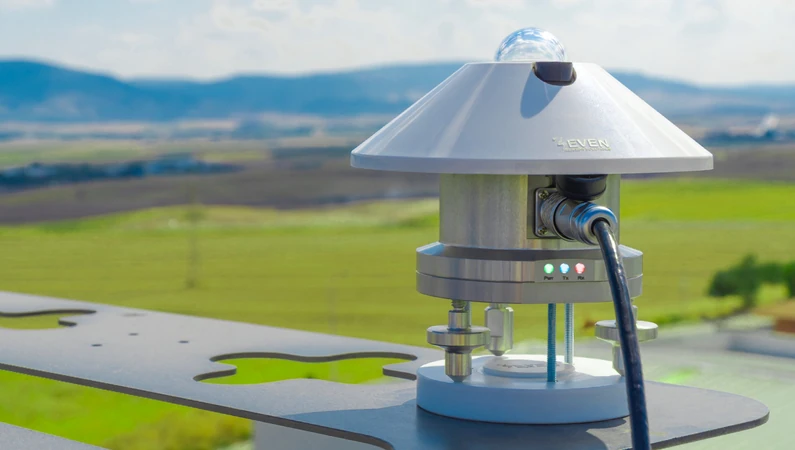
The two terms irradiance and irradiation differ by just a letter but are often used interchangeably, not only in tender documents but in monitoring and reporting tools as well as in some datasheets. In addition to being a terminology issue, this confusion can give a false impression of the actual performance of a PV system.
In this article, we will explain both of the terms, teach you how to convert the W/m² values into kWh/m² and tell you what peak sun hours really mean.
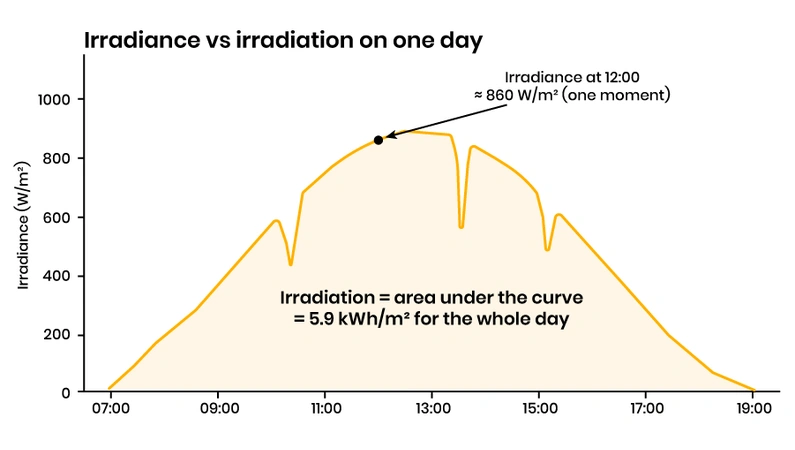
As a brief answer: Irradiance is the intensity of solar energy received at a certain moment in time measured in W/m². Irradiation, or insolation as it is also called, is the total amount of energy received over the period of time measured in Wh/m² or kWh/m². Irradiation is the accumulation of the irradiance. Peak sun hours are simply irradiation per day in units of kWh/m² as 1 peak sun hour equals 1 kWh/m² or 1 hour at 1,000 W/m².
Irradiance and irradiation
What Is Solar Irradiance?
Solar irradiance is the instantaneous energy from the sun that strikes one square meter of surface area. It is measured in watts per square meter (W/m2). On a sunny day at midday, irradiance on a surface oriented towards the sun is about 1,000 W/m2. This explains why 1,000 W/m2 is taken to be the reference value of STC of PV panels.
Irradiance is what is measured by your sensor. Either a pyranometer or a PV reference cell irradiance sensor provides the W/m² reading once per second or a couple of seconds, fluctuating with each passing cloud.
What Is Solar Irradiation?
The amount of radiation received during a certain period, whether it is one hour, one day, one month or even one year is known as solar irradiation. Solar irradiation is measured in units of Wh/m², kWh/m² or sometimes MJ/m² (1 kWh/m² = 3.6 MJ/m²). The term “insolation” was used previously, which is now referred to as irradiation.
Irradiation is what one requires to measure the energy and performance and output of solar panels.
| Irradiance | Irradiation | |
| Physical quantity | Power per area | Energy per area |
| Unit | W/m² | Wh/m², kWh/m², MJ/m² |
| Time | One moment | Period of time (hour, day, year) |
| Where it takes place | Irradiance measurement of sensors, STC (1,000 W/m²) | Monthly and daily measurements, solar maps, yield estimation |
| Typical range | From 0 to 1,300 W/m² | From 2 to 8 kWh/m² according to location and season |
How to estimate irradiance (W/m²) to irradiation (kWh/m²)?
Multiply each irradiance measurement by its time interval and sum up all the values:
Irradiation (Wh/m²) = ∑ (irradiance W/m² x time interval in hours)
Then divide the resulting value by 1,000 to get kWh/m².
Below you can find an example of irradiance and energy per hour calculation:
| Hour | Average irradiance (W/m²) | Energy for this hour (Wh/m²) |
| 07:00–08:00 | 100 | 100 |
| 08:00–09:00 | 250 | 250 |
| 09:00–10:00 | 450 | 450 |
| 10:00–11:00 | 650 | 650 |
| 11:00–12:00 | 800 | 800 |
| 12:00–13:00 | 870 | 870 |
| 13:00–14:00 | 850 | 850 |
| 14:00–15:00 | 750 | 750 |
| 15:00–16:00 | 580 | 580 |
| 16:00–17:00 | 380 | 380 |
| 17:00–18:00 | 180 | 180 |
| 18:00–19:00 | 40 | 40 |
| Total | 5,900 Wh/m² = 5.9 kWh/m² |
In case the datalogger gives you 1-minute averages, the formula is the same; every number should be multiplied by 1/60 hours. People usually make mistakes here as they just add up W/m2 numbers without multiplying by time. If you add up 1-minute readings without the time factor, your result will be 60 times bigger than it should be.
Here are some recommendations for practice:
- Calculate average values in each period, do not calculate based on only one reading.
- Always check whether there are gaps in your data before making calculations. 1-hour gap in the middle of the day can give you almost 15% less energy per day.
- Always take into account the negative readings of thermopile pyranometers at night.
What Are Peak Sun Hours?
Peak sun hours (PSH) express irradiation per day as the number of hours the sun radiation would need to stay at 1,000 W/m2 to give the same energy. As 1,000 W/m2 in one hour is 1 kWh/m2, the calculation is quite easy:
Peak sun hours = Daily irradiation (kWh/m²) ÷ 1 kW/m²
In our case, 5.9 kWh/m² is equal to 5.9 hours of peak sun time. This does not imply that the sun shone for 5.9 hours. In fact, the sun shone for 12 hours but at a much lower irradiance than 1,000 W/m².
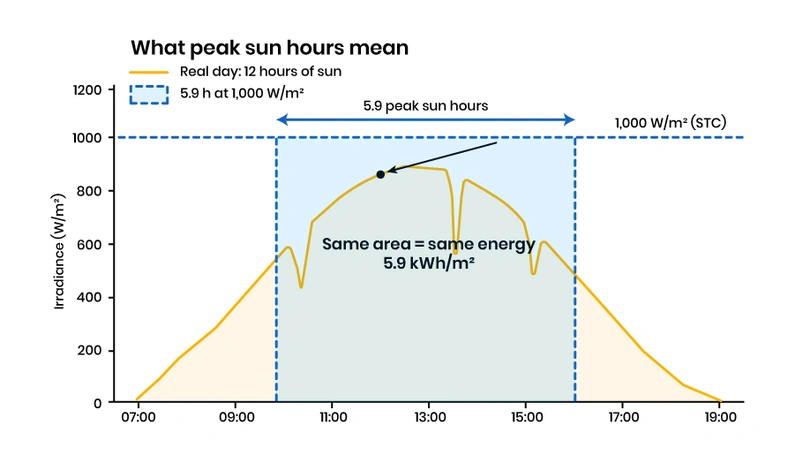
5.9 peak sun hours: the real 12-hour day and 5.9 hours at 1,000 W/m² deliver the same energy.
How Do You Use Peak Sun Hours to Estimate PV Energy?
A quick daily energy estimate for a PV system looks like this:
Energy (kWh) = PV power at STC (kWp) × Peak sun hours × Performance Ratio
For an example of 100 kWp system with peak sun hours being 5.9 and performance ratio of 0.80:
100 × 5.9 × 0.80 = 472 kWh per day.
Two things are important here. First, the peak sun hours must come from irradiation on the plane of the modules (POA or GTI), not from horizontal irradiation (GHI), unless the modules are flat. Our research on using pyranometers for GHI, POA, GTI, diffuse and reflected irradiance explains the difference. Second, the performance ratio already includes losses from temperature, soiling, cabling and the inverter. If you want to go one step further, read our case study on how to calculate PV performance using one day of irradiance data.
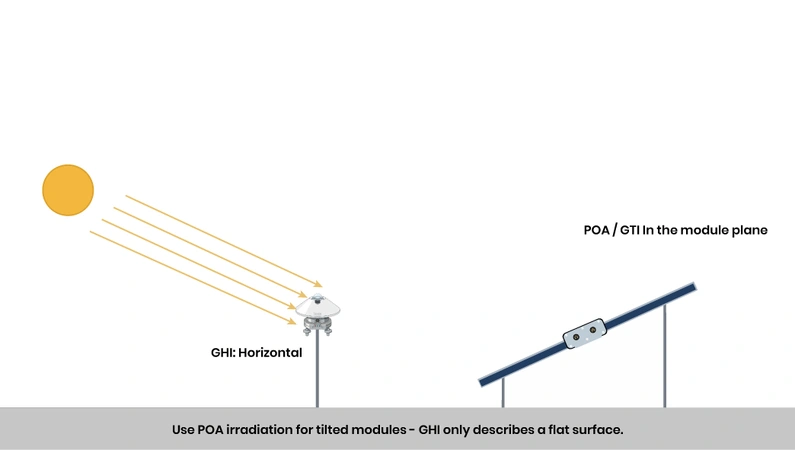
GHI is measured on a horizontal surface; POA/GTI is measured in the plane of the modules.
Which Sensor Should You Use to Measure Irradiation?
Irradiation is not measured by any sensor. All irradiance sensors measure W/m², while energy values are computed in the datalogger or the monitoring software. The crucial thing is the accuracy of W/m² values:
For PV system monitoring: the PV reference cell sensor installed in the plane of the modules responds to radiation similarly as the modules do,
For meteorology and resource analysis applications: a thermopile pyranometer meeting ISO 9060:2018 standards covers the whole spectrum of the solar energy.
Also, the orientation of the sensor plays its part. If the sensor orientation is incorrect compared to the modules, all your kWh/m² will be wrong. Our guide on how to calculate the sun’s angle in solar power plants is a good starting point. For the sensor requirements of each monitoring class, see how to select sensors for a PV plant according to IEC 61724-1:2021.
Get Reliable Irradiance Data for Your Plant
High-quality energy measurements have to be preceded by high-quality W/m² data. When you are setting up a measuring system and are unsure about the irradiance sensor, the pyranometer, and its orientation to use in your project, contact the SEVEN sales team and we will help you choose.
Frequently Asked Questions (FAQ) about Irradiance and Irradiation
Are irradiance and irradiation synonymous terms?
No. Irradiance is power, which means energy per second or W/m². Irradiation is energy, accumulated over a certain time; kWh/m².
What is solar insolation?
The term insolation is an old used term for irradiation.
How much of peak sun hours can be achieved by a standard site?
Depends on location, season and orientation of module. Possible daily figures vary from less than 2 hours in winter months in the North to more than 7 hours in desert area during summer.
Can I calculate the peak sun hours based on GHI?
Yes, however, the figure you get would only relate to horizontal surface. To calculate the peak sun hours for tilted module, you should use POA.
How do I convert MJ/m² into kWh/m²?
By dividing the number by 3.6. Example: 18 MJ/m² = 5 kWh/m².
My monthly irradiation data seem to be way too high. Why?
Probably, the W/m² figures were summed up without multiplying on the time interval between each measurement.
References
7
View Sources
Close
-
ISO 9488:2022, Solar energy — Vocabulary.
-
IEC 61724-1:2021, Photovoltaic system performance — Part 1: Monitoring.
-
ISO 9060:2018, Solar energy — Specification and classification of instruments for measuring hemispherical solar and direct solar radiation.
-
IEC 60904-3, Photovoltaic devices — Part 3: Measurement principles for terrestrial photovoltaic (PV) solar devices with reference spectral irradiance data.
-
SEVEN Sensor Solutions, Use of Pyranometers for GHI, POA, GTI, Diffuse and Reflected Irradiance Measurement. https://www.sevensensor.com/use-of-pyranometers-for-ghi-poa-gti-diffuse-and-reflected-irradiance-measurement
-
SEVEN Sensor Solutions, How to Calculate PV Performance Using One Day of Irradiance Data? https://www.sevensensor.com/how-to-calculate-pv-performance-using-one-day-of-irradiance-data
-
SEVEN Sensor Solutions, How to Calculate the Sun’s Angle in Solar Power Plants? https://www.sevensensor.com/how-to-calculate-the-suns-angle-in-solar-power-plants