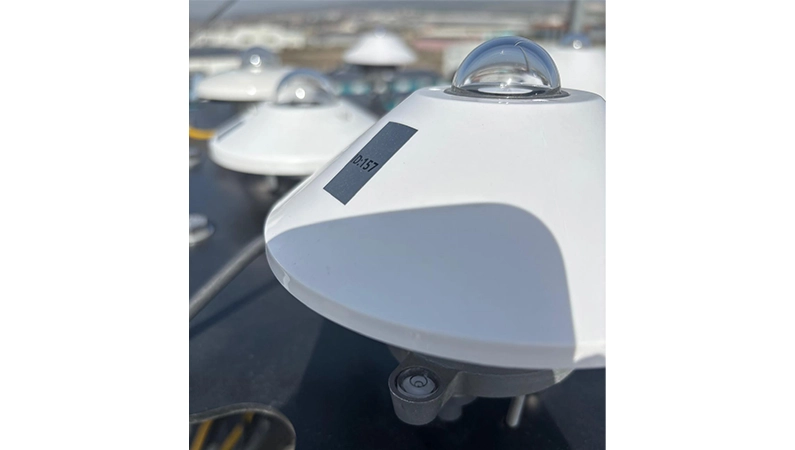
Pyranometer data is crucial in solar power plants, meteorological measurement stations, and PV performance analyses. However, every W/m² irradiance value obtained from a pyranometer must be evaluated in conjunction with a specific measurement uncertainty.
For this reason, “measurement uncertainty” a term frequently encountered in technical documents is one of the most important performance parameters indicating how closely the value provided by the pyranometer approximates the actual solar irradiance value. In this article, we will examine measurement uncertainty in Thermopile Pyranometers in detail and from a technical perspective.
What Is Measurement Uncertainty?
Measurement uncertainty indicates how much a measurement result deviates from the true value. When considered in the context of a pyranometer, this concept indicates that the measured solar irradiance value represents the true value within a specific range. This uncertainty is not an error. It reflects the physical, environmental, electronic, and calibration-related limitations of the measurement system.
For example, if a pyranometer measures 1000 W/m² of irradiance and the total measurement uncertainty is ±20 W/m², the true irradiance value is expected to fall within a specific confidence interval, approximately between 980 W/m² and 1020 W/m².
Why Is Measurement Uncertainty in Pyranometers Important?
Pyranometer data is used as reference data in PV systems. If the measurement uncertainty of the pyranometer is high, the reliability of the performance analysis is compromised. This becomes particularly critical in the following areas:
- PV performance ratio calculations
- PV system acceptance tests
- Energy production guarantees
- Investor performance reports
- Panel and inverter loss analyses
- Long-term meteorological data tracking
- Simulation and field data comparisons
The IEC 61724-1:2021 standard defines the terminology, equipment, and analysis methods for PV system performance monitoring. Therefore, the quality of irradiance measurements is of direct importance in PV performance monitoring systems.
Key Factors Contributing to Measurement Uncertainty in Pyranometers
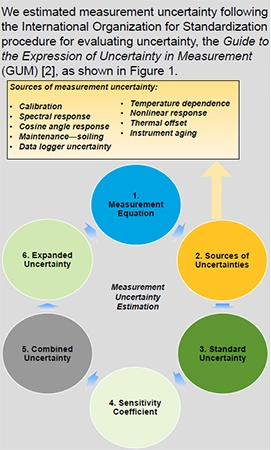
Figure 1 is taken directly from the NREL document “Evaluating the Sources of Uncertainties in the Measurements from Multiple Pyranometers and Pyrheliometers.”
The total measurement uncertainty of a pyranometer does not consist of a single parameter. It is calculated as the combination of multiple sources of uncertainty. For a detailed examination of these technical specifications according to ISO 9060, please refer to our previously shared article.
-
Calibration Uncertainty
Every pyranometer has a specific sensitivity coefficient. This coefficient is typically expressed in µV/(W/m²). The pyranometer’s output signal is converted to a W/m² value using this coefficient. During calibration, a certain uncertainty arises due to the reference instrument, the radiation source, environmental conditions, and the measurement method. This value is specified as the calibration uncertainty in the calibration certificate.
-
Directional Response Uncertainty
Pyranometers should ideally measure sunlight in accordance with the cosine law based on the angle of incidence. However, in practice, no sensor provides a perfectly ideal cosine response. When sunlight arrives at a low angle, particularly during morning and evening hours, errors due to directional response may increase. This error is included in the total measurement uncertainty.
-
Spectral Response Uncertainty
Pyranometers operate within a specific spectral range. However, the solar spectrum can vary depending on atmospheric conditions, cloud cover, air mass, and solar angle.
When the sensor’s spectral sensitivity does not fully align with the solar spectrum, spectral response uncertainty arises. For this reason, the term “spectrally flat” is important in technical documentation.
-
Temperature Response Uncertainty
Thermopile pyranometers measure based on temperature differences. Therefore, ambient temperature, sensor body temperature, and internal thermal equilibrium can affect the measurement result. In particular, in areas with extremely high or low temperatures, or where rapid temperature changes occur, uncertainty due to temperature response may increase. In high-quality thermopile pyranometers, efforts are made to minimize the effect of temperature.
-
Zero Offset A and Zero Offset B
In pyranometers, values different from zero may be observed under low irradiance conditions or at night. One of the primary causes of this is the thermal offset effect.
- Zero Offset A typically represents deviations caused by net thermal radiation.
- Zero Offset B, on the other hand, represents deviations related to changes in ambient temperature.
These offset values become significant in low-irradiance measurements and contribute to the total measurement uncertainty.
-
Non-Linearity
The pyranometer’s output signal is expected to remain linear across different irradiance levels. However, small deviations may occur at low, medium, and high irradiance levels. For example, if the sensor does not exhibit the same linear sensitivity at 200 W/m², 600 W/m², and 1000 W/m² levels, uncertainty due to non-linearity arises. This uncertainty is included in the calculation.
-
Non-Stability
The accuracy of a pyranometer may change over time. UV exposure, environmental conditions, electronic aging, dome contamination, and long-term changes in the sensor structure can lead to non-stability. For this reason, pyranometers must be recalibrated at regular intervals.
-
Data Logger Uncertainty
No matter how sensitive the pyranometer is, measurement data is often read via a data logger. The data logger’s input accuracy, resolution, signal noise, and cabling quality all contribute to the overall uncertainty.
How Is the Measurement Uncertainty of a Pyranometer Calculated?
The total measurement uncertainty of pyranometers is generally calculated by taking the square root of the sum of the squares of the various uncertainty components. This method is known as the Root Sum Square (RSS) approach. The simplified formula is as follows:

Here, each “U” value represents a separate uncertainty component.
What is the measurement uncertainty of the SEVEN Thermopile pyranometer?
When calculated by converting the values given in W/m² to percentages using a 1000 W/m² reference irradiance:
- Calibration uncertainty: 1.21%
- Zero Offset A: ±1 W/m² – 0.10%
- Zero Offset B: ±1.5 W/m² – 0.15%
- Total Zero Offset C: ±3 W/m² – 0.30%
- Drift: 0.50%
- Nonlinearity: 0.20%
- Directional response: ±10 W/m² – 1.00%
- Spectral error: 0.20%
- Temperature response: 0.40%

When the same calculation is performed according to ISO 9060:2023, the total uncertainty is ±2.9%. The calibration uncertainty used in the calculation is based on IEC 61724-1:2021 for Class A pyranometers.
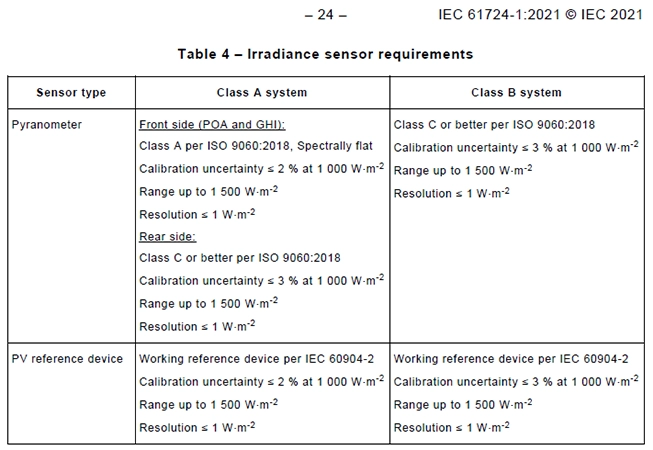
In other words, the SEVEN 3S-TP-MB-A Thermopile Pyranometer can be considered a technical solution that meets the standards for accuracy, stability, and reliable data in solar irradiance measurements. The use of a thermopile pyranometer offers significant advantages for businesses seeking accurate irradiance data, particularly in PV performance monitoring, field measurements, meteorological data collection, and solar energy testing applications.
What Is Expanded Uncertainty?
Technical reports sometimes use the terms “standard uncertainty” and “expanded uncertainty.”
- Standard uncertainty refers to the standard uncertainty value of each uncertainty component.
- Expanded uncertainty, on the other hand, is typically the uncertainty expanded by a specific coverage factor.
In most technical applications, the coverage factor k is set to 2. This corresponds to an approximate 95% confidence interval. For example, if the standard uncertainty is ±1%, the expanded uncertainty for k = 2 can be reported as approximately ±2%.
Conclusion
Measurement uncertainty in pyranometers is one of the key technical parameters determining the reliability of measured solar irradiance values. The total measurement uncertainty is composed of numerous factors, including calibration, directional response, spectral response, temperature response, zero offset, non-linearity, non-stability, and data logger accuracy.
The SEVEN 3S-TP-MB-A Thermopile Pyranometer offers a robust measurement solution for users seeking precise and reliable data in solar irradiance measurements. By selecting the right pyranometer, performing regular calibration, and using an appropriate data acquisition system, it is possible to achieve more reliable results in PV performance analysis. For more information, please contact SEVEN Sensor Solution.
Frequently Asked Questions
What does “measurement uncertainty” mean in a pyranometer?
It is a technical uncertainty value that indicates how much the irradiance value measured by the pyranometer may deviate from the true value.
Is measurement uncertainty an error?
No, it is not. Measurement uncertainty expresses the natural limits of the measurement system and its confidence interval.
How is pyranometer uncertainty calculated?
Uncertainty components such as calibration, temperature, directional response, spectral response, offset, and data logger are combined using the RSS (Root Sum Square) method to calculate it.
Why is low measurement uncertainty important?
It provides more accurate solar irradiance data. This helps ensure more reliable PV performance ratio, loss analysis, and production evaluation.
Does pyranometer calibration affect uncertainty?
Yes, it does. Calibration uncertainty is one of the most significant components of total measurement uncertainty. Regular calibration is essential for long-term data reliability.