We’ve already covered the fundamentals of Portable Soiling Sensors and the role they play in PV performance management. You can follow our previous articles for more details on these subjects: SEVEN Portable Soiling Sensor: On-the-Go Dust Loss Assessment for Smarter PV Maintenance, A Lift-and-Shift Sensor: SEVEN’s Portable Soiling Sensor
This article is intended as a practical follow-up, based on the most frequent questions we receive from users. The sections below provide clear guidance on recalibration intervals, measurement uncertainty, and what the displayed soiling percentage actually indicates along with simple ways to use those readings to support cleaning planning and routine O&M decisions.
How often should the Portable Soiling Sensor be recalibrated?
To ensure accurate and reliable measurements, the Portable Soiling Sensor should be recalibrated every 500 operating hours or after 2 years of use, whichever comes first. Recalibrating before reaching 500 hours or the 2-year mark can further improve measurement accuracy and long-term reliability.
How accurate is the Portable Soiling Sensor, and how was that accuracy checked?
The measurement uncertainty is ≤ 2%.
This performance was validated through:
- Testing on multiple PV module and multiple soil colors
- Benchmark comparison against fixed/reference solutions to confirm measurement consistency and accuracy across scenarios
The device shows Soiling Ratio values between 2% and 20%. How should this be interpreted compared to the conventional 0–100% Soiling Ratio scale?
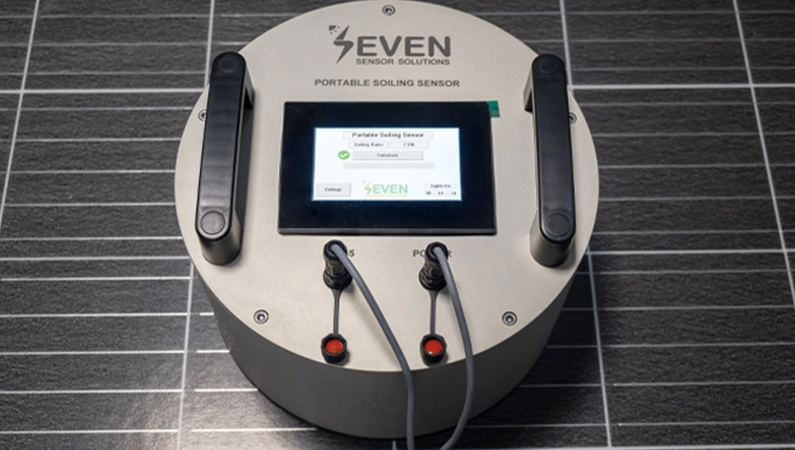
The Portable Soiling Sensor reports the Soiling Ratio (SR) directly as the percentage loss in energy yield (i.e., actual performance loss due to soiling).
Example: If the device displays 7.5%, that means 7.5% energy yield loss on the conventional 0–100% SR scale. No conversion factor is needed (do not multiply by five).
The 2–20% display range is intentionally chosen for operational relevance, especially for cleaning service workflows, and is determined based on both cleaning requirements and the measurement technique of the Portable Soiling Sensor. The Portable Soiling Sensor measures dust levels using reflection and scattering techniques, and light reflection from dust is not very sensitive below 2% and above 20%. Therefore, this range has been determined to achieve the most accurate and precise measurement with both cleaning requirements and the sensor’s measurement technique in mind:
- Below 2% SR: Soiling impact is typically lower than the cost of cleaning, so corrective action is usually not recommended.
- Above 20% SR: The module surface is considered heavily soiled (significant coverage). Cleaning is clearly required, and reporting values above 20% provides limited additional practical value.
How does the SEVEN Portable Soiling Sensor differ from other sensors that use optical measurement principles?
In plain terms, other sensors are generally used as a fixed soiling systems while the Portable Soiling Sensor is designed for fast, on-demand checks anywhere on site.
Others: Typically requires dust-type-specific calibration for each site or dust condition. Additionally, needs to be installed on the site where measurement is intended and must wait for the surface to become contaminated before it can calculate the soiling ratio. This means that it will not provide accurate results if installed on a surface that is already dirty. In other words, for them to deliver correct results, both the site and the sensor must start becoming contaminated simultaneously.
SEVEN Portable Soiling Sensor: Does not require dust-type calibration for each field condition. Instead, the user selects:
- Panel color
- Soil color
- Soil tone
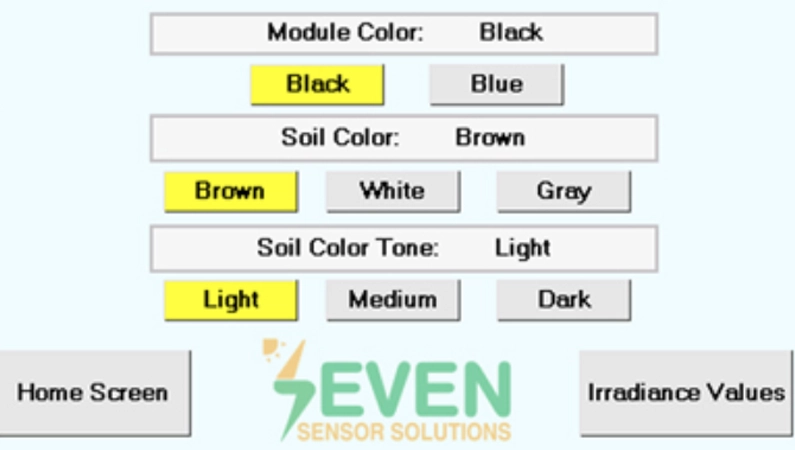
The sensor then calculates the Soiling Ratio based on these selections, providing accurate results without repeated site-specific dust calibration. Unlike others, the SEVEN Portable Soiling Sensor is not a fixed sensor. It can take measurements on-site immediately by selecting the appropriate parameters for the conditions at any given moment.
| Feature | Others | SEVEN Portable Soiling Sensor |
| Installation | Typically installed at a specific location and left in place to track trends over time. | Handheld/portable checks across different modules, strings, or sites as needed. |
| Setup/calibration approach | Must be locally calibrated to match site-specific dust characteristics. Can give wrong measurements if the dust color is different. | No site-specific dust calibration is needed. You select panel color and soil characteristics in the device. |
| When you can measure | Best for continuous monitoring at the installed spot. | Immediate spot checks, even if the surface is already soiled. |
| Best fit | Long-term tracking and trend data at one representative location. | Fast verification, troubleshooting, and cleaning decision support across large areas. |
How is the SEVEN Portable Soiling Sensor calibrated?
The SEVEN Portable Soiling Sensor is recalibrated every 2 years or after 500 hours of operation, whichever comes first.
Calibration is performed at SEVEN Sensor’s facility using our in-house test equipment and solar panels. Because this process requires controlled laboratory conditions, the device must be shipped to our factory for recalibration. After calibration is completed, the sensor is returned to the customer.
FREQUENTLY ASKED QUESTIONS (FAQ)
How often should the SEVEN Portable Soiling Sensor be recalibrated?
Recalibrate every 500 operating hours or every 2 years, whichever comes first. Recalibrating sooner can improve accuracy and long-term reliability.
What is the measurement uncertainty of the 3S-SMS-P Portable Soiling Sensor?
The sensor’s measurement uncertainty is ≤ 2%.
How was the accuracy of the SEVEN Portable Soiling Sensor validated?
Accuracy was validated through:
Testing on multiple PV module types and multiple soil colors
Benchmark comparisons against fixed/reference solutions to confirm consistency across scenarios
The Portable Soiling Sensor shows Soiling Ratio values between 2% and 20%. Is that a different scale than 0–100%?
Not exactly. The sensor reports Soiling Ratio as direct energy-yield loss (%). Example: If the device reads 7.5%, that means 7.5% energy yield loss.
Why does the Portable Soiling Sensor display focus on the 2–20% range?
That range is where readings are most operationally useful and optically sensitive for the sensor’s reflection/scattering technique:
Below 2% soiling ratio: the energy loss caused by soiling is usually too low to justify the cost of cleaning. In most cases, the cleaning cost is higher than the revenue loss.
Above 20% soiling ratio: the modules are already heavily soiled, and cleaning is clearly necessary. At that point, additional precision above 20% has limited practical benefit for maintenance decisions.
In practice, a soiling sensor helps determine the optimal cleaning time by comparing the cost of energy loss with the cost of cleaning.
At low soiling levels, cleaning is usually not economical.
At high soiling levels, cleaning is generally justified.
Between 2% and 20%, users can compare both values and decide when cleaning makes the most economic sense.
If a 1 MW PV plant produces 8.000 kWh/day, the electricity price is 0.10 USD/kWh, and the soiling ratio is 10%, then:
Energy loss: 800 kWh/day
Revenue loss: 80 USD/day
Monthly revenue loss: 2.400 USD/month
This type of calculation helps plant operators decide whether the accumulated soiling loss has exceeded the cleaning cost.
Does the Portable Soiling Sensor require site-specific dust calibration like some fixed optical systems?
No. Unlike many fixed optical systems that often need dust-type-specific calibration and must start “clean” to track contamination properly, the SEVEN Portable Soiling Sensor is designed for immediate, on-demand measurements even on already-soiled surfaces.
What settings does the user select before taking a measurement with the Portable Soiling Sensor?
Instead of site-specific dust calibration, users select:
Panel color
Soil color
Soil tone
The device then calculates Soiling Ratio based on these selections.
When is a portable soiling sensor the better choice vs. a fixed soiling sensor?
Choose fixed systems for continuous long-term trend monitoring at one representative location.
Choose the SEVEN Portable Soiling Sensor for fast spot checks, troubleshooting, verifying cleaning needs, and comparing different modules/strings/areas across a site.
How is recalibration performed? Can it be done in the field?
Recalibration is performed at SEVEN Sensor’s facility using controlled lab equipment and solar panels. Because it requires laboratory conditions, it cannot be done on-site. The device must be shipped to the factory and is returned after recalibration.
What does a soiling percentage reading help me decide operationally?
Use the SR reading as direct estimated energy loss to support cleaning planning:
< 2%: typically monitor, cleaning usually not cost-effective
2–20%: use as a decision band for scheduling/confirming cleaning Needs, comparing energy loss cost to cleaning cost.
≥ 20%: heavily soiled; cleaning is clearly recommended
What is the price of the SEVEN Portable Soiling Sensor?
The price of the SEVEN Portable Soiling Sensor varies between 2500 EUR – 2900 EUR.