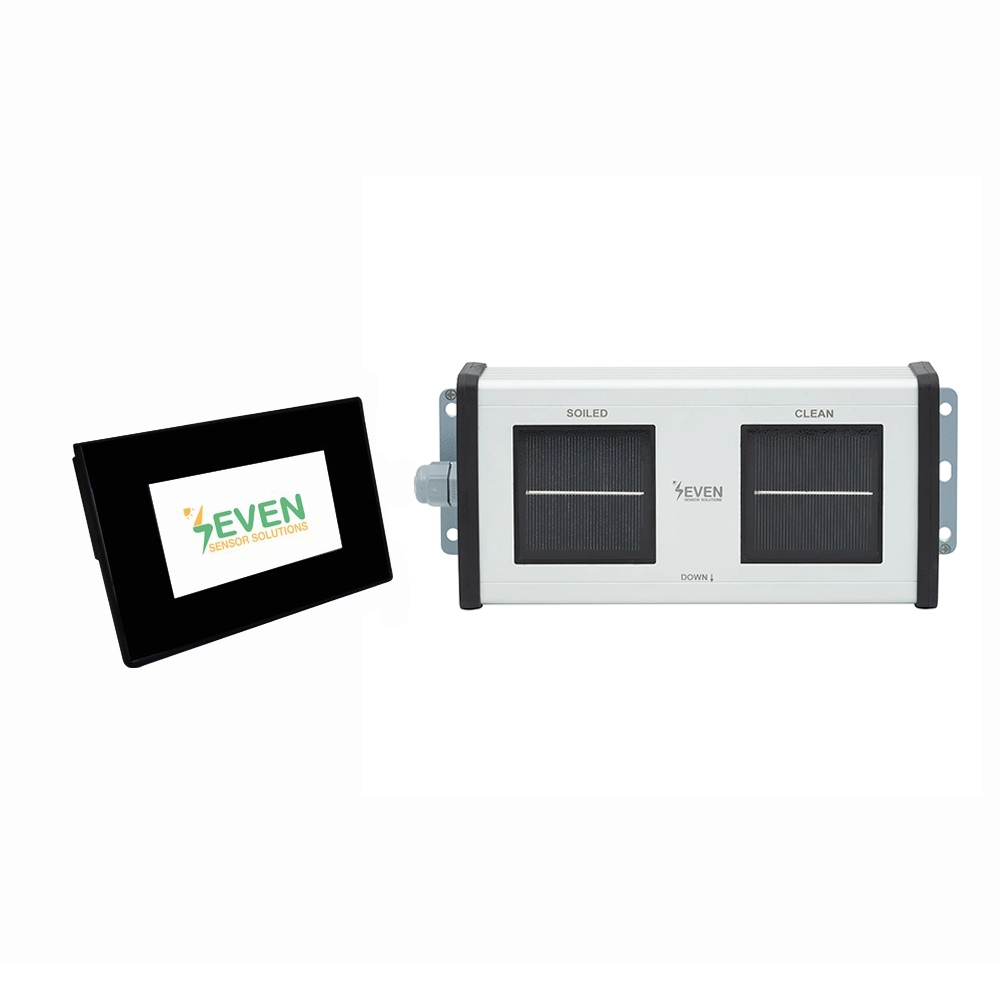
Manual Soiling Sensor with HMI-PLC Monitoring – 3S-SMS-HMI-M
3S-SMS-HMI-M is a manual soiling sensor that measures energy loss caused by dust and dirt accumulating on photovoltaic panels. The system consists of two irradiance sensors and an HMI/PLC touchscreen. You can see the calculated soiling ratio directly on the screen. This eliminates the need for a separate data logger to read the data. If the sensor reading is 10%, it means there is approximately a 10% energy loss in the facility.
Technical Specifications of Manual Soiling Sensor With HMI-PLC Monitoring
| Item Code | 3S-SMS-HMI-M |
| Soiling Ratio | 0% – 100% |
| Resolution | 0,1% |
| Uncertainty | ≤ 1% |
| Data Output | RS485 up to 38400 Baud |
| Communication Protocol | Modbus RTU |
| Output Rate | 1/s |
| Operating Temperature Range | -40°C to +85°C |
| Operating Humidity Range | 0 to 100 %RH |
| Power Supply | 12 to 30 V DC |
| Power Consumption | 20 – 50 mA @ 24 V DC |
| Cable Length and Features | 3 m, 3x2x0,22 mm2, 24 AWG, LI2YC11Y-TP PUR Cable, UV and weather resistant |
| Galvanic Isolation | 1000 V between power supply and RS485 Bus |
| IP Rating | IP 54 (Optional IP 68) |
| Dimensions | 246 mm x 108 mm x 42 mm (W x L x H) |
| Weight | 0,7 kg |
| Display Device | HMI-PLC Display |
| Standard | IEC61724-1:2021 (Annex C) |
| Origin | TÜRKİYE |
What is the Purpose of a Soiling Sensor?
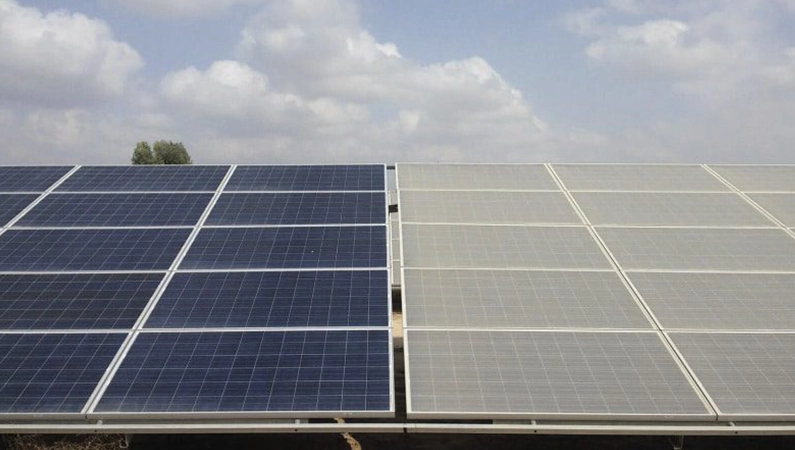
Solar panels accumulate dust over time. Dust and dirt on the panel surface block some of the sunlight, reducing production. This is called soiling loss. This loss is often invisible to the naked eye but is reflected in production reports.
The soiling sensor measures this loss numerically. It shows the soiling level in the facility and the resulting power loss. This allows you to decide when to clean the panels based on data, not guesswork. You avoid unnecessary cleaning costs and protect production by cleaning only when necessary.
How Does the Manual Soiling Sensor Work?
The system uses two reference cells. One sensor is periodically and manually cleaned and remains as a reference. The other is left exposed to contamination under the same conditions as the panels.
Both sensors measure solar radiation in W/m². The difference between the readings of the clean and dirty sensors indicates the level of dust accumulation on the panels. The system converts this difference into a soiling ratio according to the IEC 61724-1 Annex C standard. The result is displayed as a percentage on the HMI/PLC screen.
What Does an HMI/PLC Display Provide?
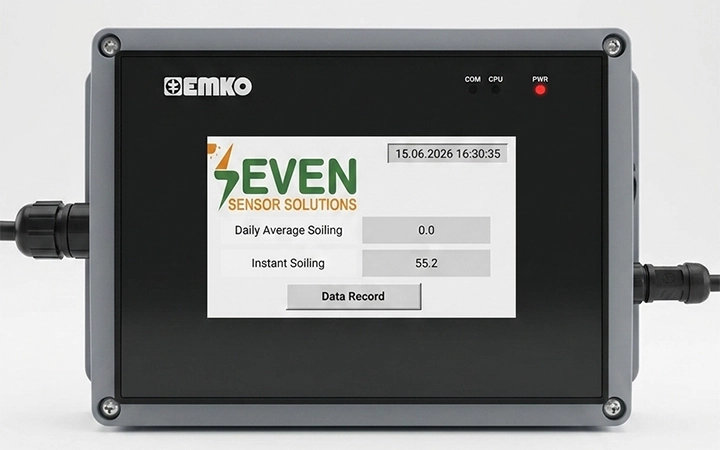
What distinguishes this model from a standard manual soiling sensor is its HMI/PLC touchscreen. You don’t need a separate data logger or monitoring system to read the soiling ratio. Everything is displayed on the screen.
- You can see the soiling ratio as a percentage directly on the screen.
- The system records data once every hour. You can view the historical data on the screen.
- You can transfer the recordings to a USB flash drive as a PDF or Excel file.
- Status LEDs indicate the health of the system. Green indicates that everything is working correctly, red indicates a lack of communication between the sensor box and the display, and yellow indicates that there is data that should not be considered according to the standard.
You simply supply power, do connector connections, and the system starts working.
The Difference Between Manual and Automatic Soiling Sensors
Unlike the automatic model, the manual soiling sensor does not include a water pump, water tank, and control unit. Cleaning of the reference sensor is done manually when the soiling level needs to be checked. This makes the manual system more economical than the automatic system. In facilities where a field team is present for regular cleaning, the manual system is a sufficient and cost-effective solution.
Key Advantages of Manual Soiling Sensor With HMI-PLC Monitoring
- No separate data logger is required: Thanks to the HMI/PLC display, the soiling level is shown directly on the device.
- Easy reporting: Data can be downloaded using a USB drive in the form of PDF or Excel file.
- Standard-based calculation: Soiling ratio is calculated according to IEC 61724-1 Annex C standard.
- An economical solution: It does not include a water pump or tank, making it more cost-effective than an automated system.
- Plug and play installation: The system comes pre-configured at the factory; you just need to power it on.
- Robust design: UV-resistant aluminium sensor housing and IP65 protection rating.
- SEVEN calibration: Irradiance sensors are calibrated under an AAA-rated solar simulator.
Installation and Use of Manual Soiling Sensor With HMI-PLC Monitoring
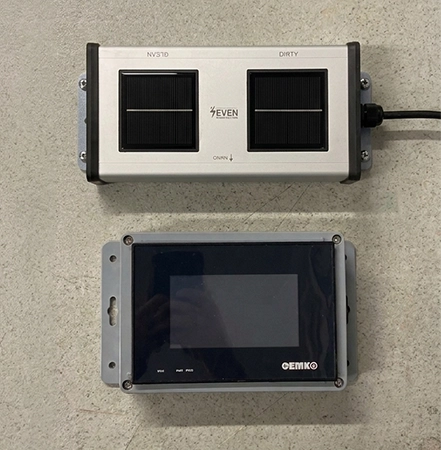
Installation is very simple.
- Mount the sensor box in a location where it will not be directly exposed to rain or sunlight. The sensor should be positioned in POA and parallel to the panels.
- Connect the soiling sensor to the HMI/PLC display using the provided connector.
- Connect the HMI/PLC display to a 24 V DC power supply.
- Clean the reference cell periodically as needed to monitor soiling ratio.
Frequently Asked Questions (FAQ)
How does the Manual Soiling Sensor With HMI-PLC Monitoring work?
It uses two irradiance sensors. One is kept clean, the other is left to get dirty under the same conditions as the panels. The difference between the two readings is converted into the soiling ratio according to the IEC 61724-1 Annex C standard.
What does Manual Soiling Sensor With HMI-PLC Monitoring measure?
It measures the percentage of energy loss caused by dust and dirt on the panels.
Is a separate data logger needed for Manual Soiling Sensor With HMI-PLC Monitoring?
No. Thanks to the HMI/PLC screen, the soiling rate is displayed and recorded directly on the screen. A separate datalogger is not required.
How do I export the data on Manual Soiling Sensor With HMI-PLC Monitoring?
You can transfer the recordings to a USB flash drive as a PDF or Excel file.
What is the difference between this and the standard Modbus model (3S-SMS-MB-M)?
This model features an HMI/PLC display. It shows and records the dust accumulation rate on the screen and does not require a separate data logger. The Modbus model, however, only provides Modbus RTU output and requires a data logger to read the data.
How is Manual Soiling Sensor With HMI-PLC Monitoring different from an automatic soiling sensor?
This system is manual. It does not include a water pump, water tank, or control unit. The reference sensor is cleaned manually. Therefore, it is more economical than an automatic system.
How often is the soiling ratio updated?
The value displayed on the screen is updated once a day after 3 PM. The system also keeps a record once every hour.
What power supply does Manual Soiling Sensor With HMI-PLC Monitoring need?
It operates with 12-30 V DC, we recommend 24 V.
What protection class does Manual Soiling Sensor With HMI-PLC Monitoring have?
The sensor comes with IP68 protection class.
What is the price of Manual Soiling Sensor With HMI-PLC Monitoring?
The price of the product varies between 866 - 1575 EUR.
What are the delivery times for Manual Soiling Sensor With HMI-PLC Monitoring?
For small orders approx. 2-3 weeks and for bulk orders (100 pcs) approx. 8-10 weeks.
What is the warranty of Manual Soiling Sensor With HMI-PLC Monitoring?
A two-year warranty is provided against manufacturing defects. Opening the sensor box will void the warranty.