

Cloud Sensor – 3S-CS-MB
3S-CS-MB is a cloud sensor developed for measuring the cloud cover in commercial and industrial photovoltaic power plants. The sensor uses two irradiance sensors, one in permanent shade and one in permanent exposure, along with a shade band. The shaded sensor measures diffuse irradiance, while the exposed sensor measures the plane of array irradiance. The ratio of these two values is used to calculate the cloud cover.
The data obtained is used in tracker systems to optimize panel positioning, and in fixed systems to monitor cloud ratio and accurately interpret performance. All measured values are transmitted to data loggers via RS485 using Modbus RTU.
Technical Specifications of Cloud Sensor
| Item Code | 3S-CS-MB |
| Measured Data | POA, DPOA, BPOA, and cloud ratio |
| Cloud Ratio Range | 0% – 100% / 0 – 8 Okta |
| Cloud Ratio Resolution | 5% / 1 okta |
| Output Rate | 1/s |
| Data Output | RS485 up to 38400 baud |
| Communication Protocol | Modbus RTU |
| Power Supply | 12 – 30 V DC |
| Power Consumption | 25 mA max @ 24 V DC |
| Cable Length & Features | 3 m, 3x2x0.22mm 24 AWG cable, UV and weather resistant. |
| Galvanic Isolation | 1000 V between the power supply and the RS485 line |
| Operating Temperature Range | -40°C to +85°C |
| Operating Humidity Range | 0% – 100% RH |
| Dimensions | 616 x 500 x 328mm (W x L x H) |
| Weight | 4,2 kg |
| IP Rating | IP54 (optional IP65, IP68) |
| Housing Material | Aluminum |
| Shade Band Material | FBE epoxy coated steel |
| Standard | IEC 61724-1:2021 and IEC 60904 |
| Calibration | Each sensor is calibrated under Class AAA Sun Simulator as per IEC 60904-2 and IEC 60904-4 by using a reference cell calibrated by ISFH-Germany |
| Origin | Türkiye |
What is a cloud sensor used for?
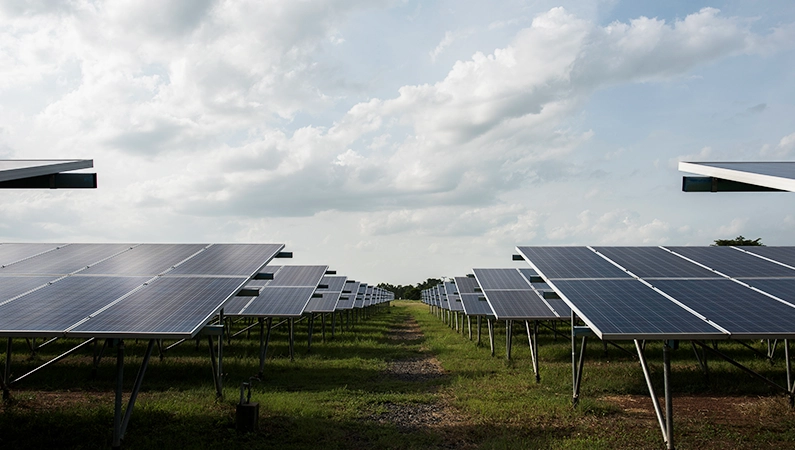
When solar energy generation drops, the first question is: is the problem with the system or with the weather? Looking only at total irradiance, the effect of weather conditions can be confused with system losses. Cloud sensors clarify this distinction.
For example, if there is a sudden drop in production during the day, and cloud ratio and diffuse irradiance increase simultaneously, this drop is most likely due to a passing cloud. Since the sensor provides this information, it becomes easier to distinguish whether the performance drop is truly due to the system or to atmospheric conditions.
This allows for more accurate interpretation of performance indicators such as PR, and enables users to improve energy efficiency by taking necessary measures based on cloud cover levels.
Working Principle of the Cloud Sensor
The sensor consists of two irradiance sensors operating simultaneously and a shadow band. The task distribution is as follows:
- The open sensor measures the plane of array irradiance (POA) on the panel plane without any shadowing. This value is the sum of direct, diffuse, and reflected components.
- The shaded sensor is continuously shaded by a shade band. Therefore, it only measures diffuse irradiance (DPOA). The shade band provides shading in accordance with the IEC 61724 standard.
The system ratios diffuse irradiance to total irradiance. This ratio indicates how much of the sky is covered by clouds, i.e., the cloud ratio. As cloud cover increases, the share of diffuse irradiance increases, and the cloud ratio rises.
What data does the SEVEN cloud sensor measure?
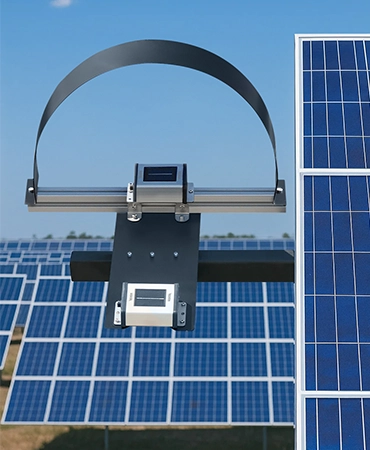
The sensor is not limited to a single cloud ratio value. By breaking down the irradiance in the panel plane into its components, it presents four separate data points.
| Measured Data | Explanation |
| POA – Total Irradiance in the Plane Array | It is the sum of direct, diffuse, and reflected irradiance on the plane of the panels. It is measured with an open irradiance sensor. |
| DPOA – Diffuse Irradiance in the Plane Array | This is irradiance that is scattered by clouds, aerosols, and similar factors and reaches the panel indirectly. It is measured by an irradiance sensor shaded by a shadow band. |
| BPOA – Direct Irradiance in the Plane Array | It is the component of irradiance that directly reaches the panel. It is calculated from the difference between POA and DPOA. |
| Cloudiness | It is the ratio of diffuse irradiance to total irradiance. It is calculated as instantaneous and daily average values. |
How to Express Cloudiness: Percentage and Okta
The sensor displays cloudiness in two different units.
- In percentage terms: 0% indicates a completely clear sky; 100% indicates a completely overcast and dark sky.
- In oktas: An okta is a meteorological unit that indicates what fraction of the sky is covered by clouds. The sky is divided into eight equal parts. 0 oktas mean a completely clear sky, while 8 oktas mean a completely cloudy sky.
Okta is widely used in meteorology. However, percentage representation is more practical in technical analysis, reporting, and automation systems. Since the sensor provides both values, it meets both needs.
| Code | Explanation |
| 0 Okta | No Clouds |
| 1 Okta | Few Clouds |
| 2 Okta | |
| 3 Okta | Partly Cloudy |
| 4 Okta | |
| 5 Okta | Mostly Cloudy |
| 6 Okta | |
| 7 Okta | |
| 8 Okta | Overcast |
Can Cloud Sensors be Used in Tracker and Fixed Systems?
SEVEN Cloud Sensor can be used in every power plant installation. In tracker systems, cloud ratio data helps to position panels optimally. Since diffuse irradiance is dominant in cloudy weather, turning the panel directly towards the sun may not always be the most efficient option. The cloud sensor ensures that this decision is data-driven.
In fixed systems, the sensor continuously monitors cloud cover and feeds into performance evaluation. Production reports become much more meaningful when read in conjunction with the actual state of the sky at that moment.
Key Advantages of SEVEN Cloud Sensor
SEVEN Cloud Sensor offers many advantages such as:
- It calculates cloud ratio in both percentages and oktas.
- It separates air-related loss from system loss, enabling accurate interpretation of indicators such as PR (pressure level).
- The shaded irradiance sensor measures diffuse irradiance in accordance with the IEC 61724 standard.
- It offers a unique sensor design and Class A irradiance measurement.
- It easily connects to data loggers via Modbus RTU output over RS485 and SunSpec compatibility.
- With its aluminum body and FBE epoxy-coated steel shade ring, it is field-resistant.
- It comes with free software updates, SEVEN remote installation service, and a 2-year warranty.
Installation of Cloud Sensor and Shade Band Adjustment
The cloud sensor must be mounted at the same tilt angle and in the same direction (same azimuth) as the panels in the field. This allows the sensor to precisely measure the irradiance received by the panels.
The shadow band is the most critical part of this sensor and needs to be properly adjusted for accurate results. Points to consider regarding adjustment are as follows:
- The initial adjustment and periodic corrections of the shade band should preferably be done at local solar noon. Solar noon is the time when the sun reaches its highest point of the day and the zenith angle is at its smallest.
- Because the sun’s height varies slightly from day to day, the position of the shade band should be checked periodically and readjusted if necessary.
- During the checks, it should be observed that the shadow remains on the DPOA sensor throughout the day.
- If the shadow is observed to shift away from the DPOA sensor during the day, deviations in the sensor’s azimuth and tilt angles should be examined, and the shadow band should be readjusted at noon.
Note: Adding splices to the communication cable is not recommended; the cable should be used as a single unit. SEVEN can provide the required cable length. Since IP54 protection class may pose a risk in terms of sealing in tracker systems, please discuss the protection class preference for high-angle systems with the SEVEN Sales Team.
Frequently Asked Questions (FAQ)
What does a cloud sensor measure?
It measures the cloud cover in the sky. It also provides the plane of array irradiance (POA), diffuse irradiance (DPOA), and direct irradiance (BPOA) values in the panel plane.
How does the cloud sensor work?
It uses two irradiance sensors and a shade band. The exposed sensor measures POA irradiance, while the sensor covered by the shade band measures diffuse irradiance. Cloud ratio is calculated from these two measurements.
What is okta in Cloud Sensor?
An okta is a meteorological unit that indicates how much of the sky is covered by clouds. The sky is divided into eight parts; 0 okta means completely clear, and 8 okta means completely cloudy.
Why is Cloud Sensor output given in both percentages and okta?
Okta is a commonly used unit in meteorology. However, in technical analysis, reporting, and automation systems, the percentage representation is more practical. The sensor provides both values.
How does Cloud Sensor help with performance analysis?
It helps distinguish whether the drop in production is due to weather or systemic factors. If cloud ratio and diffuse irradiance increase simultaneously, the drop is most likely due to a passing cloud. This also helps in the accurate interpretation of indicators such as PR.
What is the purpose of Cloud Sensor in trackers systems?
Cloud cover data helps in positioning the panels optimally. Since diffuse irradiance is dominant in cloudy weather, pointing the panel directly at the sun may not always be the most efficient option.
Which output and protocol does Cloud Sensor use?
It uses Modbus RTU (up to 38400 baud) over RS485 and is SunSpec compliant.
What power supply does Cloud Sensor need?
It operates with 12 - 30 V DC.
What protection class does Cloud Sensor have?
Standard IP54, optional IP65 and IP68. Higher protection class is recommended for high-angle tracker systems.
What is the operating temperature range of Cloud Sensor?
It operates between -40°C and +85°C.
What is the price of the Cloud Sensor?
The price of the sensor varies between 620 – 1130 EUR.
What are the delivery times for Cloud Sensor?
For small orders the delivery time is 2-3 weeks. For bulk orders 8-10 weeks
What is the warranty of the Cloud Sensor?
The standard warranty is 2 years with an option to extend it.