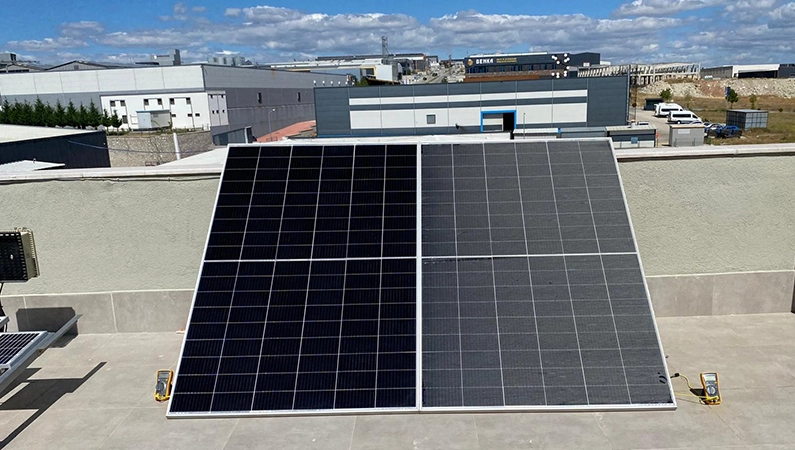
There is no doubt that soiling sensors are required for PV plants. However, there might be some question marks about their accuracy. SEVEN has carried out many experiments and continuous tests for all its soiling sensor models. Even we are sure about accuracy of our product, we decided to witness it with an international independent certification organization. A field comparison conducted in Çorum, Türkiye, in September 2026 and witnessed by a TÜV SÜD inspector provides a concrete proof. The test was carried out on our Portable Soiling Sensor model since it is a new patented technology and which receives the most questions about its accuracy.
Above photo is taken from TÜV SÜD witnessed test report 26-II-0481a-35-T-002 and demonstrates the main setup for the test.
How was the comparison performed?
Patented technology, SEVEN 3S-SMS-P Portable Soiling Sensor uses light reflected and scattered from the module surface to calculate the loss associated with soiling. It displays the Soiling Ratio (%) directly on its HMI screen. In this test, the optical reading was compared with a ratio derived from the short-circuit currents (Isc) of clean and soiled PV modules of the same brand and technical specifications. The selected panels give stable current output under 1000 W/m2 clear sky environment. Gray dust was applied on the PV module until a uniform soil distribution was reached.
The electrical output comparison used for calculation of the Soiling Ratio (%) from PV modules output through this formula:

The soiling ratio is calculated based on Short-Circuit Current.
The measurements took place on 7 September 2026 under clear, cloudless skies and within ±2 hours of local solar noon. The TÜV SÜD report records the test time as 11:30 a.m. to 12:30 p.m. The procedure referenced stable-condition guidance in IEC 61724-1:2021. This method is defined in related standard in Anex-C section.
This exercise was carried out for three different modules and dust color was gray and Isc readings through ammeter were recorded. Then Soiling ratio was calculated by above formula.
Time to Check Portable Soiling Sensor Performance
The operator first selected the appropriate module color and dust color on the HMI screen. Measurements were taken at three locations on the soiled surface; each measurement was one minute. Those same spots were then cleaned and measured again. Comparing the same locations reduces the effect of variations in surface reflectance. Three clean module measurements and three soiled module measurements were taken, six readings in total. The sensor calculates the result and presents it on its display screen. Each of the six readings takes about one minute; 6 minutes in total; surface cleaning and setup take additional time. Total operation time was 10 minutes for one Soiling Ratio calculation. The measurement is taken from three different modules and all of them were gray color soiled.
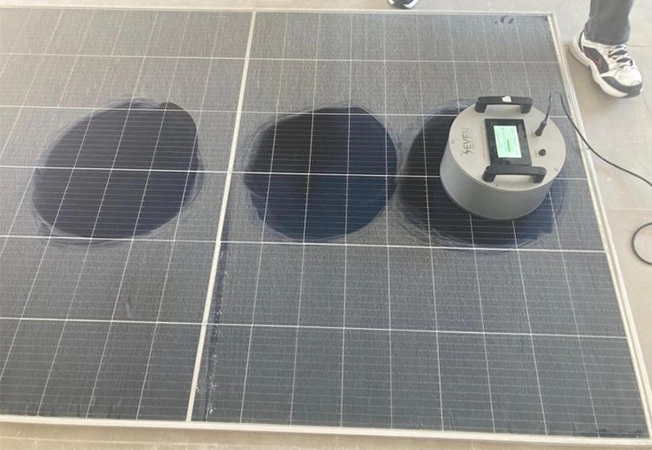
Figure 1 – The Portable Soiling Sensor at the selected measurement locations on the module.
This photo is taken form TÜV SÜD witnessed test report 26-II-0481a-35-T-002.
What is the result of the Test?
For the three gray-dust measurements, the sensor displayed 11.7%, 11.3%, and 9.8%. The TÜV SÜD report states that the results were within the ±2 percentage-point limit specified in the product datasheet after comparison of the module-current method. A test photograph also shows the 11.7% reading on the HMI display.
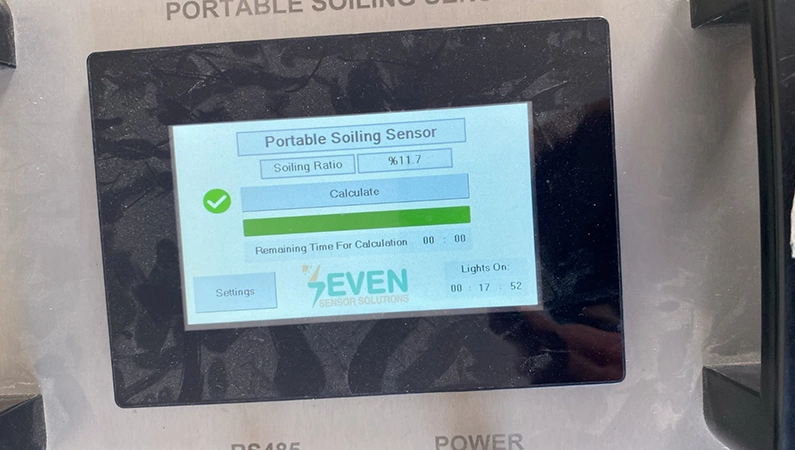
Figure 2 – The comparison table is available in same report for Soiling Ratio. Total three tests were caried on three different panel setups. Each test took 10 minutes.
The comparison table is available in same report for Soiling Ratio. Total three tests were caried on three different panel setups. Each test took 10 minutes.
| No | Soiling Color | Clean Solar Panel Short-Circuit Current (A) | Short-Circuit Current of Soiled Solar Panel (A) | Soiling Ratio (%) Calculated Based on Short-Circuit Current | Soiling Ratio (%) Measured via Portable Soiling Sensor | Difference Between Calculated and Measured Soiling Ratios |
| 1st Test | Gray | 18,70 | 16,23 | 13,21% | 11,70% | 1,51% |
| 2nd Test | Gray | 10,63 | 9,53 | 10,35% | 11,30% | -0,95% |
| 3rd Test | Gray | 9,60 | 8,62 | 10,21% | 9,80% | 0,41% |
Table 1- The table is taken from TÜV SÜD witnessed test report 26-II-0481a-35-T-002
What do these results mean for PV Plant operators?
“Can I trust the Soiling Sensor measurement?” In this field exercise, the three portable sensor measurements fell within the stated uncertainty limit in SEVEN datasheet against results based on PV module short-circuit current measurement, according to the report. This is evidence for one tested unit under gray-dust conditions but it is strong evidence about portable sensor accuracy which is tested and reported by an independent certification organization, TUV SÜD.
“Is it practical to use?” The sensor measures directly on the module without a fixed soiling station. The user selects the appropriate module and dust settings, measures three soiled spots, cleans those spots, measures them again, and reads the result on the screen. A clean-surface comparison is still required. Total required time for single Soiling Ratio is approximately 10 minutes.
“What does the displayed percentage mean?” A reading such as 11.7% is the device’s calculation of soiling-related loss. It is not a direct meter reading of a plant’s actual energy-production loss but is equal to plant energy loss due to Soiling within 2% tolerance. It can support cleaning plans, comparisons between site areas, and checks after cleaning.
Portable Soiling Sensor Accuracy: TÜV SÜD Witnessed Results:
The comparison witnessed by a TÜV SÜD inspector on 7 September 2026 found that the SEVEN Portable Soiling Sensor produced results consistent with the module-current comparison under the tested gray-dust conditions. Upon evaluation of the results, it was determined that the measurement results were within the ±2% uncertainty limits specified in the product datasheet.
For more details, see the Portable Soiling Sensor overview and frequently asked questions, or contact the SEVEN team.
Frequently Asked Questions
What exactly is the Soiling Ratio?
It is an indicator of the loss of efficiency of solar panels due to soiling in percentage.
How was the accuracy of the sensor tested?
The difference between the currents of the clean and dirty solar panels was measured and compared with the results provided by the sensor.
Who controlled the test?
A TÜV SÜD inspector. Results of this test were included into the report of TÜV SÜD under number 26-II-0481a-35-T-002.
What is the accuracy of the sensor?
Within 2 percentage points in all three measurements. The largest deviation was 1.51%.
What is the time required for measurement?
Approximately 10 minutes including cleaning.
Why do you need to clean the same places and make measurements again?
To ensure the consistency of the parameters between the two measurements apart from dust.
What was the weather like?
No clouds and sunny, about noon.
Will it work with other dust colors?
This measurement is performed for gray dust only. Other dust and panel colors can be chosen on the screen. If you are not sure which setting suits your site, contact us.